Advances in Engineering Advances in Engineering features breaking research judged by Advances in Engineering advisory team to be of key importance in the Engineering field. Papers are selected from over 10,000 published each week from most peer reviewed journals.

Significance
Dielectric elastomer actuators (DEAs) are a fascinating technology that might become a game-changer in areas like soft robotics, wearable devices, and interactive systems. What makes them so appealing is their unique combination of being lightweight, flexible, and capable of performing multiple functions. These actuators work by applying an electric field to stretchy polymer membranes sandwiched between flexible electrodes, which makes them deform in a controlled way. Measuring their electrical capacitance allows using them also as position or stretch sensors.
Most sensor and actuator technologies are designed to perform a specific task, like moving an object, sensing an external stimulus, or producing sound (e.g. loudspeakers). Combining all these tasks into a single system usually requires stacking different components together, which adds complexity, weight, and cost. This is especially problematic for systems that need to be compact and lightweight, like wearables or small robots. DEAs are very good candidates to develop actuator systems that can handle multiple jobs at the same time – a goal that is highly sought-after, but has proven tricky to achieve. A feature that makes DEAs promising for multi-task operations is self-sensing, which is the ability of an actuator to detect its own changes, such as how much it’s deforming. Self-sensing has been widely investigated in DEAs, but existing approaches often rely on adding dedicated signals on top of the electrical driving signal, which complicates the design and control. What’s really needed is a way to seamlessly integrate self-sensing into the actuator without affecting its performance.
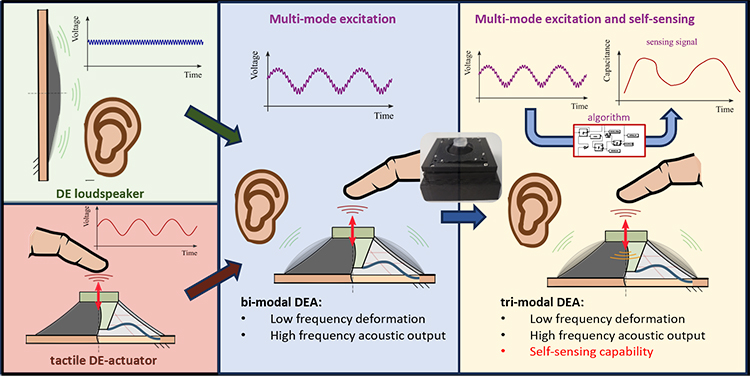
A team of researchers decided to tackle the challenge of rendering DEAs multi-functional in a study recently published in Sensors and Actuators A: Physical. The project, led by Dr. Giacomo Moretti from the University of Trento and involving PhD student Sebastian Gratz-Kelly along with Tim Felix Krüger, Stefan Seelecke, and Gianluca Rizzello from Saarland University, introduced a fresh approach. They developed a DEA system that can perform three tasks simultaneously: generating low-frequency motion, producing high-frequency sound, and sensing its own deformation. This design eliminates the need for extra sensors or signal inputs, creating a streamlined, all-in-one system. The potential uses for this tri-modal actuator are impressive. It could lead to smarter, more compact wearable devices that provide both tactile and audio feedback, making them more interactive and immersive for applications such as virtual reality, or in application contexts like user guidance and rehabilitation.
The research team wanted to build something that could move precisely, produce sound, and sense its own movements—all without needing extra parts or losing performance. First, they tested how well the device could handle controlled movement. Using low-frequency electrical driving signals, they measured its ability to produce smooth, reliable motion. At the same time, the team tested its ability to produce sound. By applying high-frequency signals, they got the actuator’s flexible membrane to vibrate and act as a loudspeaker. What stood out was that the motion and sound didn’t interfere with each other—they could be produced together effortlessly. The team also focused on a feature that sets this actuator apart: its ability to sense its own deformation. By processing the electrical signals generated by the device during operation, the DEA could accurately detect changes in its shape or position. In contrast with traditional self-sensing approaches, which require modifying the electrical driving signals by introducing high frequency perturbations, here the authors performed self-sensing by directly using the driving signal used to generate sound, without additional modifications. They proved that complex multi-harmonic driving signals, like those used to reproduce a sound track, could also be used for self-sensing.
To show how all these features could come together, the team ran a few hands-on demonstrations. In one test, they turned the actuator into a “smart button.” When someone pressed it, the device didn’t just detect the pressure—it also responded in real time by adjusting the pitch or volume of the sound it produced. In another demo, the actuator adapted its sound output to changes in its environment, like impacts or other forces. These weren’t just technical tests—they showed how the device could be used in everyday applications, like interactive gadgets or wearable technology. The actuator not only excelled at each individual task but also worked beautifully when all three functions—motion, sound, and sensing—were combined. By putting everything into one compact system, the authors made the device simpler, more efficient, and more versatile.
The multi-function actuator concept described in this work could be a game-changer, because it provides touch-based feedback, produces sound, and even detects what the user is doing—all at once. Imagine wearing a VR headset and not only seeing and hearing virtual objects but actually feeling them respond to your touch. It’s the kind of seamless interaction that could make virtual and augmented reality worlds feel far more real and immersive than they are today. It’s not just wearables that stand to benefit, though. This technology could make a huge difference in robotics. Picture a robot in a factory. Instead of being rigid and mechanical, it could have flexible parts that move smoothly, produce sounds as warnings, and even sense when it bumps into something. A robotic arm with this kind of actuator could stop mid-motion if it senses a collision or send out an audio alert to signal an issue. For soft robotics—those inspired by how living organisms move—this kind of flexible, multifunctional actuator is a perfect fit. Another big area this research could impact is human-machine interfaces. Right now, most devices need separate components for sensing input, providing feedback, and generating outputs. But imagine a single actuator that can do all three. Take something as simple as a button. Instead of just clicking, a smart button equipped with this DEA could sense how hard you press, vibrate to let you know it registered the input, and even play a sound—all from one tiny, efficient system. This could make user interfaces in everything from consumer electronics to industrial machinery smarter, simpler, and more intuitive. We think one of the most impressive parts of this study is the actuator’s ability to sense its own movements and uses the same electrical signals that make it move or generate sound. This kind of built-in intelligence makes the whole system more efficient and reduces the need for complicated setups.


Reference
Sebastian Gratz-Kelly, Tim Felix Krüger, Stefan Seelecke, Gianluca Rizzello, Giacomo Moretti, A tri-modal dielectric elastomer actuator integrating linear actuation, sound generation, and self-sensing capabilities, Sensors and Actuators A: Physical, Volume 372, 2024, 115332,