Significance Statement
2D materials lightening pulsed laser technology
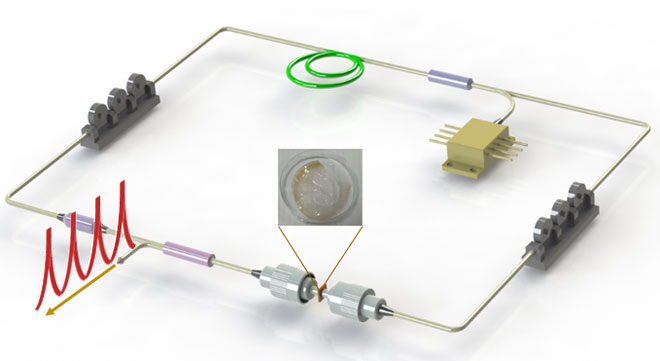
The discovery of graphene since 2004 has triggered great interest in two-dimension (2D) like materials for their abundant electronic and photonic properties. Among various demonstrations with different 2D materials, transition metal dichalcogenides (TMDs) have caught researches’ attention because their optical nonlinearity are estimated to be even larger than graphene. Meanwhile, Q-switched fiber laser is a kind of pulsed laser generating high-energy pulse up to several milli-joules and has important applications in both scientific research and medical treatment. Using the saturable absorption, one kind of optical nonlinearity, in transition metal dichalcogenides, one can obtain Q-switched pulses in a fiber laser. In this work, Prof. Kan Wu’s group from Shanghai Jiao Tong University, China and Prof. Jun Wang’ group from Shanghai Institute of Optics and Fine Mechanics, Chinese Academy of Sciences have demonstrated the Q-switched operation with four different transition metal dichalcogenide materials, i.e., MoS2, WS2, MoSe2, WSe2, simultaneously. The four types of transition metal dichalcogenides were embedded in PVA, a kind of polymer, to form thin film and the TMD-PVA thin film was incorporated in an erbium-doped fiber ring cavity. With this setup, Q-switched pulses with great flexibility were obtained. By adjusting the injected pump power, the pulse energy, pulse duration and repetition rate can all be tuned. This work shows the universality of different transition metal dichalcogenide materials to be utilized as saturable absorber in the fiber lasers and provides a good reference for the future research on the nonlinear properties of transition metal dichalcogenides.


About the author
Bohua Chen received the B.S. degree in electronic engineering from Shanghai Jiao Tong University (SJTU) in 2014. He is currently pursuing M.S. degree in electronic engineering at SJTU. His current research interest is mode-locked fiber laser with two-dimensional nano materials. Mr. Chen received a Best Student Paper Award at Opto Electronics and Communications Conference (OECC) in 2015.06.

About the author
Xiaoyan Zhang currently is a vice professor with Shanghai Institute of Optics and Fine Mechanics (SIOM), Chinese Academy of Sciences (CAS). She received her PhD degree in materials physics and chemistry from Fudan University of Shanghai in 2012. Her research interests are focused on design and synthesis of functional low dimensional nanomaterials and their applications. So far she has published more than 30 peer-reviewed journal papers in Journal of Materials Chemistry, ACS Nano, Nanoscale, Laser & Photonics Reviews, etc., cited over 1000 times, coauthored 1 chapter and 9 patents.

About the author
Kan Wu received the B.S. and M.S. degree in electronic engineering from Shanghai Jiao Tong University, in 2006 and 2009, respectively. He received the Ph.D. degree in Nanyang Technological University, Singapore in 2013. Since 2013, Dr. Wu joined Shanghai Jiao Tong University and now he is an Associate Professor with the State Key Laboratory of Advanced Optical Communication Systems and Networks, and Department of Electronic Engineering. His research interests include low-jitter mode-locked lasers, optical properties of novel 2D materials and optoelectronics.

About the author
Hao Wang received the B.E. degree in Computer and information engineering college from Shanghai University of Electric Power, in 2013. After 2014, he was a Master degree candidate State Key Laboratory of Advanced Optical Communication Systems and Networks, Department of Electronic Engineering, Shanghai Jiao Tong University. His research interests include optical properties of novel 2D materials and optoelectronics.

About the author
Jun Wang currently is a professor with Shanghai Institute of Optics and Fine Mechanics (SIOM), Chinese Academy of Sciences (CAS). He was awarded his PhD degree in materials science and engineering from the Chinese University of Hong Kong in 2006. Then he was granted an IRCSET postdoctoral fellowship and joined Prof. Werner Blau’s group at Trinity College Dublin. In 2011, he obtained financial support from the 100-Talent Program of CAS and relocated his research activities to SIOM. His research interests are focused on nanoscale nonlinear optics and organic/inorganic microcavity lasers. So far he has published more than 80 peer-reviewed journal papers in Nature Nanotechnology, Advanced Materials, ACS Nano, Laser & Photonics Reviews, Nanoscale, etc., cited over 1400 times, coauthored 2 chapters and 3 patents.

About the author
Jianping Chen received the B.S. degree from Zhejiang University, Hangzhou, China, in 1983, and the M.S. and Ph.D. degrees from Shanghai Jiao Tong University, Shanghai, China, in 1986 and 1992, respectively. He is currently a Professor with the State Key Laboratory of Advanced Optical Communication Systems and Networks, Department of Electronic Engineering, Shanghai Jiao Tong University. His main research interests include opto-electronic devices and integration, photonic signal processing and system applications. He is a Principal Scientist of National Basic Research Program of China (also known as 973 Program).
Journal Reference
Optics Express , Volume 23, Issue 20, Page 26723 (2015).
Bohua Chen1, Xiaoyan Zhang2, Kan Wu1, Hao Wang1, Jun Wang2, Jianping Chen1
[expand title=”Show Affiliations”]
- State Key Laboratory of Advanced Optical Communication Systems and Networks, Department of Electronic Engineering, Shanghai Jiao Tong University, Shanghai 200240, China
- Key Laboratory of Materials for High-Power Laser, Shanghai Institute of Optics and Fine Mechanics, Chinese Academy of Sciences, Shanghai 201800, China.
[/expand]
Abstract
In this paper, we report 4 different saturable absorbers based on 4 transition metal dichalcogenides (MoS2, MoSe2, WS2, WSe2) and utilize them to Q-switch a ring-cavity fiber laser with identical cavity configuration. It is found that MoSe2 exhibits highest modulation depth with similar preparation process among four saturable absorbers. Q-switching operation performance is compared from the aspects of RF spectrum, optical spectrum, repetition rate and pulse duration. WS2 Q-switched fiber laser generates the most stable pulse trains compared to other 3 fiber lasers. These results demonstrate the feasibility of TMDs to Q-switch fiber laser effectively and provide a meaningful reference for further research in nonlinear fiber optics with these transition metal dichalcogenides materials.
© 2015 Optical Society of America
Go To Optics Express Advances in Engineering Advances in Engineering features breaking research judged by Advances in Engineering advisory team to be of key importance in the Engineering field. Papers are selected from over 10,000 published each week from most peer reviewed journals.