Advances in Engineering Advances in Engineering features breaking research judged by Advances in Engineering advisory team to be of key importance in the Engineering field. Papers are selected from over 10,000 published each week from most peer reviewed journals.

Significance
Encapsulation of drug/small molecules in nanocarriers is a very promising approach for development of nanomedicine. Modern drug encapsulation methods allow efficient loading of drug molecules inside the nanocarriers thereby reducing systemic toxicity associated with drugs. Moreover, the possibility of direct and sustained delivery to the target epithelial cells in mucus covered tissues would be an invaluable development in the medical arena. Unfortunately, the impermeability of the mucus barrier and its entrapment of foreign particles have made the practical realization of such a therapeutic route challenging.
In fact, various reports have well documented the challenge that is encountered in maintaining the physiological stability of the mucosal matrix, and attributed it to the nanoparticle-induced reduction in the matrix diffusivity and promotion of mucin aggregation. In particular, such aggregation has also been established to adversely impact the permeability of the nanoparticles/nanocarriers and, thus, diminishes the efficacy of nanoparticle-based formulations. By contrast, a chemically tunable microenvironment would offer an attractive strategy to prevent nanoparticles from adversely reacting or adhering to the mucus hydrogel. However, reports on tuning the microenvironment of the mucus to make it more conducive for administration of drug formulations are limited.
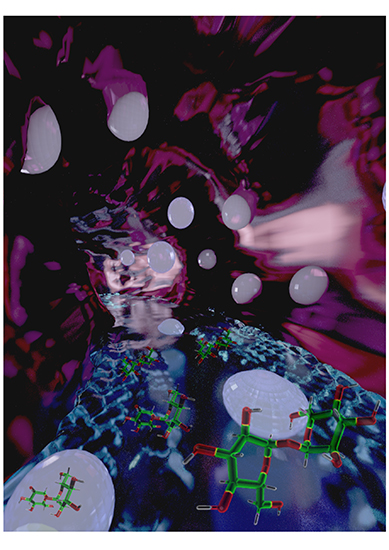
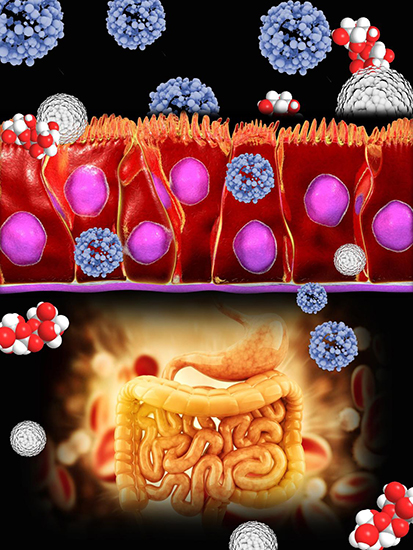
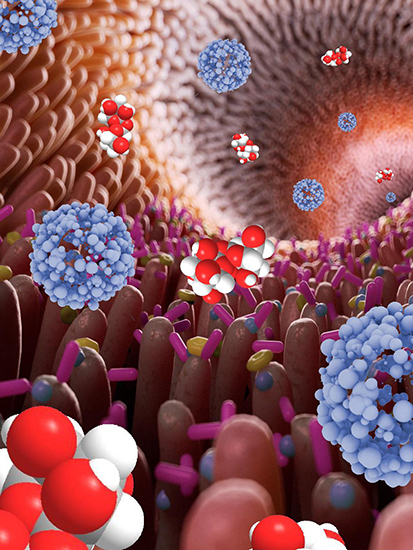
To this end, given the considerable protein content of mucin, it is hypothesized that trehalose-induced prevention of adverse nanoparticle interactions combined with conservation of the coordinated water molecules could enhance mucus dispersion and, thus, retain the intrinsic matrix hydration. To confirm this, a group of researchers from the University College Dublin: Dr. Sourav Bhattacharjee, Dr. Sabine Harrison and Professor Dimitri Scholz, in collaboration with Dr. Soumik Siddhanta and Professor Ishan Barman at the Johns Hopkins University; proposed using trehalose to facilitate the transport of nonfunctionalized nanoparticles through the gut mucosal layer by lessening nanoparticle agglomeration as well as by precluding aggregation of the mucus components. Simply put, they sought to create an entirely complementary route to enhance nanoparticle transport through the mucus by expanding on the recently demonstrated bioprotectant attributes of trehalose in nanoparticle-cellular interactions. Their work is currently published in the research journal, Small.
In the study, such a role for trehalose is explored through molecular spectroscopic, rheological and nano-structural measurements using fresh undiluted porcine jejunal mucus under physiologically relevant conditions. Specifically, the researchers employed three types of nanoparticles classified according to the surface charge and reactivities—positively charged polystyrene nanoparticles, negatively charged silica nanoparticles, and negatively charged surface reactive silver nanoparticles. Their approach was unique in the way that the intrinsic molecular markers and far-red emission from the nanoparticle-mucin aggregates obviated the need to use any separate exogenous reporter molecules.
The research team reported that in the presence of a trehalose-rich milieu, the rheological properties of mucus did not show appreciable changes, even when the nanoparticles were introduced. In addition, the Raman and SERS measurements revealed that the mucoadhesive nanoparticles, such as, the positively charged polystyrene nanoparticles, interacted with the negatively charged MUC2 glycoproteins, and hence, were trapped within the mucus.
In summary, through the application of photonic and spectroscopic tools, Professor Ishan Barman and his colleagues were able—for the first time—to establish the role of preferential nanoparticle-induced aggregation of the globular domains of mucin and non-mucin proteins, in alteration of rheological properties. Overall, in contrast to the prevailing belief, the obtained results demonstrated that non-functionalized nanoparticles may rapidly penetrate through mucus barriers, and by leveraging the bioprotectant attributes of trehalose, an in vivo milieu for efficient mucosal drug delivery can be generated.





Reference
Soumik Siddhanta, Sourav Bhattacharjee, Sabine M. Harrison, Dimitri Scholz, Ishan Barman. Shedding Light on the Trehalose-Enabled Mucopermeation of Nanoparticles with Label-Free Raman Spectroscopy. Small 2019, volume 15, Article number: 1901679.