 Advances in Engineering Advances in Engineering features breaking research judged by Advances in Engineering advisory team to be of key importance in the Engineering field. Papers are selected from over 10,000 published each week from most peer reviewed journals.

Significance
The proliferation of electronic waste has become a pressing global concern. Each year, millions of tonnes of discarded devices—smartphones, tablets, sensors, and circuit boards—accumulate in landfills, with only a fraction ever recycled. At the core of this problem lies the stubborn durability of traditional materials: thermosetting polymers, which once cured, form permanent, non-reversible chemical networks. These polymers, commonly found in circuit boards and electronic packaging, provide structural stability and heat resistance but are fundamentally unrecyclable. Even when high-value components like gold or rare earth metals can be chemically recovered, the polymer backbones that hold devices together remain inert, contributing little more than long-lived debris to the environment. This paradox—between performance and sustainability—has spurred significant interest in developing alternatives to conventional thermosets. However, finding a material that combines robustness, electrical conductivity, and the capacity for end-of-life recovery has proven deeply challenging. Conductive composites often sacrifice mechanical strength for flexibility or recyclability. Organic semiconductors offer softness and tunability but degrade under ambient conditions and are prone to cracking. Meanwhile, efforts to blend conventional polymers with conductive nanofillers, such as graphene or carbon nanotubes, have yielded mixed results. These systems often require high filler content to achieve reasonable conductivity, which not only adds cost but further complicates the recycling process.
New research paper published in Advanced Materials and conducted by Dong Hae Ho, Meng Jiang, Ravi Tutika, and led by Professor Joshua Worch and Professor Michael Bartlett from the Virginia Tech Department of Mechanical Engineering, they recognized that many attempts to engineer recyclable electronics were constrained by a binary approach: materials were either strong and permanent or soft and recyclable, but rarely both. The researchers instead proposed a different path—leveraging the emerging chemistry of vitrimers, a class of dynamic covalent polymers that behave like thermosets in performance but can be reconfigured or degraded when triggered by heat or chemical agents. Their vision was to merge this dynamic polymer platform with liquid metal inclusions, specifically gallium-indium alloys known for their exceptional electrical conductivity and mechanical resilience. The goal was to engineer a new composite material that could deliver the electrical and mechanical performance demanded by modern electronics while retaining the rare ability to heal itself, reshape under heat, and degrade for component recovery.
To bring their vision to life, the research team embarked on a meticulous series of experiments, beginning with the synthesis of a vitrimer matrix designed for recyclability without sacrificing strength. They selected an ester-based epoxy resin and reacted it with a cycloaliphatic amine hardener, deliberately avoiding harsh catalysts or elevated temperatures. This deliberate choice wasn’t merely about convenience—it allowed for a simpler, greener fabrication route. The resulting vitrimer exhibited an impressively high glass transition temperature of around 130 °C and a robust modulus near 1 GPa, confirming the creation of a mechanically strong and chemically resistant network. Yet, beneath this rigidity lay a dynamic architecture: when heated above 165 °C, the vitrimer’s internal ester bonds could rearrange, allowing the material to flow and be reshaped, a behavior confirmed through stress relaxation and rheology tests.
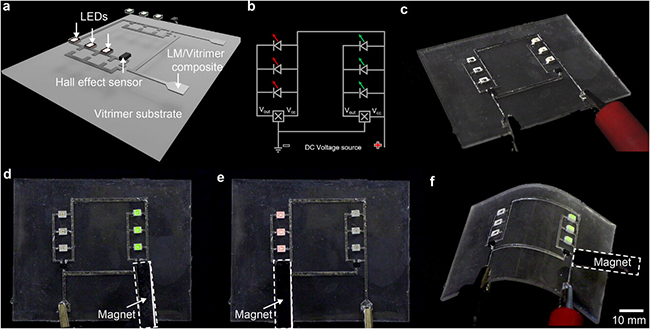
Once the vitrimer foundation was established, the team introduced droplets of eutectic gallium-indium alloy, or EGaIn—a liquid metal known for its low toxicity and exceptional conductivity. Shear mixing dispersed the LM into microdroplets averaging 80 μm, and as the composite cured at just 40 °C, these dense droplets sedimented toward the bottom, forming a layered structure with conductive and insulating faces. This natural stratification turned out to be a stroke of design elegance. Electrical testing revealed that with as little as 5% volume of LM, the composite became highly conductive—an outcome that typically demands much higher filler concentrations. At 30% LM, conductivity reached an impressive 2 × 10⁵ S/m, all while the composite remained lightweight and solid. Mechanical testing followed, where the team observed that despite incorporating a liquid phase, the composite retained excellent strength and even gained ductility. Samples with LM showed greater strain at break than the pristine vitrimer, and the bilayer structure enabled reliable circuit patterns without complex fabrication steps. Perhaps most striking was the material’s resilience. When damaged, it could self-heal—both structurally and electrically—through modest heating. In one demonstration, a cut in the surface sealed itself within minutes, and an LED powered by the composite continued to function even after the circuit trace was punctured.
In a final and poignant experiment, the researchers submerged the composite in sodium hydroxide. Over several days, the polymer disintegrated, releasing intact LM droplets and embedded electronic components for recovery. Unlike traditional epoxies, which remained inert, this vitrimer unraveled—quietly proving that high performance and full-cycle recyclability can indeed coexist in the same material.
The significance of this study reaches far beyond the lab bench. In merging structural robustness with dynamic chemical adaptability, the researchers have quietly redefined what electronic materials can be. For decades, durability and recyclability have stood at odds in material science, with high-performance devices typically built from polymers engineered to last forever—an admirable trait until those devices are discarded. What this work shows, with elegant clarity, is that these trade-offs are no longer inevitable. By harnessing the unique reversibility of vitrimer chemistry and the unmatched conductivity of liquid metal microdroplets, the team has created a composite that not only performs under real-world mechanical and electrical demands but also knows how to let go—disassembling cleanly and intelligently at the end of its life.
The implications ripple across industries. From flexible medical devices to rigid consumer electronics, this composite could offer a viable pathway toward devices that are no longer designed to die in landfills. The built-in capacity for self-healing and shape recovery opens doors to adaptive electronics—wearables that conform to the body and restore function after damage, or sensors that survive harsh industrial environments. And on a systems level, the fact that this material can be chemically degraded and its valuable components recovered speaks directly to the urgent need for circularity in electronics manufacturing.
Beyond practical outcomes, the study also delivers a philosophical shift. It challenges the deeply embedded idea that functionality must come at the cost of environmental consequence. Here is a material that doesn’t force that choice. It holds weight, conducts power, endures stress—and then, when asked, it steps aside, yielding its components with a grace that most modern materials simply cannot match. In an age of climate anxiety and technological saturation, this kind of research reminds us that innovation is not just about making things smarter or faster. Sometimes, it’s about making them kinder—to the environment, to the people who use them, and to the future we hope to preserve. The Virginia Tech team has not just developed a composite; they’ve opened a conceptual framework for thinking about how we build and unbuild the technologies of tomorrow. That alone makes their work not just timely, but quietly transformative.


Reference
Dong Hae Ho, Meng Jiang, Ravi Tutika, Joshua C. Worch, Michael D. Bartlett. Liquid Metal‐Vitrimer Conductive Composite for Recyclable and Resilient Electronics. Advanced Materials, 2025; DOI: 10.1002/adma.202501341