Advances in Engineering Advances in Engineering features breaking research judged by Advances in Engineering advisory team to be of key importance in the Engineering field. Papers are selected from over 10,000 published each week from most peer reviewed journals.

Significance
The demand for minerals and metals by society rises continuously, requiring an ever-increasing supply from a dwindling natural resource base. Fine-grained processing wastes that originate from the activities of the raw materials industry are typically discarded in industrial tailing storage facilities (TSF). Significant amounts of minerals of commercial interest usually remain in these TSFs. Such minerals might have been the prime target of the industrial exploitation but escaped during processing or were not commercially viable when the material was originally processed. Such anthropogenic deposits have reduced financial risks and development factors in that they are readily exposed at the surface, have a well-defined tonnage and the raw material is already crushed and milled. Regardless, for commercial exploitation, such TSF still demand exploration and technical feasibility studies similar in detail to those commonly applied to primary ore deposits.
Philipp Büttner and colleagues from the Helmholtz Institute Freiberg for Resource Technology in Germany introduced a novel and innovative approach that would aid in the identification of the resource potential of a given TSF. Their technique also proposed to determine all tangible characteristics of the tailings material – and include their consideration in the resource assessment process. They illustrated this approach for the case study of residual amounts of Sn (cassiterite) from a silicate-rich tailings material. Their work is published in the research journal, Minerals Engineering.
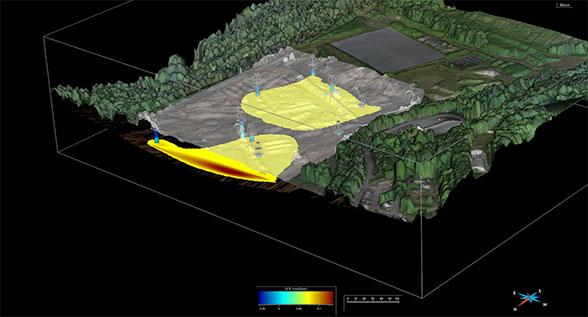
The researchers commenced the studies by identifying and employing flotation as the technique most suited to recover the cassiterite based on three material parameters namely, grade, liberation and particle size of cassiterite. Next, for each of the identified parameters, a suitable weighting function was defined and applied to the entire data set. The research team then geo-referenced the data and combined it to construct a 3-Dimensional model illustrating a depreciated grade.
The authors observed that by introducing weighting indices, they were able to quantify the inevitable losses that were due to unfavorable mineralogical or physical attributes of the ore minerals to be recovered. In addition, from the analytical data and subsequent 3D modelling, the calculated recoverable cassiterite content from the tailings was seen to be 2038 tons of a total of 4970 tons of cassiterite contained in the TSF.
Philipp Büttner and colleagues study has successfully presented a geo-metallurgical 3D-model based approach that helps depict the potential of fine grained material contained in TSFs. It has been seen that by using this approach a recovery of 41% can be achieved. Furthermore, the case study demonstrated here further elucidates on the importance of coalescing chemical grade data with quantitative mineralogical and micro-fabric information in any effort to objectively assess the residual value confined in industrial tailings or any other prospective residue. Altogether, this novel technique will provide an alternative way to extract ore minerals from fine-grained flotation tailings in a commercially viable but technologically incapacitated endeavor.

Reference
P. Büttner, I. Osbahr, R. Zimmermann, T. Leißner, L. Satge, J. Gutzmer. Recovery potential of flotation tailings assessed by spatial modelling of automated mineralogy data. Minerals Engineering, volume 116 (2018) pages 143–151.