Advances in Engineering Advances in Engineering features breaking research judged by Advances in Engineering advisory team to be of key importance in the Engineering field. Papers are selected from over 10,000 published each week from most peer reviewed journals.

Significance
Computational fluid dynamics techniques have been widely used for ship-optimization. This, however, requires a large amount of optimization data to achieve the desired optimization objectives. On the other hand, the complex interaction between the optimization objectives and design variables hinders the provision of implicit information on the data. Presently, hull-form optimization methods have been adopted for providing optimal solution results for data optimization. This method is less efficient due to difficulty in obtaining a global optimal solution. This can be attributed to ignoring the implicit relationship between the optimization variables and optimal solutions. To address this problem, data mining technology has been recently identified as a promising solution for effective data analysis simulation.
To this note, Dr. Chang Hai-Chao and his research team (Wuhan University of Technology) developed a knowledge extraction method for effective determination of the ship-form optimization. Fundamentally, the approach was based on two data mining techniques: partial correlation analysis and self-organizing maps methods. The former was used to determine the relationship between variables and objectives while the latter helped in sampling and analyzing the data features. The main objective was to extract the design knowledge between the hull design variables and objectives. The work is currently published in the research journal, Ocean Engineering.
Briefly, multiple Froude numbers were used to optimize the wave drag of DTMB5415. By considering the numerical functions and DTMB5415 as the objectives, the authors performed a knowledge extraction by combining the two methods based on the optimization data. Next, a mathematical function example was used to validate the data-mining technology design-knowledge extraction. Eventually, a comparative result analysis was conducted to verify the feasibility and effectiveness of data mining technology in ship-form optimization applications.
The authors observed that both partial correlation analysis and self-organizing map can be used to extract the same design knowledge accurately. Whereas it was generally easy to obtain the partial correlation coefficients, this method could not produce a full analysis of the relationship between the variable and object in a weak linear relationship. On the other hand, despite being used in both linear and nonlinear problems, self-organizing maps are more complicated. Thus, a combination of the two data-mining techniques was a great step in extracting and optimizing design knowledge.
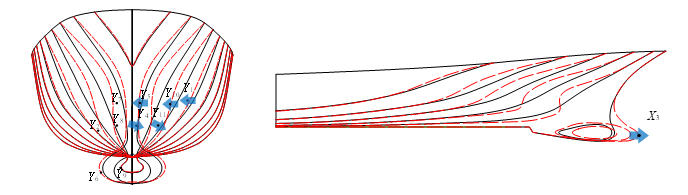
For the DTMB5415 design knowledge obtained, a longer bulb proved beneficial for reducing the wave-making resistance coefficient at both low and high speeds. In each velocity section, however, variation in the bulbous-bow width exhibited a little effect on the wave-drag coefficient. Additionally, it was easy to reduce the wave-drag coefficient at high speeds, especially for the U-shaped body plans. However, as the speed increases, the waterline shape changed from concave to a straight line.
In summary, the research team applied partial correlation analysis and self-organizing maps to acquire design knowledge about the hull forms. Based on the obtained results, the study provides vital information that will be of great significance in enhancing ship design and optimization.

Reference
Qiang, Z., Hai-Chao, C., Bai-Wei, F., Zu-Yuan, L., & Cheng-Sheng, Z. (2019). Research on knowledge-extraction technology in optimisation of ship-resistance performance. Ocean Engineering, 179, 325-336.
Go To Ocean Engineering