 Advances in Engineering Advances in Engineering features breaking research judged by Advances in Engineering advisory team to be of key importance in the Engineering field. Papers are selected from over 10,000 published each week from most peer reviewed journals.

Significance
Acoustic vortex beams are a class of structured sound fields distinguished by a helical phase distribution around the propagation axis. Unlike ordinary acoustic waves, which usually propagate with a comparatively uniform phase front, these beams possess an azimuthally varying phase term of the form eilθ, where θ is the angular coordinate and l is the topological charge. This topological charge defines the number of phase windings around the axis and is directly associated with the orbital angular momentum carried by the beam. Because of that helical structure, acoustic vortex beams have attracted interest in areas where controlled wavefront shaping and angular momentum transfer are important. A central challenge in this area has been the practical generation and detection of acoustic vortices without relying on cumbersome auxiliary systems. Most existing approaches generate them either through active transducer arrays or through passive structures designed to reshape incident sound fields. Rotating aerodynamic sources suggest a different possibility, since their tonal radiation is already shaped by periodic motion and strong spectral components tied to rotation frequency and blade passing frequency. In a recent research paper published in Applied Acoustics, Associate Professor Lianyun Liu and Professor Zhigang Chu from Chongqing University examined whether the tonal sound produced by rotating rotors can be understood as acoustic vortex fields. They combined this idea with a virtual rotating receiver measurement strategy that extracts Doppler-shifted spectra and adjacent-phase differences from a static circular microphone array. They also demonstrated single-rotor and coaxial twin-rotor generation of vortex beams, including multiplexing at shared or distinct operating frequencies and contactless inference of rotor speed and blade number.
The authors began from the tonal sound emitted by rotating rotors. Instead of treating rotor noise as something tied to one particular source mechanism, they considered the rotor more broadly as a periodically rotating acoustic source whose tonal content appears at the rotation frequency, the blade-passing frequency, and higher harmonics. From there, Liu and Chu showed that the phase lag between observers placed at different azimuthal positions around the rotor naturally gives rise to a helical phase structure. This means that the blade-passing component behaves as an acoustic vortex, while higher harmonics and other tonal components can also be understood within the same theoretical description. More importantly, the full tonal field can be described as a superposition of acoustic vortex beams, which becomes the central theoretical claim of the paper.
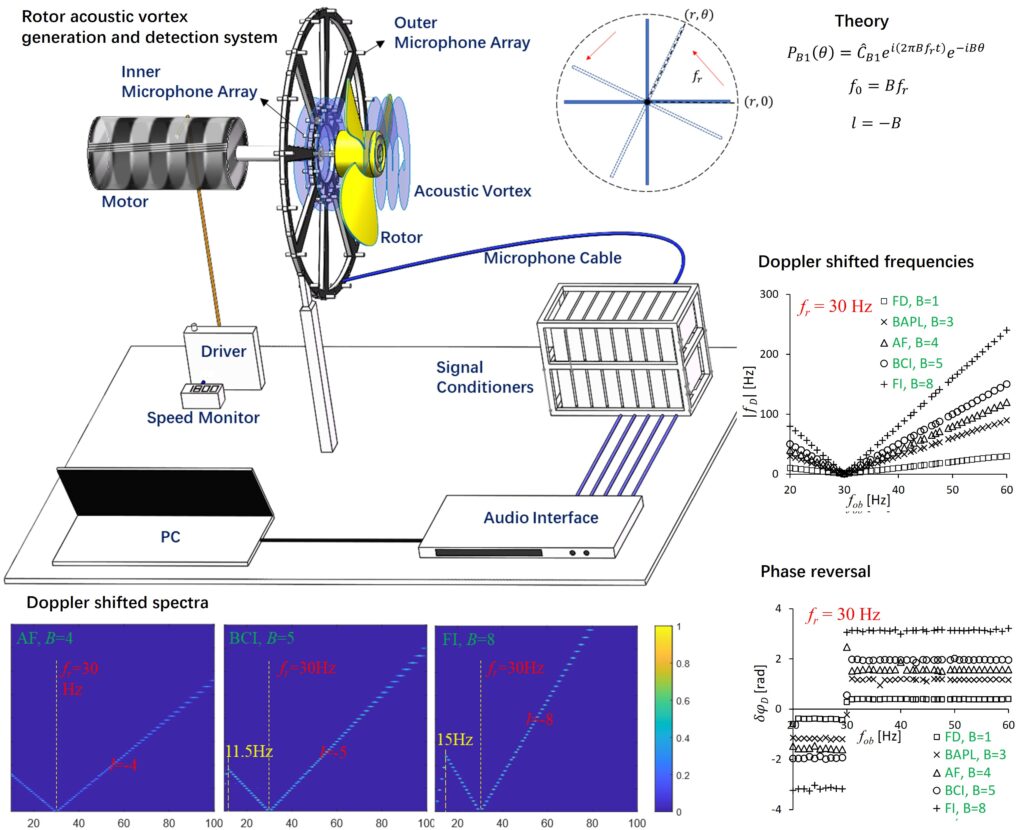
Liu and Chu designed the experiments to test that idea under realistic rotor operating conditions. A coaxial microphone array with inner and outer rings recorded both near-field and far-field sound from eight different rotors, including disks, axial propellers, axial fans, a centrifugal impeller, and a fiber impeller. They then applied the virtual rotating receiver method to reconstruct Doppler-shifted spectra while suppressing plane-wave contamination by removing the azimuthal average of the static microphone signals. That choice was important because once the spatially uniform part of the signal was removed, the remaining spectra preferentially retained sound with azimuthal structure, which is where the helical signature of acoustic vortices is expressed.
The near-field measurements revealed a consistent pattern. For all tested rotors, the blade-passing components were strongest on the inner array, and second harmonics were often clearly present as well. When the virtual rotating receiver spectra were examined, the dominant spectral ridges followed the Doppler behavior expected for vortex-carrying sound fields, and their slope with observer rotation matched blade number. At the same time, the phase difference between adjacent virtual receivers changed sign at the point corresponding to zero Doppler shift, indicating reversal of orbital angular momentum handedness. Those two observations reinforced one another: the frequency shift established the expected rotational relation, while the phase reversal showed that the field behaved as a true acoustic vortex rather than as an ordinary tonal signal. The authors found that axial propellers retained strong blade-passing vortex signatures, whereas several non-axial rotors were instead dominated by lower-order vortex components or showed much weaker high-charge content at distance. The authors related this to the weakening or disappearance of blade-passing components in far-field spectra and to the stronger decay associated with vortices of higher topological charge. That contrast gave the results a useful internal coherence: the same theory still applied, but what survived into the far field depended on rotor type and on which tonal components propagated strongly enough to remain distinguishable from other aerodynamic noise.
Liu and Chu examined two representative cases in more detail by filtering the sound at selected harmonic frequencies. For the centrifugal impeller, strong near-field vortices appeared across several orders, and comparison between the total spectral amplitude and the vortex-associated amplitude showed that most of the near-field acoustic energy at those frequencies was carried in vortex form. In the far field, that correspondence became much weaker at higher orders, and the paper used a partial-wave interpretation to explain why measurable energy could still appear there without indicating strong ideal vortex propagation. The large axial propeller showed a different pattern: even after propagation to the far field, several vortex orders remained prominent, and the blade-passing component was clearly dominant. The coaxial twin-rotor experiments then extended the argument from generation to multiplexing. Different rotor pairings produced simultaneous vortex beams with different topological charges at the same operating frequency, or at different operating frequencies for frequency-separated transmission. The virtual rotating receiver analysis resolved these as distinct channels rather than as a single ordinary tonal field. A simple coding demonstration then showed that the vortex-associated signal levels could distinguish whether one or both rotors were active, giving a proof-of-principle multiplexing scheme based on rotor-generated acoustic vortex beams.
The research work of Liu and Chu shows that acoustic vortex generation can arise intrinsically from rotor tonal radiation, with the vortex operating frequency and topological charge determined directly by rotation frequency and blade number. The methods used in the study are also important. The paper shows that acoustic vortex generation can be identified using a static microphone array processed with the virtual rotating receiver method, without needing a specially built vortex source. That gives the theory a practical experimental basis and clarifies why the authors emphasize contactless measurement of rotor speed and blade number. In their industrial fan example, ordinary sound pressure level peaks were not sufficient on their own, but the virtual rotating receiver spectra provided the information needed to determine both the rotation frequency and the blade number. The authors’ findings have practical implications and rotor-generated sound can be exploited as a structured acoustic signal with measurable and usable vortex properties. This is important because in practical terms this supports contactless measurement of rotor speed and blade number, enables multiplexed acoustic communication using distinct vortex channels, and points toward future strategies for rotor noise control and acoustic energy harvesting through manipulation of acoustic orbital angular momentum.

Reference
Lianyun Liu, Zhigang Chu, Detection of acoustic vortex generation from rotors using a virtual rotating receiver method, Applied Acoustics, Volume 239, 2025, 110870,
Go to Journal of Applied Acoustics