Advances in Engineering Advances in Engineering features breaking research judged by Advances in Engineering advisory team to be of key importance in the Engineering field. Papers are selected from over 10,000 published each week from most peer reviewed journals.

Significance
Underwater optical imaging is difficult because light does not travel through water in a simple, direct way. As it passes through suspended particles, part of the light is weakened and part of it is redirected which creates backscattered illumination that can mask the signal from the object being imaged. When the image must reveal boundaries, surface markings, material differences, or quantitative radiometric information, this scattering changes the measured intensity and makes the true scene radiance harder to recover. Polarization is well suited to fix this limitation because underwater backscattering is partially linearly polarized and measurements taken through different analyzer orientations make it possible to extract Stokes parameters and use the degree and angle of linear polarization to help separate direct radiance from scattered light. Classical polarization-difference and Stokes-based descattering methods have already shown that this information can suppress haze more directly than intensity-only enhancement. The central difficulty is that the practical underwater scene rarely follows the clean assumptions that make a simple Stokes inversion stable. Orthogonal analyzer channels may not be balanced. Scattering may be anisotropic. Target surfaces may contribute their own polarization. Multiple scattering, illumination residuals, and sensor response can shift the measured polarization away from an idealized model.
In a recently published research paper in Optics and Lasers in Engineering Dr. Ziqian Chen, Dr. Junkai Wu, Dr. Haofeng Hu, and Professor Xiaobo Li from School of Marine Science and Technology at Tianjin University developed a polarization-guided Stokes descattering method for underwater images acquired from multiple analyzer orientations. The technically distinct element is the joint use of a scene-induced Stokes mixing weight, an effective polarized visibility factor, and an asymptotic airlight scaling parameter, all estimated automatically rather than manually selected. They also developed a DoLP-gated airlight estimation step to reduce foreground polarization leakage into the scattering estimate. The complete method combines physical radiance inversion with a two-stage genetic algorithm and sequential quadratic programming optimization driven by contrast and entropy.
The research team built the method around three analyzer measurements, acquired at 0, 45, and 90 degrees and instead of applying the conventional Stokes relations directly, they introduced a scene-induced mixing parameter to adjust the contribution of the 90-degree channel. This modification preserves the Stokes structure while allowing the measured polarization state to compensate for unequal energy partition caused by anisotropic scattering, target reflection, illumination residuals, alignment effects, or sensor sensitivity. This matters because orthogonal-channel imbalance can affect the polarization parameters and the airlight estimate.
Airlight estimation is handled through a background window selected by high mean degree of linear polarization, which favors regions dominated by coherent backscattering. From that region, the method estimates a representative angle of polarization and intensity scale. A polarized background scale is then obtained using a robust high-quantile statistic, reducing sensitivity to isolated strongly polarized pixels. The new approach also introduces an effective polarized visibility factor, which accounts for the fraction of polarized background actually observable in the measured channel. Since some objects may produce stronger or more heterogeneous polarization than the background scattering itself, the gate suppresses the tendency to assign target-induced polarization to the backscattering term and by reducing foreground leakage into the airlight estimate, the inversion can preserve material and boundary information. The asymptotic airlight scale is also treated adaptively, using a global scaling parameter tied to the representative background intensity.
Because the three central parameters cannot be measured directly, the study estimates them through unsupervised optimization. The objective combines edge contrast with image entropy, so that the restored radiance is encouraged to retain both structural sharpness and gray-level richness. A genetic algorithm first searches the physically admissible parameter space, and sequential quadratic programming then refines the solution. This two-stage strategy reflects the non-smooth, nonconvex nature of the pipeline, where quantiles, clamping, and positivity enforcement make a purely local search unreliable. Experiments in a controlled water tank used semi-skimmed milk to vary turbidity, polarized illumination, a monochrome camera, and objects with different polarization characteristics, including metallic, plastic, paper, and polarizer-film targets. Under moderate turbidity, the proposed method recovered clearer boundaries, stronger contrast, and more visible fine structure than the classical Stokes-based comparison. The distinction between crossed polarizer films was especially informative because it tested whether the restoration preserved polarization-dependent target differences, instead of simply increasing contrast.
Quantitative comparisons using enhancement measure estimation, entropy, and peak signal-to-noise ratio supported the visual observations. The authors found across selected regions and the full image, the proposed method generally produced higher contrast and fidelity measures than the raw images and the classical Stokes approach. Additional comparisons with intensity-only enhancement methods and other polarization-based or learning-based methods showed that the new method retained sharper edges and more uniform background recovery as turbidity increased. Deep learning methods degraded under stronger turbidity in the reported comparisons, which the paper relates to differences between training and testing conditions.
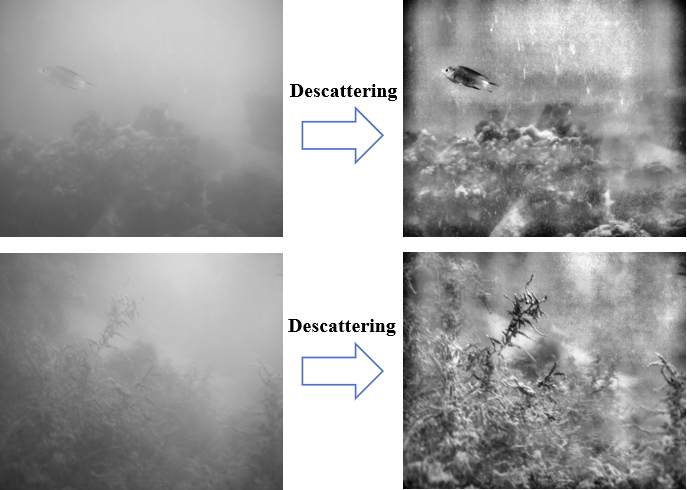
The team extended across milk concentrations from low to high turbidity and noticed as scattering increased, all methods became more challenged, but the proposed method maintained higher contrast and higher peak signal-to-noise values than the alternatives over much of the range. Tests on additional samples showed recovery of structural features in plastic and metallic coins and restoration of printed or surface details across paper, metal, wood, and plastic targets. The researchers also evaluated real seawater data acquired with polarization cameras under active lighting, where fish, coral, seaweed, and rock textures became clearer after restoration. A further comparison under polarized and non-polarized illumination indicated that the method can still operate when ordinary non-polarized lighting is used, although higher turbidity remains associated with reduced signal-to-noise ratio.
The findings of Professor Xiaobo Li and colleagues have direct engineering relevance for underwater imaging systems that must operate in scattering environments where conventional intensity images lose contrast and structural detail. In ocean observation, inspection, and monitoring tasks, the main requirement is not simply to make an image look clearer, but to recover enough reliable target information for interpretation, identification, or downstream decision-making. The polarization-guided Stokes descattering method addresses this need by combining a physically based imaging model with automatic scene adaptation, allowing the restoration process to respond to changes in turbidity, illumination, and material-dependent polarization behavior. One important application is underwater robotic inspection. Remotely operated vehicles and autonomous underwater platforms often rely on cameras to examine submerged structures, seabed objects, marine organisms, and engineered equipment. In turbid water, backscattering can hide edges, surface markings, cracks, contours, or material boundaries. By improving texture visibility, target-background separation, and structural contrast, the proposed method could support more reliable visual inspection when the water column is not optically clear. The real seawater demonstrations are particularly relevant here because they show that the approach is not limited to a controlled tank environment. The new method is also useful for marine environmental monitoring and biological observation. Underwater scenes often contain low-polarization natural objects, such as fish, coral, rocks, and vegetation-like structures, whose details may be weakened by scattered light. The reported seawater results indicate that polarization-guided descattering can enhance contours and surface texture under practical imaging conditions. This can make visual records more informative for documenting habitats, tracking marine organisms, or supporting image-based ecological analysis. A further engineering implication concerns system design. The procedure can work with polarized measurements and was also tested under non-polarized illumination, suggesting that practical systems may not always require complex polarized lighting arrangements. The use of automatically optimized, physically interpretable parameters also reduces dependence on manual tuning when the imaging scene changes. For maritime security, underwater search, and target discrimination, the ability to preserve fine structures and distinguish objects with different polarization characteristics is valuable. The method’s treatment of scene-induced Stokes imbalance and DoLP-gated airlight estimation gives engineers a more adaptable restoration tool for visually degraded underwater environments.
Reference
Ziqian Chen, Junkai Wu, Haofeng Hu, Xiaobo Li, Underwater polarimetric descattering via scene adaptation and multi-parameter optimization, Optics and Lasers in Engineering, Volume 196, 2026, 109410,
Go to Journal of Optics and Lasers in Engineering