Advances in Engineering Advances in Engineering features breaking research judged by Advances in Engineering advisory team to be of key importance in the Engineering field. Papers are selected from over 10,000 published each week from most peer reviewed journals.

Significance Statement
A breakthrough additive technology
Rapid prototyping techniques have been studied by now for nearly 20 years. Currently, four relatively mature RP&M processes are dominating on the commercial market: stereolithography (SL), selective laser sintering (SLS), fused deposition modeling (FDM) and laminated object manufacturing (LOM). Each of these four processes represent a special class of RP&M technologies.
New roll powder sintering (RPS) technology that combines the main advantages of the mature RP&M processes mentioned above and offer more competitive products with better quality, lower price and shorter fabrication time.
It is based on the commercially available inexpensive components, providing manufacturing of plastic, ceramic, metal and other objects with precision up to 77000×77000 dpi, a layer thickness of about 0.5 µm and processing volume of 1 m3 from CAD model during 1 hour.
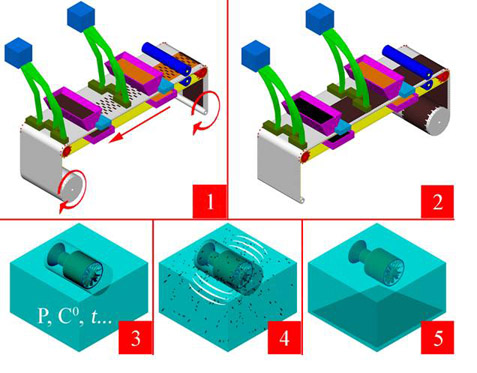
The general view of RPS plant is illustrated in Fig. 1. The construction process consists in having a thin inexpensive compressible (at a wide interval) and perforated ribbon on the side for precise allocation. The required production accuracy determines the ribbon’s thickness and perforation method.
First, a ribbon roll is rewound in the direction shown by the arrows by extending the rollers and the supporting ribbon. When the compressible ribbon is being rewound, e.g. the laser perforates it in the places into which a powder needs to be poured, i.e. where the component is.
After perforating, the holes are filled with the powder from the upper bunker. Then, to provide better accuracy and sintering, the filled ribbon is flattened evenly from top to bottom by upper and lower pressure rollers.
When the whole component roll is rewound, it is ready for a sintering plant. Sintering is possible in wide range of conditions, at different temperatures, pressures, vacuum or gas states.
At the end of the manufacturing process, it is required to remove the ribbon. The leftovers of a compressible ribbon in cavities and other places can be easily removed by dissolving, e.g. by water.
The RPS technology can build more accurate products with a better smooth surfaces that has the potential to revolutionize micro-manufacturing, offering businesses a new way to produce micro-scale goods and parts for customers.
Additive manufacturing technology have received significant advantages from both object’s properties and performance due to the whole powders layers can be simultaneously sintered into final parts and it is probable to sintering several component rolls at the same time.
Journal Reference
The International Journal of Advanced Manufacturing Technology, 2015.
Vyacheslav R. Shulunov
Institute of Physical Materials Science of the Siberian Branch of the Russian Academy of Science, Ulan-Ude, Russia
Abstract
This paper reviews key ideas and performances of the enhanced roll powder sintering (RPS) by inkjet technology. A modification of the RPS technology aims to improve precision, reliability and lower-priced hardware, and power consumption is proposed. RPS allows accomplishing designs, which are impossible, very expensive and difficult to create using other methods. A new version has increased reliability, higher perforation precision (up to 9600 dpi), lower cost and power consumption. It is based on the commercially available inexpensive components. Various specifications of laser and inkjet perforation of one-layer, compressible ribbon are reviewed. An enhanced RPS technology could make a significant contribution to the micro-manufacturing, micro-forming, jewellery, stomatology and many other industries where there are needs of processing plastic, ceramic, metal and other objects. The RPS technology offers a new way to produce more accurate micro-scale products with better smooth surfaces. It has the potential to create parts about 1–1.5 l (or more) in volume with layer thickness about 3–5 μm and print width of 0.297 m directly from a 3D CAD model with processing time about an hour. The advantages of the inkjet perforation are compared to the RPS prototype based on laser systems.
Go To The International Journal of Advanced Manufacturing Technology
Figure Legend: RPS simplified diagram.