
Shadowgraphy-Driven Deep Learning for Rapid Coal Classification and Component Prediction

Significance

Coal is still the main energy system in the world. However, it is known two samples that look almost identical can behave completely differently once they reach the furnace and even small shifts in mineral content or the proportion of volatile matter can change how efficiently it burns or how much residue it leaves behind. These inconsistencies, rooted in the way coal formed over millions of years which make the analysis complex and predicting behavior in real systems where a misclassification can throw off entire combustion processes. The more globalized coal supply has become, the more this problem shows up in practice and blends from different regions rarely act the same once mixed. Traditional analysis methods do the job, at least in principle. For instance, the proximate and ultimate tests give detailed chemical profiles, but they’re slow, and they don’t help much when you need on-the-spot decisions. LIBS looked promising for a while because it’s faster, but the hardware doesn’t survive well in the dusty, abrasive conditions of power plants. Chemical assays remain the benchmark for precision, but they’re tedious and too static for materials that can change from batch to batch. In other words, our best tools still feel one step behind the realities of industrial use. Optical diagnostics, especially shadowgraphy, have started to shift that picture. The basic idea is simple: a laser pulse hits the coal surface and, in that instant, everything changes—plasma forms, shockwaves spread, the air refracts light differently, and for a few microseconds you can actually see the dynamics of what just happened. Those fleeting images, called shadowgrams, contain clues about the sample’s structure and composition, though interpreting them isn’t straightforward. Each one is like a fingerprint, delicate and unique. The catch is that conventional high-speed cameras, which are used to capture these moments, can’t quite keep up; to get higher frame rates, they sacrifice resolution, and the differences between coal types are often lost in that compromise. To this account, new research paper published in Optics Letters and led by Professor Honglian Guo and Dr. Tong Peng from the College of Science at Minzu University of China alongside Dr. Junrong Feng, Dr. Wen Yi, Dr. Feng Li, and Dr. Ruibing Liu, from the Beijing Institute of Technology, the researchers developed two integrated models: a fiber-based shadowgraphy imaging system capable of capturing nanosecond-resolved shockwave evolution without loss of spatial detail, and a convolutional neural network (CNN) for automated coal classification and component prediction.

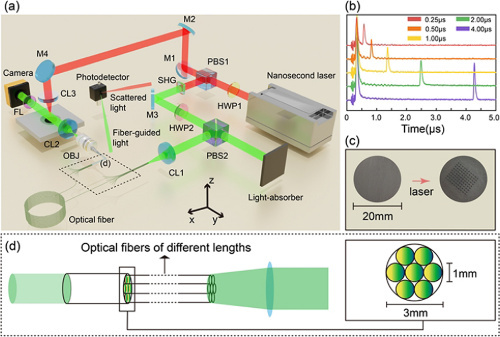
The research team constructed a laser–fiber shadowgraphy system using a 1064 nm Nd:YAG pulsed laser split into excitation and illumination pathways. The excitation beam impinged perpendicularly on compressed coal sheets—each 2.5 mm thick and 20 mm in diameter—composed of fine coal particles pressed at 10 tons of pressure. Meanwhile, the illumination beam, frequency-doubled to 532 nm, was routed through optical fibers ranging from 30 m to 800 m in length. Each fiber introduced a calibrated delay, allowing sequential shadowgrams of the same plasma event to be captured across intervals spanning 0.15 to 4.00 microseconds. The synchronized detection used a CMOS camera equipped with a 532 nm passband filter, which ensured suppression of broadband plasma emission and minimizing image saturation. The authors found the shadowgrams provided high-resolution visualization of shockwave dynamics. At 0.25 µs, for instance, arcuate wavefronts with radii near 0.5 mm emerged, propagating at approximately 1550 m/s—confirming the supersonic character of LIP-induced shockwaves. When they increased the excitation energy from 22 mJ to 400 mJ elevated the initial velocity to around 3580 m/s before it gradually decayed toward the acoustic limit of air. Moreover, the shockwave propagation behavior, when fitted to the Dewey explosion model (R = A + Bt + C ln(1 + t) + D(ln(1 + t))¹ᐟ²), demonstrated remarkable correspondence with theoretical blast dynamics, which reinforced the analogy between micro-scale LIP events and macro-scale explosions. They also evaluated the method’s analytical potential, and to do this shadowgrams from 29 distinct coal types were acquired, each represented by 90 laser-excited regions. The convolutional neural network, trained with 73 images per class and tested on 17 unseen samples, achieved an exceptional classification accuracy of 98.38%. Five-fold cross-validation confirmed the robustness of this approach, yielding an average accuracy of 97.53%. Visual inspection revealed that shadowgram brightness correlated inversely with volatile matter content, suggesting that optical intensity inherently reflects compositional attributes. The authors also tested predictive capacity, shadowgrams from three representative coal samples—spanning low, intermediate, and high volatility—were analyzed to estimate ash content, volatile matter, and fixed carbon. The model achieved root mean square errors of prediction (RMSEP) of 1.75%, 1.04%, and 2.74%, respectively.

In conclusion, the new work by by Professor Honglian Guo and colleagues developed innovative models that achieved 98.38% accuracy across 29 coal types and predicted key composition metrics with minimal error. The innovation lies in combining optical fiber–controlled temporal imaging with deep learning analytics, offering a new route for rapid, non-destructive analysis of complex materials. Additionally, the successful deployment of a fiber-based shadowgraphy platform effectively democratizes access to time-resolved plasma imaging by replacing bulky high-speed cameras with a compact, modular system that preserves spatial fidelity. The innovative use of varying fiber lengths as temporal gates exemplifies an elegant solution to the trade-off between resolution and frame rate, enabling simultaneous multi-timepoint imaging of shockwave dynamics within a single laser pulse. Moreover, the new study pioneers a methodological framework for material identification where each shadowgram encodes image as well as provide multidimensional signature of density, volatility, and composition by coupling high-resolution physical imaging with deep learning. We believe such data-driven optical analytics could transform in-situ monitoring of energetic materials, reduce dependency on costly chemical assays, and accelerate the transition toward smart, automated energy systems. In practical terms, the demonstrated 98% classification accuracy means that power plants, mining facilities, and material sorting operations could one day implement non-contact, instantaneous coal identification pipelines, reducing inefficiencies and lowering environmental impact. Furthermore, the CNN’s ability to discern coal types from intensity variations highlights how artificial intelligence can show latent correlations between optical patterns and chemical composition and relationships that elude traditional spectroscopic intuition. In a nutshell, the new model’s capacity to predict ash and carbon content with sub-3% RMSEP highlights its quantitative credibility, while its limitations for minor constituents point toward future refinements in dataset diversity and hybrid architectures combining spectral and spatial inputs.

About the author

Honglian Guo
Education and Work Experience:
1998–2003: Institute of Physics, Chinese Academy of Sciences, Optics, Ph.D. (Science)
1993–1998: Capital Medical University, Biomedical Engineering, B.E. (Engineering)
2018.02–Present: Professor, College of Science, Minzu University of China
2015.09–2017.01: Professor, School of Physics and Optoelectronics, South China
University of Technology
2006.05–2015.08: Associate Researcher, Key Laboratory of Optical Physics, Institute
of Physics, Chinese Academy of Sciences
2009.05–2010.01: Visiting Scholar, School of Medicine, Yale University
2010.02–2011.02: Research Assistant, School of Engineering, Vanderbilt University
2003.07–2006.04: Assistant Researcher, Key Laboratory of Optical Physics, Institute of
Physics, Chinese Academy of Sciences
2004.10–2004.12: Visiting Scholar, King’s College London

Representative Publications:
1. Qian W, Peng W, Lv Y, Meng L, Li C, Lv M, Guo H. Wearable pulse monitoring system
for evaluating cardiovascular parameters based on tapered no-core fiber Opt Lett.
2025;50(16): 5081-5084.
2. Peng T, Feng J, Yi W, Li F, Liu R, Guo H. Coal classification and analysis based on
shadowgraphy and deep learning methods. Opt Lett. 2025;50(13):4294-4297.
3. Li, Y.; Qin, Y.; Wang, H.; Huang, L.; Guo, H.; Jiang, Y. Calculation and measurement of
trapping stiffness in femtosecond optical tweezers. Opt. Express 2024, *32*(7), 12358.
4. Perumalveeramalai, C.; Zheng, J.; Wang, Y.; Guo, H.; Pammi, S.V.N.; Ravi, M.; Li,
C. Monolithically grown CSPbBr3 by chemical vapor deposition for Self-Powered
photodetector. Chem. Eng. J. 2024, *492*, 152213.
5. Li, J.; Zhao, X.; Zhang, R.; Zhou, D.; Li, F.; Li, Z.-Y.; Guo, H.* Programmable
photoacoustic manipulation of microparticles in liquid. Opt. Express 2024, *32*(9),
16362. 6. Zhao, X.; Zhang, R.; Li, J.; Zhou, D.; Li, F.; Guo, H.* Programmable spin and transport
of a living shrimp egg through photoacoustic pressure. Opt. Lett. 2024, *49*(9), 2341.
7. Zhang, R.; Zhao, X.; Li, J.; Zhou, D.; Guo, H.; Li, Z.-Y.; Li, F.* Programmable
photoacoustic patterning of microparticles in air. Nat. Commun. 2024, *15*, 3250.
8. Qiao, S.; Zhang, X.; Liang, Q.; Wang, Y.; Ji, C.-Y.; Li, X.; Jiang, L.; Feng, S.; Guo, H.; Li,
J. Refractive index sensing based on a twisted nano-kirigami metasurface. Photonics
Res. 2024, *12*(2), 218.
9. Tang, J.; Ma, F.; Li, F.; Guo, H.; Zhou, D.* Strongly nonlinear topological phases of
cascaded topoelectrical circuits. Front. Phys. 2023, *18*(3), 33311.
10. Qiao, S.; Liang, Q.; Zhang, X.; Liu, X.; Feng, S.; Ji, C.-Y.; Guo, H.; Li, J.* Flexible
engineering of circular dichroism enabled by chiral surface lattice resonances. APL
Photonics 2022, *7*, 116104.
11. Wei, W.; Chen, S.; Ji, C.-Y.; Qiao, S.; Guo, H.; Feng, S.; Li, J.* Ultra-sensitive amplitude
engineering and sign reversal of circular dichroism in quasi-3D chiral
nanostructures. Opt. Express 2021, *29*(21), 33572.
12. Chen, S.; Wei, W.; Liu, Z.; Liu, X.; Feng, S.; Guo, H.; Li, J. Reconfigurable nano-kirigammetasurfaces by pneumatic pressure. Photonics Res. 2020, *8*, 1177. (Zone 1, Top)
13. Zhang, R.#; Guo, H.#; Deng, W.; Huang, X.; Li, F.; Lu, J.; Liu, Z.* Acoustic tweezers and
motor for living cells. Appl. Phys. Lett. 2020, *116*, 123503.
14. Hong, X.; Feng, S.; Guo, H.; Li, C. A small-spot-size and polarization-insensitive flat
lens employing dielectric metasurface in the terahertz region. Opt.
Commun. 2020, *459*, 125083.
15. Tian, W.#; Guo, H.#; Lu, J.; Huang, X.; Deng, W.; Li, F.*; Liu, Z. Generating arbitrary
photoacoustic fields with a spatial light modulator. Opt. Lett. 2019, *44*(13), 3206-
3209.
Awards and Academic Appointments:
Academic Committee Member, Beijing Key Laboratory of Optical Detection
Technology
Committee Member, Ophthalmology Professional Committee, China Association of
Medical Equipment
High-Level Outstanding Talent, Minzu University of China
Member of the Academic Committee, College of Science, Minzu University of China

REFERENCE

Peng T, Feng J, Yi W, Li F, Liu R, Guo H. Coal classification and analysis based on shadowgraphy and deep learning methods. Opt Lett. 2025;50(13):4294-4297. doi: 10.1364/OL.559226. 

Opt Lett.

Check Also

Direct Panoramic Optical Imaging via Subwavelength Silver–Glass Null-Medium Structures

Significance    Reference Yang C, Sun F, Sun R, Liu Y. Direct panoramic optical imaging …
