 Advances in Engineering Advances in Engineering features breaking research judged by Advances in Engineering advisory team to be of key importance in the Engineering field. Papers are selected from over 10,000 published each week from most peer reviewed journals.

Significance Statement
Epoxy resin is rather brittle, but has high modulus, strength, superior adhesion strength, and low creep, which makes it attractive for several industrial productions. Epoxy resins are used for anti-cavitation painting. Cavitation is the mechanical degradation of a surface reference to the continuous collapsing on it of bubbles and cavities from a surrounding liquid. Cavitation therefore affects the operation of hydraulic devices such as valves, ship propellers, fittings, hydroelectric turbines, and hydraulic pumps.
As mentioned previously, epoxy resins are brittle and this is the reason why varying percentages of nanoparticles are applied as fillers. Silica nanoparticles, for instance, can be used to increase fracture toughness. In addition, cork microparticles can also be used to reduce the brittleness of epoxies or natural fibers. Researchers have therefore; focused on micro and nanoparticles as they enhance the mechanical attributes, thermal characteristics, wear resistance, and the curing reaction of epoxy resins.
Pyrogenic silica can be used as a filler in urethane-acrylic that is normally adopted as a coating in polycarbonate substrates in order to enhance wear resistance. Amorphous silicon oxide has also been used as the main thixotropic agent in the synthesis of anaerobic adhesives. In the recent studies, silica has been applied to synthesize polyurethane nano-adhesives. This is because silica nanoparticles improve the nano-adhesives Young’s Modulus as well as tensile strength.
Reference to the applications of nano-silicon oxide and epoxy, Juana Abenojar , Miguel Angel Martínez at Universidad Carlos III de Madrid in collaboration with Joaquin Darío Tutor-Sáncehz, Juan Carlos del Real and Yolanda Ballesteros at Universidad Pontificia Comillas in Spain analyzed the performance of Silicon oxide/epoxy nanocomposites subjected to wear and erosion. They justified this performance with thermal and mechanical properties with unmodified nano silicon dioxide. Their research work is published in journal, Composites Part B.
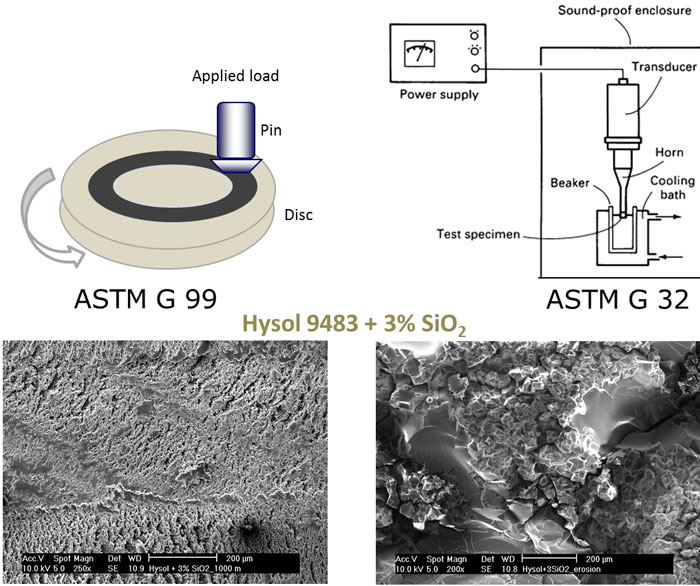
The focus of the current study was on the effect of pyrogenic silica on epoxies, normally not present in their assemblages. The researchers manufactured silicon dioxide/epoxy nanocomposites with two loads of nano silica; 3 wt% and 5 wt%. Their aim was to establish the effect that the inclusion of nano-silica has on wear, mechanical and cavitation erosion, and thermal attributes, and curing reaction. To meet these objectives, the authors prepared nanocomposite specimens as coatings and in bulk. They later evaluated bending and tensile strength, hardness, wear resistance, and cavitation erosion.
The authors observed that the inclusion of nanoparticles affected the wear resistance. They found that nanocomposites with 5% of silica should not have been used for applications requiring high wear resistance. A lubricating effect observed at 1000m sliding distance indicated that a lower content of silica, about 3%, should have been used, particularly for ‘in-bulk’ applications.
It was observed that all cavitation erosion parameters were reduced when silica was added. However, additions of 3-5% did not give an appreciable difference. The improvement in the cavitation resistance could be traced to the increment in root shape fractures as well as plastic deformation in some areas. The inclusion of silica made the composite to have less strength and hardness, but became more ductile. When a large percentage was added, the value of the Young’s Modulus was observed to reduce.
Lower values of transition temperature indicated that the nanocomposites plasticized more with respect to the clear resin. Plasticization was in keeping with the strength and hardness loss and augmented ductility. Nanoparticles also affected the curing process. They promoted the preliminary curing mechanism, but in high amounts hindered crosslinking, therefore, inhibiting the overall curing.





Reference
J. Abenojar *, J. Tutor, Y. Ballesteros, J.C. del Real, M.A. Martínez. Erosion-wear, mechanical and thermal properties of silica filled epoxy nanocomposites. Composites Part B, volume 120 (2017), pages 42-53.
Go To Composites Part B