Advances in Engineering Advances in Engineering features breaking research judged by Advances in Engineering advisory team to be of key importance in the Engineering field. Papers are selected from over 10,000 published each week from most peer reviewed journals.

Significance
Superhydrophobic cotton fabrics are cotton material that has been engineered to repel water. The Superhydrophobic property is achieved by modifying the surface structure of the cotton via the addition of coatings or treatments that create a rough micro-nanostructured surface morphology with lowered surface energy. These surface structures, combined with hydrophobic chemical treatments, enhance the water resistance of cotton to achieve superhydrophobic properties. To this account, a new study published in ACS Applied Materials & Interfaces and led by Dr. Esfandiar Pakdel and Prof. Xungai Wang from the Hong Kong Polytechnique University demonstrated a new innovative multifunctional capability of superhydrophobic cotton fabrics where they enhanced the functional properties of cotton fabrics by incorporating silver nanoparticles (Ag NPs) and polydimethylsiloxane (PDMS) into their structure. In collaboration with Dr. Julie Sharp, Dr. Sima Kashi, Dr. Wenli Bai from the Deakin University (Australia) and Dr. Mazeyar Parvinzadeh Gashti from GTI Chemical Solutions Inc./InsectaPel, LLC. (USA), the researchers strategically chose this combination to exploit the unique properties of each material: Ag NPs for their well-documented antibacterial properties and PDMS for its hydrophobicity, flexibility, and durability. The primary goal was to create a textile that not only resists water and microbial growth but also offers protection against ultraviolet radiation and has photothermal capabilities.
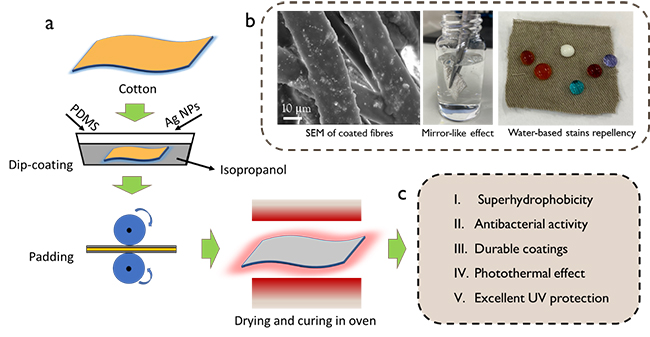
The team applied coatings made from Ag NPs and PDMS to cotton fabrics using a dip-pad-dry-cure coating method, where they immersed the fabric in a solution containing these components, followed by padding, drying and curing to ensure the coating adhered firmly to the fabric. Afterward, they measured the water contact angle (WCA) to evaluate the superhydrophobicity of the treated fabrics. It is well known and accepted that a WCA greater than 150° indicates superhydrophobicity, which the team successfully achieved, with the highest WCA recorded at 171.31° which means the surface is extremely resistant to water absorption and can effectively repel water-based contaminants. The findings suggested that the maximum superhydrophobicity was achieved only at the optimum concentrations of Ag NPs and PDMS and using excess amounts of ingredients had detrimental effects on the superhydrophobicity of fabrics. The antibacterial efficacy of the fabrics was also tested against Escherichia coli which is believed to be due to the presence of Ag NPs. Although Ag NPs were mixed with PDMS polymer, the researchers carefully examined the effect of Ag NP concentration on the antibacterial performance and showed that higher concentrations of Ag NPs directly correlate with enhanced bacterial growth inhibition. This is an important finding, due to the increasing concern over microbial resistance and the need for effective long-term antimicrobial textile solutions as well as the potential of these treated fabrics in healthcare and hygiene applications. They also assessed the UV protection capabilities by measuring the ultraviolet protection factor (UPF) of the treated fabrics and demonstrated an improved UPF in the presence of Ag NPs, indicating better protection against harmful UV radiation. This advantageous feature is particularly relevant in the context of global climatic changes and increased UV exposure, highlighting the potential of these functional textiles in protective clothing and outdoor applications. Furthermore, the photothermal properties introduced by the Ag NPs add an innovative dimension to the functional capabilities of the treated fabrics. The Ag NPs act as photothermal agents, converting absorbed NIR radiation into heat, thereby enabling the fabrics to exhibit a self-regulating temperature mechanism. This photothermal effect not only enhances wearer comfort in varying environmental conditions but also presents potential applications in de-icing and thermal management technologies. Additionally, the authors investigated another critical aspect of functional textile development which is the durability of the imparted properties. They reported that treated fabrics demonstrated remarkable resilience to repeated washing and mechanical abrasion, maintaining their superhydrophobicity and UV protection capabilities. This durability underscores the potential of these textiles for real-world applications, where longevity and performance consistency are paramount.
Another advantage for the approach taken by the authors is using environmentally friendly materials because they avoided the use of hazardous solvents, and fluoropolymers and they used instead isopropanol and PDMS as solvent and low-surface energy polymeric binder which aligns well with the growing demand for sustainable and eco-friendly textile solutions. Additionally, the authors addressed potential environmental concerns associated with silver nanoparticles by ensuring their stable incorporation within the fabric matrix, minimizing the risk of nanoparticle release during use and laundering. In conclusion, the new study is an important advancement in the functionalization of cotton fabrics. It lays the groundwork for the next generation of smart textiles, by synergistically combining superhydrophobicity, antibacterial properties, UV protection, and photothermal effects through the application of durable Ag/PDMS coatings.


Reference
Pakdel E, Sharp J, Kashi S, Bai W, Gashti MP, Wang X. Antibacterial Superhydrophobic Cotton Fabric with Photothermal, Self-Cleaning, and Ultraviolet Protection Functionalities. ACS Appl Mater Interfaces. 2023 ;15(28):34031-34043. doi: 10.1021/acsami.3c04598.