Advances in Engineering Advances in Engineering features breaking research judged by Advances in Engineering advisory team to be of key importance in the Engineering field. Papers are selected from over 10,000 published each week from most peer reviewed journals.

Significance
A kinetic responsive facade (KRF) is a type of building envelope that can move or change shape in response to environmental conditions such as wind, sun exposure, or temperature. These facades are designed to be dynamic and can adjust their configuration to optimize energy performance, occupant comfort, or aesthetic appeal. The importance of kinetic responsive facades in engineering lies in their potential to improve the energy efficiency and sustainability of buildings. By adjusting to changing environmental conditions, these facades can help regulate temperature and reduce the need for mechanical heating or cooling. Additionally, they can allow for more natural light and ventilation, improving indoor air quality and reducing reliance on artificial lighting. Kinetic facades also have aesthetic benefits, providing a dynamic and visually engaging element to the building exterior. They can be designed in a variety of shapes and sizes, creating a unique and customizable appearance for each building.
KRF mechanism allows architects to design a building with dynamic styles and morphological acclimation to improve indoor comfort and building energy efficiency. Despite the growing popularity of KRF design and simulation, its application in architectural design remains relatively low because it is built on rigid mechanical systems requiring considerably higher manufacturing and repair costs. KRF systems with large and heavy structural movements can induce more noise and vibration, causing occupant discomfort. Another critical challenge in the design and construction of KRF is the increasing complexity of buildings.
Soft robotic technology continues to attract research attention for architectural applications. Several studies have explored using this technology to address the inherent challenges in designing KRF. Generally, soft robots are tailored to mimic the complex functioning of living organisms. Unlike traditional rigid-body robots, soft robots have numerous advantages, including reduced complexity, improved human safety, reduced risks, and improved mechanical performance. They are also suitable for performing specific tasks requiring scalable and adaptive motion in unstructured surroundings.
With the growing evidence of the potential benefits of smart ad smart materials in constructing adaptive self-shaping KRFs, attention has shifted to finding suitable materials for improving performative responsibility of building and active engagement of façade morphology in climate-adaptive operation. However, despite the remarkable progress, the functional inadequacies of soft materials like weak shape retention, degradation of elastic resilience and system vulnerabilities are often ignored. This is of great significance in advancing the architectural KRF application. Therefore, it is desirable to bridge the existing research gap between advances in applied design and soft robotic fabrication technologies.
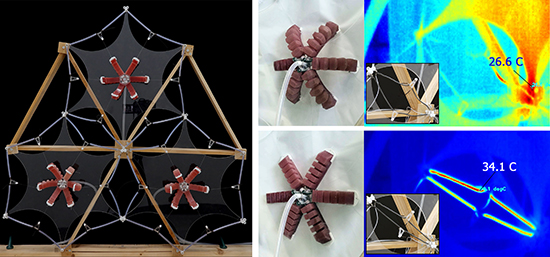
To address these challenges, Professor Hwang Yi and his team, Professor Je-sung Koh, Mi-jin Kim, and Baek-gyeom Kim from Ajou University investigated the feasibility of a lightweight, gearless and flexible flexural biomimetic climate-adaptive shading façade module. This module was compatible with nonlinear surfaces and was obtained by hybridizing smart SMA and gripper-shaped pneumatic elastomer actuators. Design procedures were presented to facilitate the design of building scale FEA and SMA actuators for stable soft KRF control. The design feasibility was validated via finite element analysis. Their work is currently published in the peer-reviewed research journal, Automation in Construction.
The authors showed that the resulting system exhibited improved shape-changing capability and structural stability for robust control of soft KRF. The compliant inflation mechanism, together with the thermomechanical response of the bias SMA actuation, achieved morphological flexibility in the design scheme as well as a maximum opening area ratio of ~20%. Through hybridization strategy, pleated FEA obtained adequate to overcome stress relaxation of the SMA actuator. When pleated FEA was deactivation, the tensional force induced by the heated SMA actuator was responsible for the panel membrane recovery. Furthermore, pneumatic control enhanced the flexibility of elastomer actuators in geometric deformation. Inflated elastomers produced greater force than SMA actuators, which is significant in building scalable applications.
In summary, the study addressed questions about the application of KRF in free-form buildings. The results revealed that a combination of two or more soft actuator systems could complement each function to reduce system complexity and improve operational performance. Stable mobility, design feasibility, and structural endurance were some of the performance benefits f the proposed approach. In a statement to Advances in Engineering, Professor Hwang Yi noted that the study findings would provide a better understanding of the bio-inspired design and construction of climate-responsive buildings.
Reference
Kim, M., Kim, B., Koh, J., & Yi, H. (2023). Flexural biomimetic responsive building façade using a hybrid soft robot actuator and fabric membrane. Automation in Construction, 145, 104660.