Advances in Engineering Advances in Engineering features breaking research judged by Advances in Engineering advisory team to be of key importance in the Engineering field. Papers are selected from over 10,000 published each week from most peer reviewed journals.

Significance Statement
VITO is an independent technological research institute in Belgium, and has been involved in research and development on organic solvent nanofiltration since the end of the 90’s. In this framework, several feasibility tests for industrial customers were performed. Successful separation processes over the course of the years include, amongst others, diafiltration processes to remove unwanted solvent from chemical or pharmaceutical product streams, recovery and re-use of homogeneous catalysts, and removal of unwanted oligomer by-products. Recently a membrane-assisted process (VITO-VID) was developed to perform reactions that require high dilution for sufficient product yield. The proof of principle of this efficient, volume-intense process was demonstrated for 2 representative macrocyclization reactions.
VITO has also own membrane development for organic solvent nanofiltration. This resulted in innovative functionalized ceramic membranes (FunMem), able to compete with current commercial polymeric membranes. Moreover, the flexibility of the functionalization technology, allows tailoring the membrane affinity to optimize its performance for a specific solute/solvent mixture.
Journal Reference
Chemie Ingenieur Technik, Volume 85, Issue 8, pages 1243–1247, 2013.
Dr. Anita Buekenhoudt, Dr. Herman Beckers, Dr. Dominic Ormerod, Dr. Metin Bulut, Pieter Vandezande ,Roel Vleeschouwers.
VITO (Flemish Institute for Technological Research), Unit Separation and Conversion Technology, Boeretang 200, 2400 Mol, Belgium.
Abstract
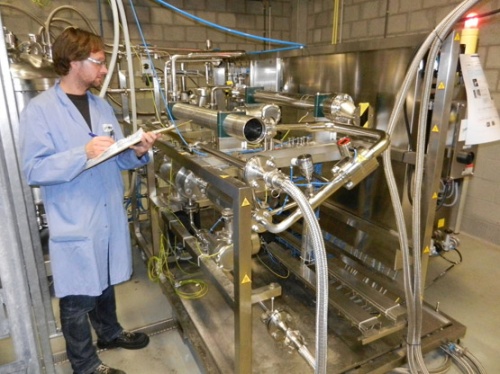
VITO has designed and recently acquired a large-scale mobile pilot installation for organic solvent nanofiltration, to facilitate the transfer of this new promising technology for process intensification to industry. The installation,suitable for all requirements ranging from proof of principle testing to pilot scale production, is mobile and can be equipped both with ceramic and polymeric membranes. The pilot is full Atex, meets the regulatory requirements of pharmaceutical and fine chemical manufacturing (GMP: good manufacturing practice) and is available to customers on a rental basis. In this paper, the technical specifications of the pilot unit, possible applications and some successful case studies performed, will be presented.
Copyright © 2013 WILEY-VCH Verlag GmbH & Co. KGaA, Weinheim