 Advances in Engineering Advances in Engineering features breaking research judged by Advances in Engineering advisory team to be of key importance in the Engineering field. Papers are selected from over 10,000 published each week from most peer reviewed journals.

Significance
Graded metamaterials have become an increasingly important tool for shaping how waves move through engineered media, precisely because they depart from the constraints of uniform or strictly periodic designs. By allowing material or structural properties to change gradually in space, these systems make it possible to access behaviors that are otherwise difficult to realize, including broadband attenuation, frequency-selective transport, asymmetric propagation, and improved energy capture. In mechanical and elastic systems in particular, spatial grading has been used to slow wave packets, trap energy in prescribed regions, and generate rainbow-type effects in which different frequencies peel off and localize at different positions. These ideas are now well established. What is less often emphasized is that grading comes with an inherent cost. Any spatial variation, even a smooth one, introduces scattering. As waves travel through a graded medium, they inevitably encounter regions where the local properties shift enough to trigger partial reflection, mode mixing, or outright energy loss. This issue becomes especially problematic in settings where transmission efficiency matters, such as guided-wave devices, sensors, or energy-harvesting architectures. In practice, waves entering strongly graded regions often experience effective impedance mismatches, even when no sharp interfaces are present. Designers typically address this by adjusting grading profiles through trial and error, hoping to reduce reflections without a clear guarantee of success. A general principle that predicts when grading will suppress scattering, rather than exacerbate it, is still missing. Interestingly, a comparable problem has already been resolved for systems that vary in time instead of space. The adiabatic theorem, first developed in quantum mechanics and later adapted across optics, acoustics, and mechanics, establishes that sufficiently slow temporal variation can prevent unwanted transitions between modes. In mechanical wave systems, this idea has enabled controlled energy transfer and stable modal evolution under gradual time modulation. Whether a similar principle applies when variation occurs along space, rather than time, is far from obvious and remains a genuinely open question.
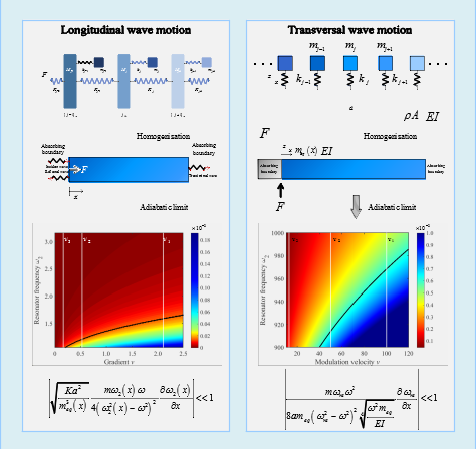
To this end, new research paper published in Journal of Intelligent Material Systems and Structures and led by PhD student Pingping Liu and Professor Hongjun Xiang from the Beijing Jiaotong University, the researchers developed a space-adiabatic theorem that rigorously links spatial material gradients to wave scattering in graded metamaterials. They derived explicit analytical limits for adiabatic grading and validated them numerically for both longitudinal and transversal wave systems. Their results show that sufficiently slow spatial modulation suppresses reflection and enhances transmission.
The research team first reformulated the equations of graded mechanical systems as first-order spatial evolution problems and defined appropriate state vectors and spatial Hamiltonian matrices, wave propagation were also described as a trajectory through an eigenmode space that evolves with position. Within this formulation, spatial gradients in material or structural properties act as coupling terms between modes, analogous to non-adiabatic transitions in time-dependent systems.
The authors derived a general quantitative condition for space adiabaticity and the criterion relates the spatial derivative of the Hamiltonian to the separation between local wavenumbers, showed that mode coupling becomes negligible when gradients are sufficiently small. More important, this condition yields explicit limiting expressions for acceptable gradients once the system parameters are specified.
The team then apply this framework to longitudinal wave propagation in a spring–mass system with graded resonators, a canonical model for elastic metamaterials. They obtained closed-form expressions for the adiabatic limit by homogenizing the discrete structure into an equivalent continuous rod with spatially varying effective mass and stiffness. Moreover, numerical simulations are performed on long chains with absorbing boundaries, which ensure that observed reflections arise solely from grading effects rather than edge artifacts. Furthermore, they examined several grading scenarios ranging from rapid to slow spatial modulation of resonator frequency. In fast-modulation cases, waves encountering the graded region undergo strong reflection and frequency conversion, with energy scattered into multiple modes and found as the gradient is reduced, reflections weaken progressively. When the derived adiabatic condition is satisfied, reflected waves are almost entirely suppressed, and transmission increases dramatically compared to non-adiabatic configurations. The transition between these regimes is mapped systematically, allowing the authors to identify a clear boundary separating adiabatic and non-adiabatic behavior.
They also extended the same methodology to transversal wave motion in beams with graded resonators and noticed that despite the higher-order nature of bending dynamics, the space-adiabatic criterion remains effective. Numerical studies again showed that slow spatial modulation leads to smooth modal evolution, but rapid grading produces scattering and reflection. Additionally, the authors also investigate how space adiabaticity influences energy harvesting. When grading satisfies the adiabatic condition, energy transfer through the structure becomes more coherent, increasing the amount of energy delivered to downstream regions while minimizing back-reflected losses. Parametric studies further reveal that both the choice of grading parameter and the shape of the grading profile play decisive roles in balancing transmission, localization, and harvesting performance.
In conclusion, the work of Liu and Xiang establishes a principled foundation for designing graded structures with controlled, low-loss wave transport and provide explanation for why certain graded structures transmit waves efficiently while others suffer from severe scattering. Indeed, engineers can now appeal to a clear analytical condition that links spatial gradients directly to wave behavior. Implications of the new study are significant, for instance, unification of time- and space-based modulation concepts under a common adiabatic framework which deepens the theoretical understanding of wave control in structured media and suggests that many techniques developed for temporally modulated systems may be reinterpreted or adapted for spatially graded designs. For engineers, the ability to suppress reflection through controlled spatial grading has immediate relevance for waveguides, vibration isolation systems, and energy harvesting devices and in applications where back-reflection degrades signal quality or reduces harvesting efficiency, the space-adiabatic condition provides a direct route to performance improvement. The demonstrated enhancement in transmission and reduction of scattering highlight the practical value of slow, well-designed grading. The analysis of different grading profiles further emphasizes that adiabaticity alone is not the sole design consideration. And shows although slow gradients are essential for avoiding mode coupling, the spatial distribution of resonant frequencies also determines where energy localizes and how it flows through the structure. This view enables designers to tailor graded metamaterials to specific functional goals, whether to maximize transmitted energy, concentrate energy locally, or achieve a balance between the two. The authors’ new framework is not restricted to one-dimensional mechanical systems and can be extended to other wave systems and higher-dimensional structures which open opportunities in acoustic, elastic, and even electromagnetic metamaterials.


Reference
Liu, Pingping & Xiang, Hongjun. (2024). A space-adiabatic theorem for longitudinal and transversal wave motion analysis of graded metamaterials. Journal of Intelligent Material Systems and Structures. 35. 1511-1526. 10.1177/1045389X241276215.
Go to Journal of Intelligent Material Systems and Structures.