Advances in Engineering Advances in Engineering features breaking research judged by Advances in Engineering advisory team to be of key importance in the Engineering field. Papers are selected from over 10,000 published each week from most peer reviewed journals.

Significance
Flexible piezoelectric sensors are becoming increasingly important in intelligent electronic systems because they convert mechanical contact, deformation, or vibration directly into electrical signals. When arranged as spatially resolved arrays, piezoelectric elements can also register where pressure occurs, how it is distributed, and how a contact pattern evolves across a surface. The electrical response of a flexible polymer sensor depends closely on molecular order, local stress concentration, device geometry, and the fidelity with which individual sensing sites can be addressed. Poly(vinylidene fluoride), or PVDF, is well suited to this purpose because it combines flexibility, chemical stability, and piezoelectric activity. Its strongest piezoelectric response is associated with the electroactive β-phase, where molecular chains adopt an all-trans conformation and the dipoles are arranged in a more favorable orientation. Generating a substantial β-phase fraction without sacrificing the sensor’s ability to distinguish small, localized forces requires careful control of material organization and device architecture. Fillers can promote molecular ordering and interfacial polarization, but their effect depends strongly on exfoliation, dispersion, loading level, and interaction with the polymer. A filler that remains poorly dispersed or aggregates within the matrix can interrupt rather than reinforce the structural organization needed for an effective piezoelectric response.
Two-dimensional tungsten disulfide provides a useful material system for addressing this problem. Few-layer or odd-layer WS2 possesses intrinsic piezoelectricity because the broken inversion symmetry permits polarization under deformation, and sulfur atoms on its surface can interact electrostatically with PVDF chains. However, achieving these effects simultaneously requires processing conditions capable of transforming bulk WS2 into well-dispersed nanosheets and preserving their orientation during device fabrication.
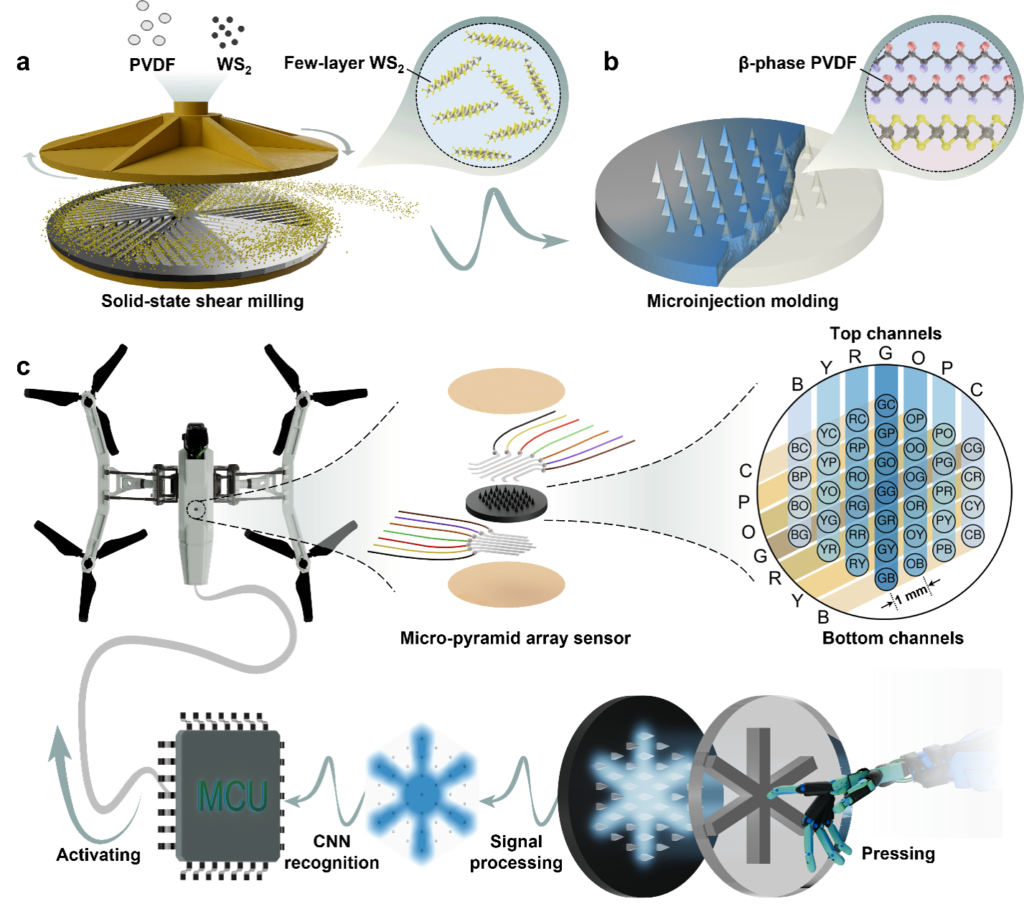
In a recently published research paper in Composites Part B: Engineering Mr. Xinwen Zhou, Dr. Haoran Pei, Mr. Zhicheng Li, Mr. Haihao He, and led by Professor Yinghong Chen from State Key Laboratory of Advanced Polymer Materials set at Sichuan University and also Polymer Research Institute of Sichuan University developed a PVDF/WS2 nanosheet micro-pyramid array sensor fabricated through solid-state shear milling followed by microinjection molding. Its technical distinction lies in using shear processing both to exfoliate and activate WS2 within PVDF and to orient the resulting nanocomposite during formation of the microstructured sensing array. A signal-processing and convolutional-neural-network workflow translated the array outputs into pressure maps for letter recognition.
The research team first mixed bulk WS2 with PVDF and subjected to solid-state shear milling and this process imposed intense three-dimensional shear fields that exfoliated the original particles into few-layer nanosheets and, in part, smaller quantum dots. Electron microscopy showed that most nanosheets contained fewer than ten layers and were oriented along the polymer-flow direction. The authors performed X-ray photoelectron spectroscopy and identified a C–S signal after milling, indicating mechanochemically induced bonding between PVDF chains and the sulfur-containing WS2 surface. Molecular-dynamics simulations complemented this observation by showing progressive adsorption of PVDF chains toward the nanosheets through electrostatic interaction. That association encouraged closer interfacial contact and favored the transition of PVDF chains toward the all-trans configuration characteristic of the β-phase. Temperature-programmed infrared measurements supported this interpretation: the composite containing 1 wt% WS2 displayed a higher β-phase content during cooling than neat PVDF.
Milling initially promoted crystallization, but excessively prolonged treatment reduced crystallinity because repeated shear could disrupt molecular regularity and introduce imperfect crystalline regions. Likewise, increasing WS2 content provided additional nucleation sites, yet excessive nanosheet loading led to aggregation and reduced molecular orientation. The 1 wt% composition, designated MWP1, emerged as the most structurally favorable balance. It contained well-exfoliated nanosheets, showed strong orientation along the flow direction, and developed a compact shish-kebab crystal morphology with long shish structures and relatively small lateral lamellar dimensions.
The authors also found using finite-element analysis that the polymer melt experienced very high shear rates during filling, while rapid cooling limited subsequent relaxation. Under these conditions, PVDF chains stretched along the melt-flow direction and formed oriented shish-kebab crystals. The design choice of combining a low WS2 loading with high-shear microinjection molding therefore had a clear scientific consequence: exfoliated nanosheets could interact with and orient PVDF chains without the aggregation that would interfere with flow-induced crystal organization. The resulting micro-pyramid array consisted of regularly formed pyramids spaced 1 mm apart across a 10 mm sensing area. The team showed using simulations that taller pyramids produced greater local strain and electrical potential under compression, which guided the selection of the array geometry. Moreover, they performed piezo-response force microscopy which revealed striped regions of high piezoelectric activity aligned with the flow direction and this is consistent with oriented β-phase crystals and WS2 nanosheets. For MWP1, the local longitudinal piezoelectric coefficient measured by piezo-response force microscopy was −24.9 pm/V.
Under periodic mechanical impact, the 1 wt% WS2 formulation produced the strongest piezoelectric response, reaching an open-circuit voltage of 15.2 V. The sensor achieved a sensitivity of 128 mV/kPa below 10 N, placing its strongest response in the low-force range associated with light pressing. Sensitivity declined at higher loads as deformation of the pyramids reduced their effective height and increased stiffness. Stable output was maintained over 4000 impact cycles. Fourteen conductive channels addressed 37 sensing units through intersecting row and column connections. Signals produced by miniature “S,” “C,” and “U” molds were filtered, subjected to peak extraction, interpolated into two-dimensional pressure maps, and analyzed with a LeNet-5 convolutional neural network. The trained network reached 100% classification accuracy for the three tested letter patterns.
The PVDF/WS2 micro-pyramid array developed in this study by Professor Yinghong Chen and colleagues is suited to interfaces that must detect light contact, resolve its location, and convert pressure patterns into control signals. Its strongest sensitivity occurs below 10 N, making it relevant to finger pressing and tactile interaction. Spatially differentiated piezoelectric signals allow the array to operate as an active tactile interface rather than a single-point pressure switch. One direct application proposed by the authors is secure authentication for intelligent electronic devices. The sensor array can translate a prescribed pressing pattern into a distributed electrical signature, which is then processed and compared with patterns stored in a microcontroller unit. The study discusses possible integration with unmanned aerial vehicles, quadruped robots, humanoid robots, laptops, and related smart devices. By assigning active and inactive states to sensing units through an intensity threshold, the authors calculate a large theoretical combination space within a compact sensing area. They presented this security configuration as a conceptual design, but it establishes a clear engineering direction for compact tactile password systems.
Robotic tactile sensing represents a second application area of Professor Yinghong Chen and team work. A micro-pyramid array could be incorporated into a robotic finger, gripper surface, or human-operated robot interface where light pressing must be detected with positional detail. The individual sensing units generate independent signals, allowing the system to reconstruct contact distributions rather than only measuring total force. Combined with filtering, interpolation, and convolutional-neural-network classification, this capability could support the interpretation of deliberately applied shapes or control patterns. The demonstrated recognition of three molded letters illustrates the underlying principle: localized deformation of the array becomes a pressure map that can be identified computationally. The authors also connect the sensor’s low-pressure response and small size to wearable electronics and physiological monitoring. Signals from arterial pulse waves, respiration, and skin-contact events fall within the type of mechanical input the device is intended to detect. In such settings, the flexibility of the PVDF-based structure and its piezoelectric operation could permit sensing without an external power supply at the point of measurement. A further practical role lies in low-level energy harvesting. Under repeated impacts, the array charged a capacitor through a bridge rectifier, reaching 1.4 V within 100 seconds at 5 Hz. This does not replace the sensor’s primary role in tactile recognition, but it shows that the same mechanical events used for sensing can also provide a small electrical output. In integrated intelligent systems, that dual function may be useful where pressure sensing, pattern recognition, and limited self-powered operation are desired within a single flexible component.


Reference
Xinwen Zhou, Haoran Pei, Zhicheng Li, Haihao He, Yinghong Chen, A piezoelectric micro-pyramid array sensor based on PVDF/WS2 nanosheets for high-precision deep learning-assisted pattern recognition, Composites Part B: Engineering, Volume 310, 2026, 113137,
Go to Journal of Composites Part B: Engineering