Advances in Engineering Advances in Engineering features breaking research judged by Advances in Engineering advisory team to be of key importance in the Engineering field. Papers are selected from over 10,000 published each week from most peer reviewed journals.

Significance
Fully mechanized top-coal caving (FMTC) is critical for underground coal mining because they enable efficient extraction of thick seams with minimal roadway development. China has become a global leader in applying this method, which offers high recovery rates and low production costs. However, the stability of the overburden and roadway support in deep-buried seams is still a challenge. When coal pillars between adjacent working faces are set without proper consideration of geological mechanics, they can either waste resources if oversized or induce severe ground pressure and roadway deformation if undersized. Striking the balance between safety and efficiency has thus emerged as one of the central problems in modern deep coal mining. In deep strata such as those of the Dongpo Coal Mine, the overburden bears enormous loads. Improperly designed sectional coal pillars (CPs) in FMTC faces amplify stress concentration, trigger plastic deformation, and often lead to roof collapse or roadway instability. Despite extensive theoretical and numerical studies, many operations still rely on empirical experience to determine pillar widths, generally choosing broad pillars (20–40 m) to guarantee safety. This conservative practice, however, sacrifices considerable recoverable coal. Moreover, previous research seldom integrates aspect ratio effects and instability probability—two factors crucial to describing the nonlinear mechanical behavior of pillars subjected to high stress and repeated mining disturbance. To this account, new research paper published in International Journal of Energy Research and led by Dr. Junwu Du, Dr. Jinhui Tian, Dr. Hai Xiao, Yong Liu, Dr. Chunjie Li from the Xi’an University of Science and Technology, the researchers developed two complementary models: a physical similarity simulation capturing overburden collapse behavior and a FLAC3D numerical model describing stress and plastic-zone evolution within sectional coal pillars.
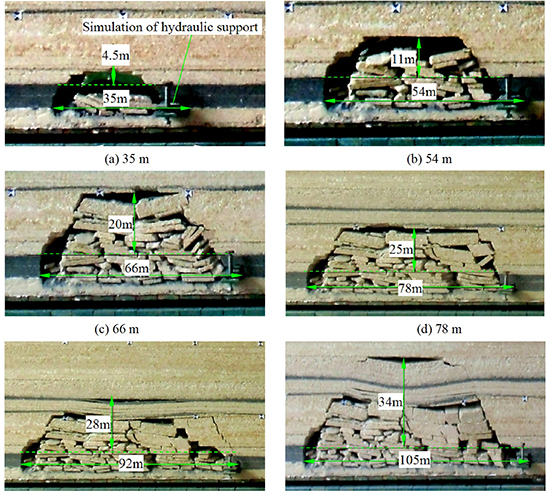
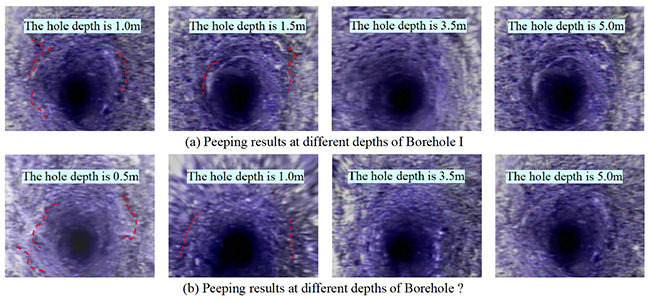
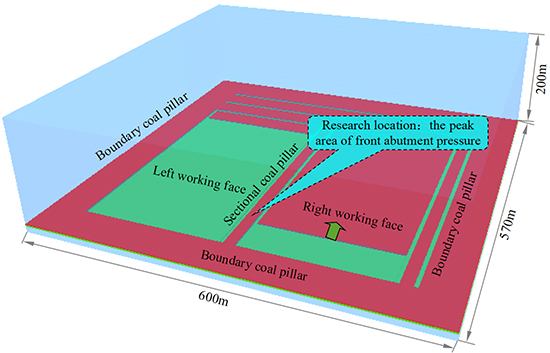
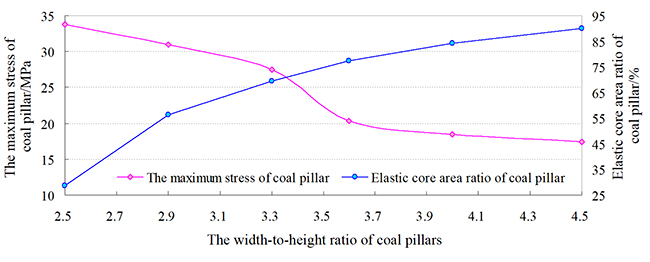
the research team began with uniaxial compression, tensile, and shear tests on samples extracted from the 4-1 coal seam and its surrounding strata to recreate the complex behavior of deep-buried FMTC faces. The coal exhibited an average compressive strength of 15.8 MPa and a cohesion of 2.2 MPa, markedly weaker than the coarse-grained sandstone roof, which reached 34.2 MPa in compression. These contrasts justified the frequent occurrence of roof failure and guided the scaling laws for the subsequent similarity simulation. They constructed a physical model, 3 m × 1.46 m × 0.2 m in dimension using sand, gypsum, fly ash, and lithopone to mimic mechanical behavior under gravitational similarity ratios. Iron bricks simulated overburden pressure equivalent to a 350 m burial depth. During staged excavation of the left working face, wireless pressure sensors and digital imaging captured stress evolution and roof caving. The immediate roof collapsed when the face advanced 35 m, and the first main-roof fall occurred at 54 m. Thereafter, periodic caving ensued every 12–14 m, producing progressively higher collapse zones up to 34 m. Support loads peaked near 8100 kN without notable dynamic shocks—an indicator of steady ground control. They performed subsequent tests and found reduced the pillar width sequentially from 25 m to 14 m while monitoring stress responses. When narrowed to 21 m, stress rose modestly to 19.5 MPa and the pillar remained intact. At 18 m, the stress increased to 22–23 MPa with only local spalling. Below 16 m, stresses exceeded 26 MPa, sidewalls fractured, and full instability occurred at 14 m, where stress reached 32 MPa. These results demonstrated a critical width threshold near 18 m beyond which the structural integrity of the coal pillar sharply deteriorates. The authors used complementary FLAC3D simulations to reproduce these transitions in stress and plastic zone development. For wide pillars (20–25 m), stress distributions were “saddle-shaped,” signifying a central elastic core 15–22 m wide. At 18 m, this core shrank to 12.5 m and localized failure appeared, while narrower pillars exhibited overlapping plastic zones and “arch-shaped” stress contours—hallmarks of imminent collapse. Quantitative analysis linked width-to-height ratio directly with stability: when this ratio exceeded 3.3 (≈ 18 m / 5.5 m), the elastic core area surpassed 69%, and the safety factor fs was ≥ 1.1, corresponding to an instability probability below 45%. Field validation on the 406 FMTC face confirmed that a 19 m pillar maintained roadway convergence within 1% and roof-to-floor displacement under 25 mm, verifying the predictive accuracy of the model.
In conclusion, the research work of Dr. Junwu Du and colleagues developed new models that successfully quantified how the width-to-height ratio governs stability and established a probabilistic criterion linking safety factor to instability risk. Their integrated framework identified 18 m as the critical width ensuring both mechanical stability and economic efficiency. This dual-model approach provides a robust scientific basis for designing sectional pillars in deep-buried FMTC mining faces. This study provides one of the most coherent frameworks yet for understanding and controlling overburden behavior in deep-buried FMTC operations. By unifying physical experiments, numerical modeling, and field verification, Du et al. bridge the traditional gap between empirical mine design and mechanics-based optimization. The discovery of a distinct turning point at 18 m in sectional pillar width transforms what had long been a matter of cautious guesswork into a quantifiable design limit. Beyond Dongpo Mine, the criterion defined by the safety factor–instability probability relationship can serve as a universal guideline for similar high-stress mining environments across China’s western coalfields. The implications in engineering is vast and for instance, reducing the pillar width from 25 m to 19 m without compromising safety saved more than 30,000 tons of recoverable coal per face, prolonging the mine’s service life and improving profitability. The approach also reduces roadway deformation, mitigates dynamic pressure risks, and enhances predictability in ground-control planning. They the first to introduce the idea that stability should be evaluated by by the evolving proportion of elastic core within the pillar—a parameter sensitive to geometry, load path, and mining sequence. Moreover, the integration of width-to-height ratio effects with instability probability represents a methodological advance. It quantifies the nonlinear feedback between stress concentration and plastic expansion, revealing how incremental reductions in width can lead to abrupt mechanical failure once the elastic core collapses below a critical fraction. The derived safety threshold (fs ≥ 1.1) and corresponding probability (< 45%) offer a rational, risk-based standard for pillar design. This aligns with broader movements in rock-mechanics research toward probabilistic rather than purely deterministic safety evaluation. The study also highlights the necessity of considering overburden caving morphology as an integral variable in pillar optimization. The periodic weighting patterns and their average intervals of ≈ 12.8 m observed in the paper can inform numerical calibration for other thick-seam mines. Indeed, their results enable a more accurate prediction of stress redistribution and potential roof collapse zones, which will allow mining engineers to tailor support systems accordingly. In a nutshell, because deep mining will remain essential for China’s energy transition in the coming decades, and improving recovery rates while safeguarding underground workers is imperative. Du and colleagues’ new methodology offers a replicable model for reconciling safety with efficiency in complex geological settings.

Reference
Du, Junwu & Tian, Jinhui & Xiao, Hai & Liu, Yong & Li, Chunjie. (2025). Investigation of Overburden Collapse Behavior and Optimization of Sectional Coal Pillar Widths in Deep‐Buried Fully‐Mechanized Top‐Coal Caving Mining Faces. International Journal of Energy Research. 2025. 10.1155/er/6349330.