 Advances in Engineering Advances in Engineering features breaking research judged by Advances in Engineering advisory team to be of key importance in the Engineering field. Papers are selected from over 10,000 published each week from most peer reviewed journals.

Significance
The growing use of composite curved beams in engineering reflects a broader shift toward structural systems that are both lighter and more tailored to complex design requirements. These beams, assembled from layers of distinct materials—such as reinforced concrete bonded to steel or fiber-reinforced polymers laminated onto timber—allow engineers to optimize for strength, cost, and flexibility. However, as these systems become more prevalent, so too does the difficulty of modeling their true mechanical behavior under realistic conditions. For instance, one persistent, and often underestimated, complication is the interface between layers which brings discontinuity for stresses and is rarely flawless with slippage occurring under load. This partial interaction between layers doesn’t just affect stiffness but it shifts how forces flow through the structure, changing stress distributions in ways that aren’t predicted by traditional models. Besides, these laminated structures generate complex interface continuity requirements for both displacements and stresses. For short beams or simple loading, these discrepancies might be minor, however, in longer spans or curved structures, the errors become significant. Most widely used straight beam theories including refined models like Timoshenko’s and Zigzag’s—aren’t equipped to handle these effects properly and they often rely on displacement-based assumptions that smooth over the very phenomena engineers need to account for, like solely displacement continuity or perfect bonding, however, these assumptions come at the cost of accuracy, especially for modeling vibration, fatigue, or long-term deformation. New research paper published in Engineering Structures and conducted by Dr. Jiaqing Jiang, Professor Rongqiao Xu, and Professor Weiqiu Chen from the Zhejiang University, the researchers developed a two-dimensional state-space elasticity-based model that accurately captures the mechanical behavior for both displacements and stresses of layered composite beams with imperfect interfacial bonding, without relying on classical simplifying assumptions like perfect adhesion or uniform shear deformation. Their framework integrates advanced numerical techniques, such as the differential quadrature method, to simulate complex loading scenarios—including axial forces, dynamic excitations, and varying connector stiffness—within a unified and computationally efficient formulation.
To evaluate how layered composite curved beam respond under realistic mechanical conditions, the research team turned to advanced numerical methods. Rather than relying on idealized assumptions, they built models that allowed for nuanced interactions between layers, capturing the effects of interfacial slip, axial force, and time-dependent loading with a level of detail not often found in traditional beam analyses. By adjusting the stiffness at the interface—from perfectly bonded to nearly free-slipping—they could systematically explore how this single variable shaped the beam’s structural behavior.
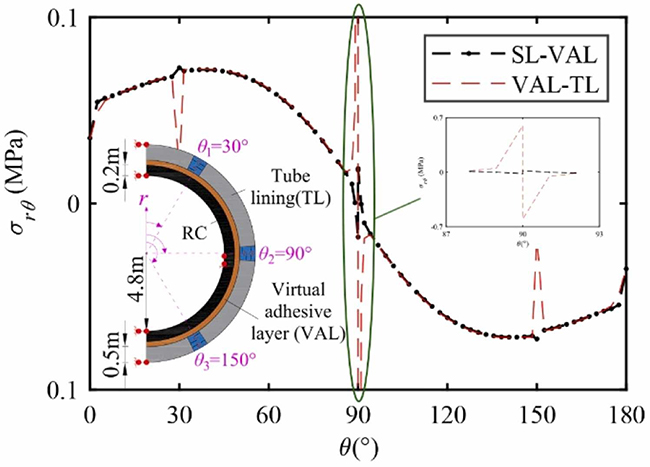
In their studies, they modeled a simply supported curved beam composed of two layers and subjected it to uniform static loading. As the interface was softened step by step, a clear trend emerged: the deflection increased notably, and the internal shear distribution began to shift in unexpected ways. These weren’t minor deviations. Compared to classical predictions, the altered load paths and redistribution of internal forces pointed to a deeper structural sensitivity to interfacial conditions. It became apparent that slip couldn’t be treated as a secondary factor—it was central to the beam’s mechanical identity. Next, they introduced surrounding loads to investigate how these imperfect interfaces might affect both displacement and stress distributions.
In conclusion, what makes the new study by Professor Weiqiu Chen and his colleagues stand out is its deliberate move away from the traditional beam theories that, for decades, have shaped how engineers model layered structures. The team rather than treating interfacial slip as a secondary or negligible effect, they placed it at the center of their analysis and this shift matters because those interfaces—especially when they begin to degrade—can have a disproportionate impact on how a structure performs over time. When you’re dealing with something like a bridge deck or a composite aerospace panel, even a small oversight in modeling interlayer behavior can lead to design inefficiencies—or, in the worst case, structural failure. We believe what’s particularly valuable about their approach is its flexibility. A lot of existing models tend to be quite narrow—they’re fine-tuned for specific geometries or ideal boundary conditions, which limits their real-world usefulness. What Jiang, Xu, and Chen developed is something different: a general framework that can adapt to a wide range of design conditions without losing fidelity. It accommodates axial loads, dynamic forces, and localized stiffness variations—all within a consistent and physically grounded formulation. That kind of generality is surprisingly rare, and it gives engineers a tool they can actually use across multiple scenarios rather than starting from scratch each time.
Additionally perhaps most importantly, this study challenges the often artificial boundary between theory and application. It shows that it’s possible to respect the complexity of elasticity theory while still delivering a model that is computationally practical. There’s something admirable about that balance—rigorous in its mechanics, but clearly informed by engineering realities. It’s a contribution that feels both technically solid and genuinely useful.

Reference
Jiaqing Jiang, Rongqiao Xu, Weiqiu Chen, Two-dimensional analysis of composite linings using mixed finite element and DQM, Engineering Structures, Volume 322, Part A, 2025, 119077,