 Advances in Engineering Advances in Engineering features breaking research judged by Advances in Engineering advisory team to be of key importance in the Engineering field. Papers are selected from over 10,000 published each week from most peer reviewed journals.

Significance Statement
Piezoelectric materials have been adopted for various applications owing to their high material linearity, low power consumption, and fast response when induced by external forces. Piezoelectric materials are able to respond easily to changing environment and control structural deformation and this has led to the emergence of new aerospace structures such as morphine airplanes. Bounded piezoceramic actuators are among these piezoelectric materials that have been applied for shape control of online monitoring systems.
Piezoceramics can also be embedded in laminated composite elements to enhance structural stiffness. Laminated composite structures are widely being used in mechanical, and structural, automotive and aerospace engineering applications. Composite structures have high stiffness and high strength to weight ratio. Piezoelectric materials can be integrated with laminated composite structures to offer smart-intelligent systems.
Most research works on smart piezocomposite laminates with complex boundary conditions and loads are mainly focused on numerical as well as experimental approaches. A number of studies have been done on clamped and simply supported beams and plates, and unattached laminates, without necessarily considering the influence of several parameters such as thickness, boundary conditions, and residual thermal stresses.
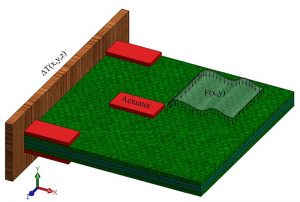
While smart cantilever composite plates are important mechanical component, their multiscale solutions adopted for their analytical evaluation are complex and necessitate characteristic functions. Dr. Scott Gohery and his team at Victoria University in Australia developed an exact analytical solution for the shape deformation control of smart cantilever piezo composite hybrid plates and beams under thermo-electro-mechanical loads. Their approach was based on double integral multivariable Fourier transformation approach in conjunction with discretized higher order partial differential unit step function equations. Their work is now published in Composite Structures.
The authors adopted an intelligent piezo composite hybrid laminate with various piezoelectric layers incorporated in the laminate. They made some initial assumptions for mathematical modeling. They assumed that the matrix and the fibers were perfectly made with no voids or impurities, and behaved linearly within the elastic domain. For smart part of the selected laminates, the researchers adopted the linear piezoelectricity theory making assumptions that, strain-electricity field varied linearly and that the piezoelectric actuators were polarized through thickness (Z direction).
The proposed method proved to be suited for long and wide plates with actuators located far from fixed ends. The exact analytical solution did not require trial deflection function to be made for shape control performance. They observed that high electrical voltage led to greater actuation and more shape control performance. Thicker actuators had low actuation power owing to low electrical field generated through the actuators thickness while enhancing stiffness against flexural deformation. Therefore, choosing actuators and composite laminates with suitable sizes and elastic/electrical properties would enable optimal shape control.
The researchers also found that actuator layers had higher actuation power than actuator patches. Patches closer to fixed end had more optimal shape control performance and their capacity to resist shape deformation reduced considerably as positions far from fixed supports. From their findings, the authors found that bounded actuator patches and layers were better choices for optimal shape control for smart laminated composite structures as opposed to embedded as well as core actuators.



Reference
Scott Gohery, S. Sharifi, and Zora Vrcelj. New explicit solution for static shape control of smart laminated cantilever piezo-composite-hybrid plates/beams under thermo-electro-mechanical loads using piezoelectric actuators. Composite Structures, volume 145 (2016) pages 89–112.
Go To Composite Structures