Advances in Engineering Advances in Engineering features breaking research judged by Advances in Engineering advisory team to be of key importance in the Engineering field. Papers are selected from over 10,000 published each week from most peer reviewed journals.

Significance Statement
Natural gas is the cleaner alternative among fossil fuels, all credit granted to its characteristic minimal emission of greenhouse gases. The ever increasing demand for this rare resource has seen its consumption nearly double worldwide. Consequently, intrinsic critical lifeline networks that supply the precious commodity have posed a challenge mainly in design stages. The analysis of a distribution network and the computation of the system’s operational state in terms of node pressures and edge flows are critical. Such analysis also represents the basis for most scopes involving natural gas networks irrespective of their size. A limited knowledge base exists that provides a detailed description with reference to the whole flow analysis formulation and its practical applicability of the flow computation in natural gas systems. More so, inherent limitations of the existing flow analysis methods for modern natural gas systems prompt further studies.
Recently, research conducted by Francesco Cavalieri at Sapienza – University of Rome proposed a study that sheds light into the novel complete steady-state flow formulation, up to the governing nonlinear system of equations and the expression of the error function that can be minimized so as to find the solution. The researcher, in his current work, aimed at providing a complete formulation of the steady-state flow analysis of a gas distribution network. His research work is now published in Energy.
From his study, it is crystal clear that the analysis of a gas network cannot rely on simple connectivity methods, given the limited tolerance on both quantity and quality of gas pressures that are required to maintain serviceability to end-users for the well-being of the community at large. Herein, he began by identifying the various taxonomies of gas distribution networks that range from national systems to local conveyance systems that lead to end-users. He then presented the steady-state flow formulation of a distribution system sequentially. The formulation was implemented and applied to several samples of increasing complexity in order to validate it, including a non-trivial realistic gas network.
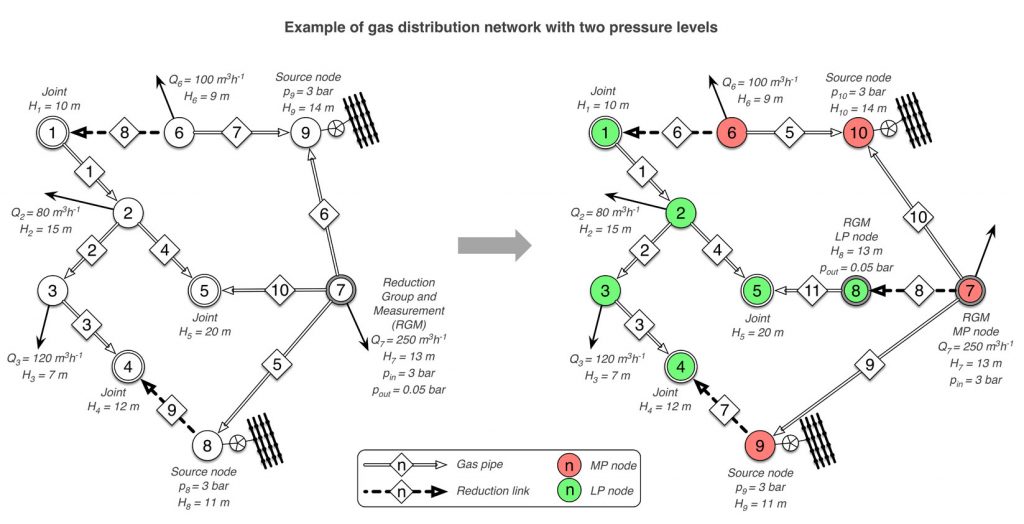
By carrying out his formulation, the author was able to accommodate for computation of gas flows in the presence of multiple pressure levels. The researcher also observed that by implementing the algorithm within an open source simulation tool for civil infrastructures, the ability of the formulation to handle system interdependencies was proven and validated.
The author of this paper has been able to achieve what no other researcher has done before him in this field. To begin with, he has been able to present, together in one organic document, several relevant features that were previously spread over different papers in the existing literature. Such features include the correction for elevation change in pipes and the load reduction according to pressure (pressure-driven formulation). More so, the developed software has applications in risk assessment for a real network while still incorporating the interactions with other infrastructural systems.

Reference
Francesco Cavalieri. Steady-state flow computation in gas distribution networks with multiple pressure levels. Energy, volume 121 (2017) pages 781-791.
Go To Energy