Advances in Engineering Advances in Engineering features breaking research judged by Advances in Engineering advisory team to be of key importance in the Engineering field. Papers are selected from over 10,000 published each week from most peer reviewed journals.

Significance
The rising global commitment to electric vehicles (EVs) has ushered in a new era of demand for lithium, the elemental cornerstone of modern battery technology. As nations scramble to decarbonize transportation and meet aggressive climate targets, lithium-ion batteries have emerged as the backbone of this transition. Yet, beneath the optimism lies a pressing dilemma: where will all the lithium come from, and how fast can we access it?
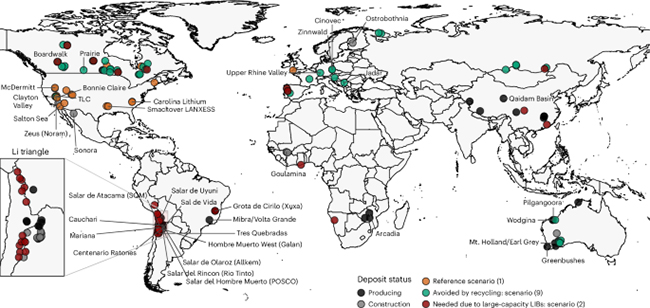
In the past, lithium was a niche commodity, with its uses largely confined to pharmaceuticals, ceramics, and small electronics. A handful of mines met global needs, and supply chains were predictable. That stability shattered as EV adoption surged. Between 2022 and 2023 alone, global demand for lithium skyrocketed by 30%, a trend that shows no sign of slowing. This dramatic shift has overwhelmed existing infrastructure and raised urgent questions about long-term supply security, sustainability, and geopolitical vulnerability. For policymakers and manufacturers alike, it’s not simply a matter of whether there’s enough lithium in the earth’s crust — there is. The deeper issue is how quickly and responsibly we can extract it. New mines, especially those involving complex environmental review processes and community engagement, often take a decade or more to come online. Add to this the billion-dollar costs and the growing resistance from local populations concerned about ecological damage, and the challenge becomes even more formidable. The clock is ticking, and the window for scalable, ethical expansion is narrow. In light of these dynamics, researchers from the University of California, Davis, led by environmental engineering professor Alissa Kendall and graduate student Pablo Busch, sought to address the blind spot in conventional lithium forecasts. Their study, published in Nature Sustainability, goes beyond cumulative resource estimation. Instead, it integrates time-based modeling and deposit-level data to simulate how quickly new lithium supply can be deployed in different future scenarios.
One of the key insights from their research is that recycling — though currently costlier than traditional mining — could offer a powerful lever for stabilizing supply. If scaled effectively, recycling old batteries could offset the need for dozens of new mines, reducing environmental damage and easing geopolitical tensions tied to raw material control. However, the benefits of recycling are not immediate; lithium must first flow through the system before it can be recaptured. This creates a critical transition period in the 2030s when both new mines and recycled material must coexist to meet demand. Ultimately, the study was driven by a need to inform smarter policies and industrial strategies. By modeling realistic timelines, geographic constraints, and material flow, the researchers hope to guide governments and industries toward a more sustainable and responsive lithium supply chain—one that can support EV growth without accelerating environmental harm or exacerbating global inequalities.
The significance of this study lies in its timely response to one of the most urgent challenges in the clean energy transition: securing a sustainable and resilient supply of lithium for electric vehicle batteries. As countries race to phase out combustion engines, the demand for lithium has grown with startling speed—outpacing the ability of traditional supply chains to adapt. Rather than simply asking whether the earth holds enough lithium, this research asks the more practical and time-sensitive question: can we extract it fast enough, and at what cost to society and the environment?
What makes this work stand out is its nuanced consideration of both the temporal and logistical aspects of lithium availability. By shifting the focus from total reserves to the rate and feasibility of new mine openings, the study captures a more realistic and actionable view of the road ahead. It acknowledges that even a theoretically abundant resource becomes functionally scarce if policy delays, local opposition, or technical hurdles slow production. This modeling approach adds an essential layer of realism to long-term planning efforts. Perhaps the most compelling implication of the study is the transformative role that battery recycling could play. Far from being a peripheral solution, recycling emerges as a critical mechanism to stabilize future supply, reduce the pressure on new mining projects, and alleviate geopolitical risk. Yet, the authors make it clear that recycling is not a magic bullet. It depends on a steady input of used batteries, robust policy frameworks, and early investments in recovery infrastructure. Still, its impact—particularly by the mid-2030s—could dramatically reduce the number of new mines needed, easing environmental and social burdens.
The study also highlights the importance of designing policies that influence demand itself, such as encouraging smaller battery sizes and expanding charging networks to reduce consumer “range anxiety.” These measures may sound subtle, but they have outsized effects on material use, and thus on the urgency of expanding extraction. In practical terms, this research offers a roadmap for decision-makers, industry leaders, and environmental advocates. It provides not just projections but tangible levers—recycling, efficiency standards, and smart regulation—that can shape a more equitable and sustainable lithium future. By integrating engineering insight with policy foresight, the authors have laid the groundwork for a lithium economy that aligns with, rather than undermines, the goals of clean mobility. In an era when technological optimism often collides with environmental reality, this study offers a rare blend of urgency, pragmatism, and hope.


Reference
P. Busch, Y. Chen, P. Ogbonna, A. Kendall. Effects of demand and recycling on the when and where of lithium extraction. Nature Sustainability, 2025; DOI: 10.1038/s41893-025-01561-5