Advances in Engineering Advances in Engineering features breaking research judged by Advances in Engineering advisory team to be of key importance in the Engineering field. Papers are selected from over 10,000 published each week from most peer reviewed journals.

Significance
The virtual response of a bridge subjected to traffic does not evolve in neatly bounded intervals; it unfolds continuously while measurement systems report loads only at discrete instants. That mismatch between physical continuity and digital sampling creates a fundamental tension in real-time bridge monitoring. When traffic-induced forces arrive as asynchronous data streams shaped by camera frame rates, weigh-in-motion sensors, and communication latency, standard structural solvers, designed for batch inputs or short, uniform time steps, struggle to maintain synchronization. The difficulty is not simply computational speed but how to reconcile unbounded, stochastic load evolution with a dynamic model that must update immediately and indefinitely. Within structural health monitoring, digital twin frameworks have been promoted as a way to bridge this divide. However, most implementations still depend either on inverse identification of loads from measured responses or on quasi-static approximations of traffic effects. Both strategies introduce delays or ill-conditioned estimation problems. Even when traffic loads are observed directly, they are often injected into finite element models in discrete batches, implicitly assuming smooth or constant evolution between updates. That assumption becomes fragile when vehicles accelerate, decelerate, or interact across spans. A true real-time mirror requires the digital twin to evolve at the same cadence as the measured load stream, not retrospectively.
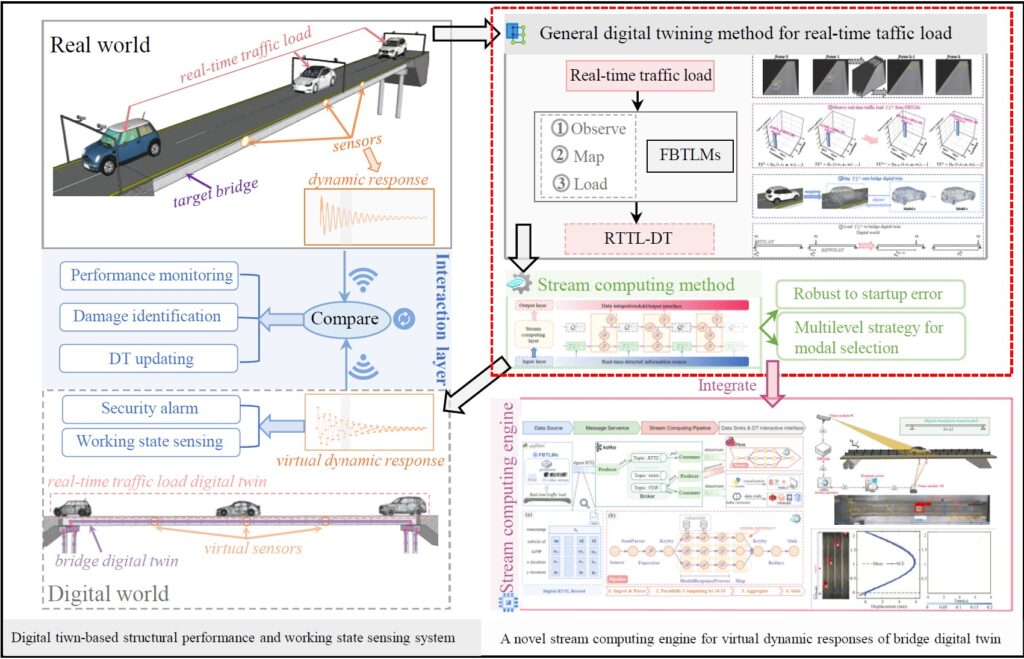
A recent research paper published in Mechanical Systems and Signal Processing and conducted by Professor Danhui Dan, PhD candidate Yuhang Chen, Professor Fangyuan Li from the School of Civil Engineering at Tongji University working with Dr. Liangfu Ge from Western University, they developed an online stream computing engine that integrates real-time traffic load monitoring with recursive modal dynamic response computation. The framework converts discrete traffic observations into streaming modal forces and updates bridge states through precomputed transition operators. It embeds structural solvers within distributed stream-processing infrastructure to achieve near real-time synchronization. Unlike prior batch or quasi-static approaches, it treats virtual dynamic response as a continuous, stateful streaming process.
if traffic load itself behaves as a stream, then the structural solver must also operate as a stream processor. This reframes virtual dynamic response not as a sequence of batch problems, but as a recursive state evolution driven by incoming load events. The intellectual motivation follows naturally. If modal dynamics can be recast into a form compatible with streaming operators, then real-time interaction between physical bridge and digital twin becomes mathematically tractable. That shift in viewpoint matters because it relocates the bottleneck. The obstacle is no longer inverse load identification or static simplification, but the construction of a solver that tolerates ultra-long computational intervals, incomplete knowledge between sampling points, and indefinite execution time. In other words, the authors treat streaming as a structural constraint rather than a software convenience and that decision shapes everything that follows.
The research team first built a full-bridge traffic load monitoring system that fused machine vision with weigh-in-motion data to produce time-stamped axle loads and vehicle positions. They did not treat these observations as static snapshots. Instead, they encoded them as sequential traffic-load stream records, which they then mapped into a digital twin representation. By doing so, they ensured that the input to the bridge model arrived as temporally ordered load frames, each associated with evolving spatial coordinates.
To compute the virtual dynamic response, the authors reformulated the beam equation of motion in modal coordinates and truncated it to lower-order modes, recognizing that vehicle-induced dynamics primarily excite these components. They derived independent second-order modal equations and then constructed a single-step recursive update using Duhamel’s integral. The investigators compared two approximations for load evolution within each computational interval. A zero-order approximation assumed constant modal force, reducing cost but ignoring spatial evolution. A first-order approximation introduced linear interpolation between adjacent load frames. They adopted the latter and accepted a modest increase in complexity in exchange for greater fidelity during long sampling intervals. The resulting stream computing operator updated modal states through precomputed transition matrices. Because damping rendered the spectral radius below unity, the researchers demonstrated that errors in initial conditions decayed over time. That property allowed arbitrary startup without exact knowledge of the initial dynamic state an understated but practical advantage for field deployment.
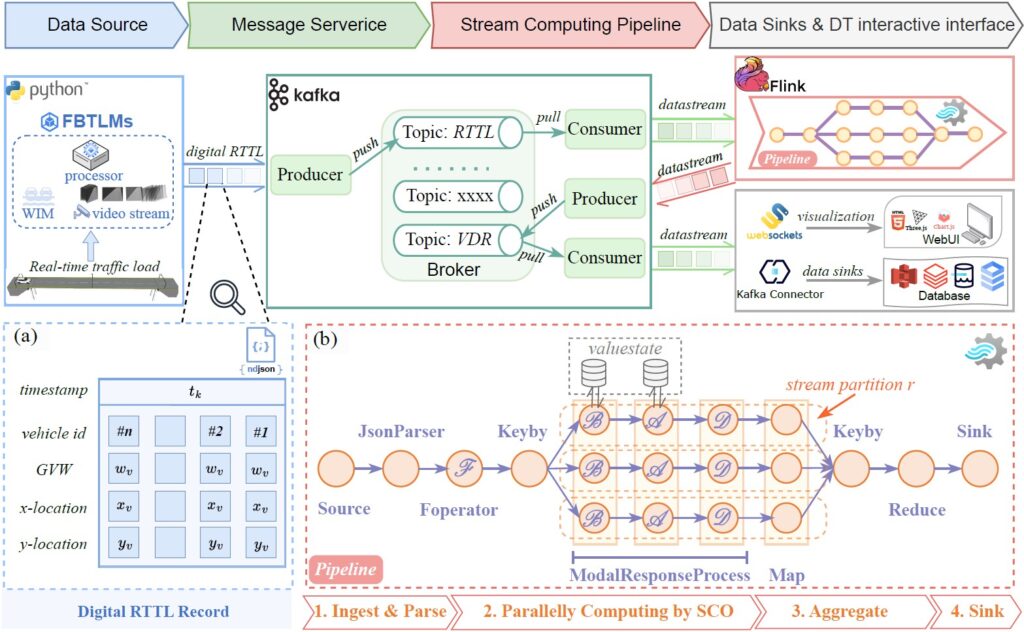
They successfully validated the method numerically against finite element solutions and analytical moving-load results. Even under high-speed conditions where vehicle–bridge interaction becomes non-negligible, the stream-based approach tracked displacement and velocity with acceptable deviation. When compared with discrete precision integration and Newmark-β schemes reformulated in stream form, their algorithm maintained accuracy under extended computational intervals while preserving sub-millisecond per-frame computation time. Plus, in their experimental implementation, the team integrated Apache Kafka and Flink to build a fully operational streaming pipeline. Traffic-load data flowed in as live topics, modal states were updated in parallel, and virtual responses were emitted continuously for storage and visualization. What matters in their study is not just speed but the bridge model was woven into a data-stream environment, and allowed the digital twin to evolve alongside the physical structure instead of trailing behind it.
The larger contribution lies in reframing how dynamic response is computed. Instead of collecting traffic data and solving structural equations in batches, the authors treated load and response as coupled streams. Modal states updated recursively as new load frames arrived. That shift from retrospective calculation to concurrent evolution which changes the practical meaning of a digital twin. It also opens the door to event-triggered alerts, anomaly detection during unusual load sequences, and coordinated monitoring across bridge networks. None of this is automatic, of course. It depends on careful modal truncation, reliable sensing, and tolerable communication delays. Still, casting structural dynamics as a streaming problem redefines what real-time interaction can look like. For engineers, we believe this is more than a software refinement. Real-time bridge monitoring often falls short of its name. Loads are simplified, inferred indirectly, or processed after vehicles have already crossed and by showing that dominant modal dynamics can be updated efficiently and stably within extended sampling intervals, the study demonstrates that high-fidelity response does not require constant large-scale finite element recomputation. The result is a digital twin that behaves less like an offline analysis tool and more like an operational companion to the bridge. For those responsible for safety assessment and maintenance decisions, that distinction is practical, not theoretical.




Reference
Danhui Dan, Yuhang Chen, Liangfu Ge, Fangyuan Li, A novel stream computing engine for virtual dynamic response of bridge digital twins under real-time traffic load: Framework and experimental validation, Mechanical Systems and Signal Processing, Volume 239, 2025, 112978,
Go to Journal of Mechanical Systems and Signal Processing