 Advances in Engineering Advances in Engineering features breaking research judged by Advances in Engineering advisory team to be of key importance in the Engineering field. Papers are selected from over 10,000 published each week from most peer reviewed journals.

Significance
Fluid oscillators serve as self-excited devices that manipulate jet flow without moving parts. They rely on the Coandă effect—where a fluid jet attaches itself to a nearby surface—and have been used for decades in flow control, combustion stabilization, and aerodynamic modulation. Their appeal lies in their ability to periodically redirect a jet’s trajectory through internal feedback channels, creating oscillations that can enhance mixing, atomization, or cooling efficiency in systems ranging from industrial burners to aeroengine afterburners. Despite their long history, the relationship between geometric configuration and oscillation behavior remains incompletely understood, particularly when oscillators are subjected to the demanding thermal and flow environments characteristic of aviation propulsion systems. For combustion applications, oscillators offer the promise of replacing conventional nozzles with designs that promote finer atomization and more uniform fuel-air mixing which can directly affects emission control, combustion stability, and thermal management. However, in high-temperature afterburners, where kerosene often circulates under severe thermal loads, oxidation and coking become problematic. The accumulation of carbon deposits within the narrow channels of an oscillator can degrade flow stability and compromise the consistency of the oscillatory jet. One proposed solution has been to use premixed, vaporized fuel–air mixtures to shorten residence time and mitigate coking. However, this modification can introduce new aerodynamic challenges: higher velocities and reduced fluid viscosity alter the internal flow regime which makes the role of structural geometry even more pronounced.
Feedback channel length, mixing chamber configuration, and wall curvature has been examined before, however, we still don’t know how oscillator thickness and outlet throat width jointly influence performance. These dimensions can dictate the mass-flow distribution, pressure gradients, and oscillation frequency within the cavity. Better understanding is critical to design compact oscillators capable of delivering high-frequency, high-stability performance under high-Reynolds-number conditions. To this account, new research paper published in European Journal of Mechanics – B/Fluids and conducted by Dr. Wenhui Zhai and Professor Yuxin Fan from the Nanjing University of Aeronautics and Astronautics, the researchers developed two complementary models—a CFD-based URANS simulation model and a hot-wire anemometry experimental model—to analyze how oscillator geometry dictates flow and oscillation behavior. Their integrated framework captured the transition between mass-flow-driven and pressure-driven regimes in double-feedback channel oscillators. What distinguishes their work is the identification of a critical geometric ratio (thickness-to-throat width) that governs oscillation stability and frequency decay. This establishes a predictive foundation for designing high-performance fluid oscillators suitable for fuel atomization and flow control applications.
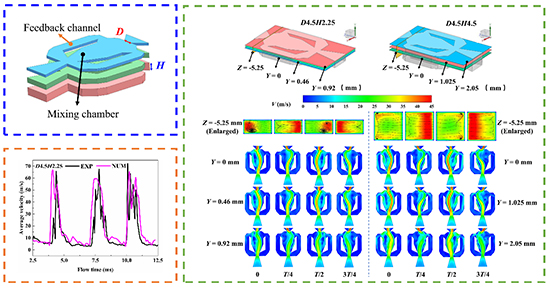
The researchers constructed a double-feedback fluid oscillator model using highly crystalline polypropylene with a dimensional tolerance of ±0.03 mm. The device’s outlet throat width (D) ranged from 2.25 to 4.5 mm, while its thickness (H) varied between 1.125 and 5.625 mm. Each configuration was denoted as D_H (e.g., D4.5H2.25). Air at 10 m/s served as the working medium, representing the vaporized fuel–air mixture expected in an afterburner context. Numerical simulations were performed using Fluent, employing a three-dimensional unsteady Reynolds-averaged Navier–Stokes (URANS) model with a shear stress transport (SST) k–ω turbulence closure. The spatial resolution was refined until grid independence was achieved at a 0.2 mm mesh scale. They used hot-wire anemometry to measure outlet velocities over time and to validate the computed oscillation frequencies and observed frequencies differed from simulations by less than 13%, a deviation largely attributed to slight inaccuracies in 3D printing and flow conditions.
The authors found that increasing the oscillator thickness produced stronger tangential velocities and larger outlet deflection angles, while simultaneously reducing the oscillation frequency. Conversely, widening the throat caused a loss in both velocity and frequency. The most striking discovery was the existence of a critical structural threshold: when the throat width equaled the oscillator thickness—forming a square outlet—the oscillation frequency reached its minimal stable value, and further geometric expansion had a diminishing effect. They also reported at small thicknesses (H < 3.375 mm), mass flow dominated the deflection of the jet within the mixing chamber. The fluid adhered closely to the Coandă surface, with oscillations driven mainly by momentum exchange between the feedback channels. As the thickness increased beyond 3.375 mm, pressure differentials between the two feedback channels became the primary driver of jet switching. Pressure contour maps showed the emergence of distinct low-pressure regions near the chamber walls, corresponding to the onset of pressure-dominated oscillation. The transition from mass-flow to pressure-governed behavior marked a change in the internal vortex dynamics and directly influenced the observed frequency decay. Furthermore, the velocity profiles evolved from single-peaked distributions in thinner oscillators to multi-peaked and eventually ring-shaped patterns as thickness increased. These transitions mirrored the gradual diffusion of airflow and the shift from confined to radially expansive oscillations. When the oscillator thickness reached 4.5 mm, the flow exhibited quasi-stable ring symmetry, indicating that structural enlargement could eventually saturate the oscillatory mechanism itself.
In conclusion, the study by Zhai and Fan provides an innovative quantitative mapping between the structural geometry of a fluid oscillator and its dynamic response which is essential for the rational design of advanced fuel delivery systems. The researchers successfully clarified why some oscillators lose stability or frequency uniformity at high flow rates by identifying the thickness-dependent transition from momentum-driven to pressure-driven oscillation. We believe these results has broad implications for aeronautical engineering especially where oscillating injection can enhance atomization without mechanical actuators. From a practical standpoint, the results suggest that an oscillator operating near the square-throat configuration (D ≈ H) offers an optimal trade-off between deflection amplitude and frequency stability. Below this regime, oscillations are energetic but prone to chaotic fluctuations; above it, pressure accumulation dampens the oscillation frequency, leading to diminished responsiveness. The identification of a critical thickness at 3.375 mm gives designers a tangible parameter for scaling oscillators across flow regimes or working media. It also introduces a physical rationale for tuning oscillators not solely by altering channel length or cavity width, but by balancing vertical confinement and lateral expansion. Moreover, we believe the new findings contribute to the general understanding of how three-dimensional confinement and geometric anisotropy shape unsteady jet dynamics—a topic relevant to cooling systems, chemical reactors, and flow-control devices. The discovery that pressure gradients can overtake mass flow as the dominant deflection mechanism under specific geometric constraints provides a new conceptual lens for designing oscillators that self-adapt to changing Reynolds numbers or fluid properties. In sustainable aviation, the new findings may support the development of cleaner, more efficient engines. A fluid oscillator capable of maintaining precise, self-regulated oscillations with vaporized fuel mixtures could reduce soot formation and thermal degradation while improving flame stability. The use of premixed fuel–air vapor mitigates coking, and the optimized geometry ensures uniform atomization at lower frequencies, thereby decreasing combustion noise and instability. In essence, we can say that Zhai and Fan’s work turned geometric proportion into a control variable, and transformed empirical design into predictive science.


Reference
Wenhui Zhai, Yuxin Fan, Influence of structural parameters on the performance of fluid oscillators, European Journal of Mechanics – B/Fluids, Volume 109, 2025, Pages 367-377,