 Advances in Engineering Advances in Engineering features breaking research judged by Advances in Engineering advisory team to be of key importance in the Engineering field. Papers are selected from over 10,000 published each week from most peer reviewed journals.

Significance
Urban rail systems are increasingly pushed underground, to avoid surface disruption and because space at grade is simply gone which means tunnels now have to live with ground that keeps moving long after construction ends. Cities affected by active ground fissures sit at the uncomfortable end of this spectrum. Movement is slow, often barely noticeable year to year, yet it never really stops. Over decades, that relative displacement between soil blocks feeds directly into the tunnel structure and the resulting demands bending in one segment, shear at another, sometimes a twist layered on top were not what most conventional tunnel designs had in mind. For metro systems expected to run daily for many decades, keeping shape, keeping water out, and keeping passengers safe under these conditions becomes a persistent concern rather than a one-time design check. Ground fissures also behave differently from hazards engineers are often more comfortable with. They are not sudden failures, and they do not announce themselves with a single dramatic event. Their origins lie in a mix of tectonic setting, groundwater extraction, and surface loading, which together create narrow zones of ongoing vertical offset and lateral extension. Rates may be small in millimeters per year is typical but the effects add up and once deformation accumulates, it does not reverse. For buried tunnels, this slow progression exposes a gap between how stable the ground is assumed to be during design and how it actually behaves over a service life measured in decades. Standard categories such as “weak” or “fractured” ground start to feel blunt when the ground itself is evolving. Construction method, structural form, and reinforcement strategy are often decided separately, guided by precedent or local comfort not by a shared mechanical picture of how fissure movement loads the lining. Shallow mining methods remain attractive because they allow access and repair, but they come with real costs: construction risk, surface settlement, and disruption that cities increasingly resist. Shield tunneling is efficient and cleaner at the surface, but questions linger about how much vertical dislocation joints and segments can tolerate over time. Added strengthening can help locally, but it tends to complicate waterproofing and pushes maintenance demands upward. None of these choices is neutral.
Part of the difficulty is that fissure activity is not uniform and not fixed. Also rates shift as groundwater use changes and as urban development spreads. Alignment matters too. A tunnel that crosses a fissure obliquely behaves very differently from one that meets it head-on, and depth only adds another layer of variation. Without an approach that links activity level, construction choice, structural response, and long-term performance, decisions tend to be reactive—adjusting after damage appears—rather than planned with the full life of the tunnel in mind. A recent new research paper published in Tunnelling and Underground Space Technology and conducted by Prof. Qiangbing Huang, Dr. Yuxuan Gou, and Prof. Jianbing Peng from the Department of Geological Engineering at Chang’an University, the researchers developed an integrated framework linking ground fissure activity classification with tunnel construction method and structural response. They established quantified influence ranges and fortification lengths for different tunnel forms based on observed deformation mechanisms. The work distinguished continuous and segmented linings in terms of damage distribution and joint behavior under cumulative dislocation. It provided engineering criteria for selecting and detailing metro tunnels that must operate within zones of long-term ground movement.
The research team first established that ground fissures in Xi’an impose three-dimensional deformation on shallow strata, dominated by vertical dislocation but accompanied by horizontal tension and torsion. This characterization mattered because it defined the loading environment imposed on tunnels buried beyond shallow depths, where vertical offset governs lining stress redistribution. To translate fissure behavior into engineering terms, the investigators classified fissure activity using surface deformation, structural damage, groundwater conditions, and measured displacement rates. This step linked geological process to design decision, since construction method selection depended directly on activity level. High-activity zones favored mining or cut-and-cover approaches, while low-activity and quasi-stable zones permitted shield tunneling. The classification therefore acted as a causal filter, preventing inappropriate construction choices rather than compensating for them afterward.
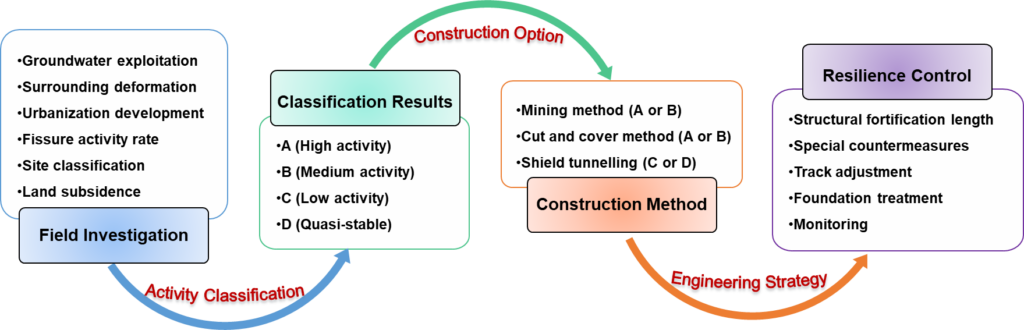
Fig. 1. Classification of ground fissure activity and disaster resilience prevention procedures for metro tunnels.
The authors performed mechanical analyses on two dominant tunnel forms: shallow-buried horseshoe tunnels and circular shield tunnels. For horseshoe tunnels, the study demonstrated that fissure dislocation induces longitudinal bending accompanied by tension on one side of the lining and compression on the other. The researchers further observed that decreasing the intersection angle between tunnel axis and fissure strike amplified torsional demand, shifting failure modes from bending-shear toward combined torsion-bending behavior. The investigators conducted model tests and simulations to quantify how far these effects extend along the tunnel axis and showed that deformation and cracking intensity decayed with distance from the fissure, but not linearly. They also found that horseshoe tunnels exhibited larger affected lengths than shield tunnels because continuous linings could not dissipate relative displacement internally. This finding established a structural consequence of continuity: greater stiffness produced broader zones of distress under imposed differential movement.
For shield tunnels, the team reported a different response mechanism and they observed that deformation localized at circumferential joints, where segment dislocation accommodated fissure movement. Joint rotation and bolt deformation dominated damage development, leading to elliptical ring distortion rather than global bending. On top of that, this behavior reduced the longitudinal influence range but introduced vulnerability at connections, particularly where cumulative dislocation exceeded joint tolerance. Across both tunnel types, the authors demonstrated that intersection angle governed whether deformation remained two-dimensional or evolved into three-dimensional response. Oblique crossings promoted combined shear and torsion, increasing complexity of stress redistribution.
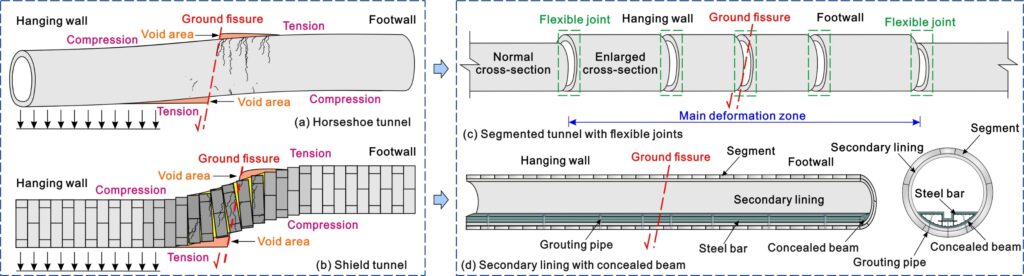
Fig. 2. Deformation and damage of metro tunnels crossing ground fissures and countermeasures. (a) Horseshoe tunnel; (b) Shield tunnel; (c) Segmented tunnel with flexible joints; (d) Secondary lining with concealed beam.
The findings of Chang’an University scientists demonstrated that structural form governs the spatial extent and mode of damage and thereby reshaped design logic for metro tunnels in deforming ground. Continuous linings concentrate stress over longer distances, while segmented systems confine damage but demand attention to joint performance. This distinction informs not only initial design but also inspection planning and repair prioritization, since damage localization dictates where monitoring effort yields the greatest benefit. The classification of fissure activity carries broader implications for risk management. By tying measurable geological indicators to construction eligibility, the framework reduces reliance on conservative blanket exclusions that inflate cost and delay. At the same time, it avoids optimistic assumptions by explicitly limiting shield tunneling to conditions where cumulative dislocation remains within tolerable bounds. This conditional approach aligns engineering choice with evolving ground behavior rather than fixed zoning.
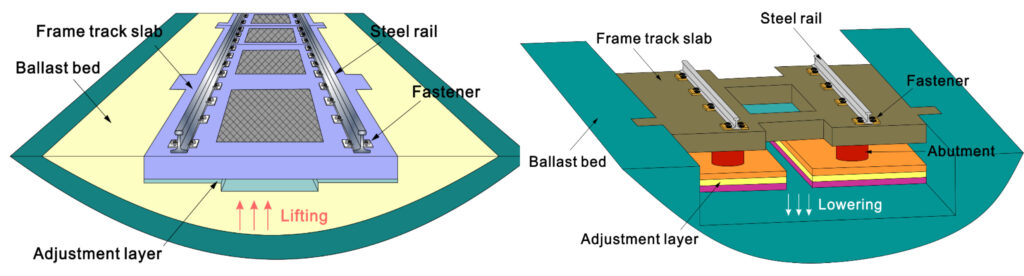
Fig. 3. Track adjustment strategy. (a) Upward-adjustable track; (b) Downward-adjustable track.
We believe the new work also contributes to understanding long-term serviceability because damage observed after years of operation confirms that millimeter-scale annual movement can accumulate into structural distress if not accommodated deliberately. The proposed determination of longitudinal fortification length, which combines theoretical estimation, physical modeling, and numerical simulation, provides a rational basis for distributing reinforcement and specialized segments. The logic rests on acknowledging uncertainty: no single method captures all interaction effects, but convergence among methods narrows acceptable design ranges. Beyond metro systems, the conclusions extend to other linear underground structures that cross zones of gradual differential movement. Utility tunnels and pipelines share similar sensitivity to bending, shear, and joint performance. The conceptual link between geological activity classification and structural adaptability offers a transferable template for infrastructure exposed to slow ground deformation rather than sudden failure.



Reference
Qiangbing Huang, Yuxuan Gou, Jianbing Peng, Disaster prevention and structural resilience of metro tunnels crossing active ground fissures in Xi’an, China, Tunnelling and Underground Space Technology, Volume 162, 2025, 106665,
Go to Journal of Tunnelling and Underground Space Technology.