 Advances in Engineering Advances in Engineering features breaking research judged by Advances in Engineering advisory team to be of key importance in the Engineering field. Papers are selected from over 10,000 published each week from most peer reviewed journals.

Significance
Titanium (Ti) and Ti-alloys have a high strength-weight ratio, excellent corrosion resistance, and good biocompatibility, and thus attract increasing applications in various weight- and environment-sensitive scenarios, such as aerospace, marine, energy and healthcare. Considering the increasingly harsh service environment, it is urgently needed to explore the forming potential of Ti-alloys and realize the precise forming of Ti components with high performance. Alpha Ti (α-Ti), however, has a low symmetric hexagonal close-packed (HCP) crystal structure with a c/a ratio of 1.587 at room temperature, leading to a small number of slip systems and weak strain hardening ability. This easily results in inhomogeneous deformation and ductile fracture in cold forming, which limits the extensive applications of the material. Fortunately, the significantly improved strength and ductility for α-Ti was observed at cryogenic temperature. Cryogenic manufacturing presents great potential for developing new high-performance materials and producing high-quality components at lower costs. Twinning is generally considered a key mechanism of outstanding cryogenic ductility. The dislocation-grain boundaries (GBs) interaction and void nucleation usually play crucial roles in the plastic deformation of polycrystalline materials. Still, their effects on the cryogenic ductility of α-Ti are rarely considered. To promote the development of titanium materials, the progress of advanced cryogenic forming technology and the extensive applications of Ti components, it is critically necessary to get an in-depth understanding of how cryogenic temperatures affect the deformation and fracture mechanisms and further change the strength-ductility synergy of α-Ti.
In this context, a recent study led by Chair Professor Fu M.W. and his team from the Department of Mechanical Engineering at The Hong Kong Polytechnic University presents an in-depth insight into the mechanism of the cryogenic strength-ductility synergy of α-Ti via a series of characterization experiments and molecular dynamics (MD) simulations. The research work is published in the International Journal of Plasticity in April 2024.
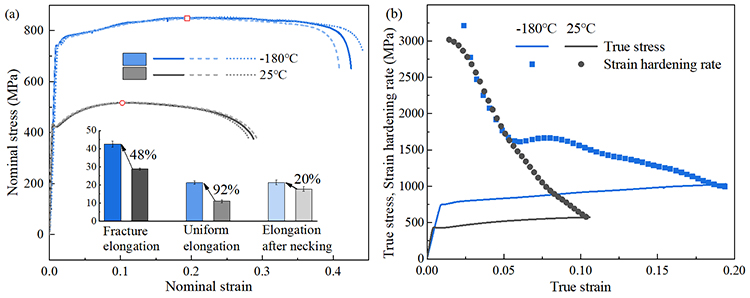
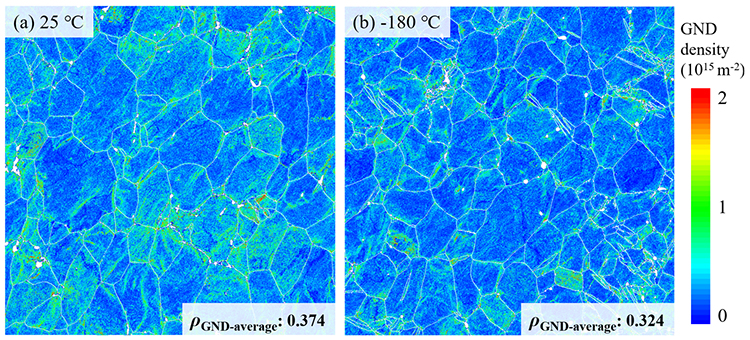
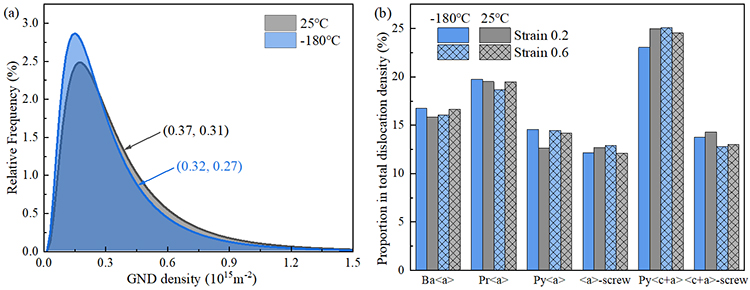
The authors first performed a series of uniaxial tension tests to determine the evolution of strength and ductility of α-Ti sheets with temperature. The microstructure and fractography observations and the analysis of slip trace, in-grain misorientation axis (IGMA) and geometrically necessary dislocations (GNDs) were conducted to reveal the deformation mechanisms in the uniform deformation stage and post-necking stage at different temperatures. It is found that, with the temperature decreasing from 25 to -180 °C, the yield strength and ultimate strength of the α-Ti were increased by 75% and 65%, respectively. The fracture elongation, uniform elongation and post-necking elongation were increased by 48%, 92% and 20%, respectively (Fig. 1). The material maintained a larger strain hardening rate within a greater range of strain at cryogenic temperature compared with room temperature. The significant increase in ductility was mainly attributed to the dramatic increase in uniform elongation. For the coarse-grained α-Ti, the twinning was mainly activated in the post-necking stage at cryogenic temperature and contributed to the increase in the post-necking elongation. In the uniform deformation stage, the plastic deformation was mainly accomplished by prismatic dislocation slip whether at room temperature or at cryogenic temperature. The relative proportions of different types of GNDs required to accommodate the strain incompatibility are similar at different temperatures. The significantly increased uniform elongation at cryogenic temperature is mainly attributed to the more uniform distribution of GNDs (Figs. 2 and 3).
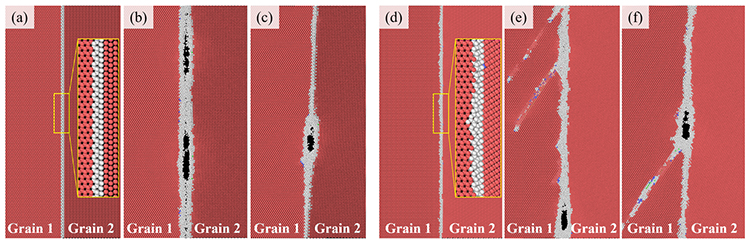
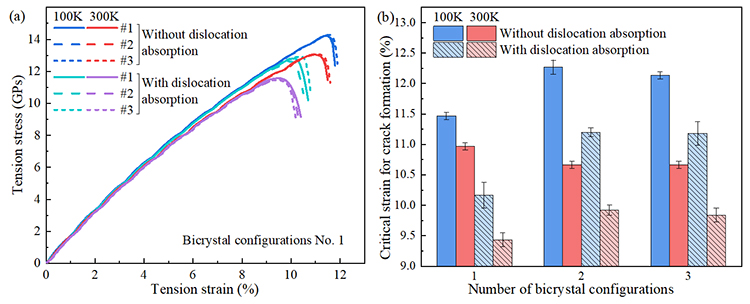
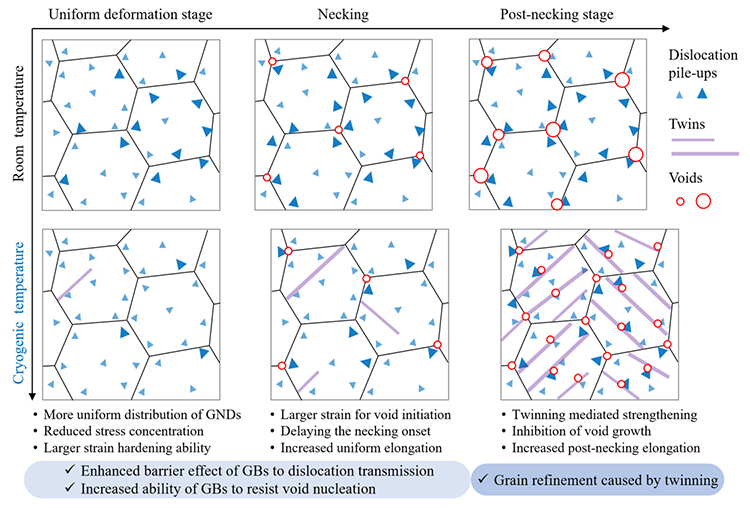
The MD simulations were then conducted to present an atomistic understanding of the effect of deformation temperature on the dislocation-GB interaction and void nucleation at GBs. The results revealed that the GBs in α-Ti present a more substantial barrier effect on dislocation transmission at cryogenic temperature compared with that at room temperature. The enhanced barrier effect restrained the dislocation transmission across most of the GBs. GNDs were thus created at more areas near the GBs in most grains to accommodate the strain incompatibility. This caused a more uniform distribution of GNDs and lower densities of GND pile-ups, which decreased the stress concentration and further inhibited the void nucleation and damage softening. This is beneficial for maintaining the large strain hardening rate within a greater range of strain. The cryogenic temperature decreases the accumulation rate of excess potential energy but increases the energy required to void nucleation, making the GBs show a more remarkable ability to resist void nucleation (Figs. 4 and 5). At the same time, considering the more uniform distribution of GNDs, the larger strains were required to increase the densities of GND pile-ups to induce large stress concentrations for driving void nucleation. This delayed the occurrence of necking and made the uniform elongation increase significantly at cryogenic temperature (Fig. 6).
This study presents an in-depth understanding of the strength-ductility synergy of α-Ti at cryogenic temperature. The strong barrier effect of GBs on dislocation transmission and the remarkable ability of GBs to resist void nucleation is believed to be the critical mechanisms besides twinning governing the excellent cryogenic ductility. The understanding developed in this work can be helpful for the development of new high-performance materials and the precise forming of complex components.

Reference
H. Yang, H. Li*, H. Sun, H. Wang, M.W. Fu*, Study of the mechanism of the strength-ductility synergy of α-Ti at cryogenic temperature via experiment and atomistic simulation, Int. J. Plast. 177 (2024) 103971. https://doi.org/10.1016/j.ijplas.2024.103971.