 Advances in Engineering Advances in Engineering features breaking research judged by Advances in Engineering advisory team to be of key importance in the Engineering field. Papers are selected from over 10,000 published each week from most peer reviewed journals.

Significance
Bubbles rising through otherwise quiescent liquid present a challenge in fluid mechanics: A gas volume is released, buoyancy drives it upward, and one might expect the path to remain nearly vertical unless the surrounding liquid is disturbed. In practice, freely rising bubbles often develop lateral motion, moving along zigzag or spiral trajectories while their shapes deform and their wakes become unsteady. Bubble trajectory affects residence time, interfacial renewal, local mixing, momentum exchange, and the distribution of gas within a liquid phase. The scientific difficulty is that the observed motion is produced by several coupled processes occurring at once: the bubble deforms, liquid flows around the interface, the wake evolves, and hydrodynamic forces shift in direction as the bubble changes orientation. A long-standing interpretation has treated wake instability and vortex shedding as central to the onset of non-vertical bubble paths. The vortex shed behind the bubble can coexist with path oscillation, but that does not by itself explain how the bubble surface is steered at the instant when its lateral motion changes direction. For a deformable bubble, the interface is both a boundary enclosing the gas phase and part of the dynamics. Local flow along the bubble surface can redistribute pressure and shear, reshape the lower interface, and shift the direction of the net hydrodynamic action.
In a recent research paper published in International Journal of Heat and Fluid Flow, Dr. He Liu, Dr. Yajing Yang, and Professor Yanju Wei from Xi’an Jiaotong University, examined a surface-flow-based interpretation of bubble path instability in quiescent water. They identified alternating dominance between clockwise and counter-clockwise interfacial streams, formed after bypass-flow separation near the stagnation point, as the driver of lateral motion and rolling torque. The technically distinct contribution is the relocation of the causal mechanism from downstream vortex shedding to local reflux and counter-flow interaction along the bubble’s lower surface. Briefly, the research team combined high-speed experimental observation with interface-resolved numerical simulation. In their experiments, air bubbles were released from a needle into distilled water and recorded from two orthogonal directions, allowing the bubble centroid and shape evolution to be tracked in three dimensions. The numerical model, implemented for laminar incompressible two-phase flow with surface tension, was used to resolve the surrounding velocity field and the interfacial motion in greater detail than the optical measurements alone could provide. This pairing mattered because the path itself shows only the global consequence; the proposed mechanism depends on what happens locally along the bubble surface.
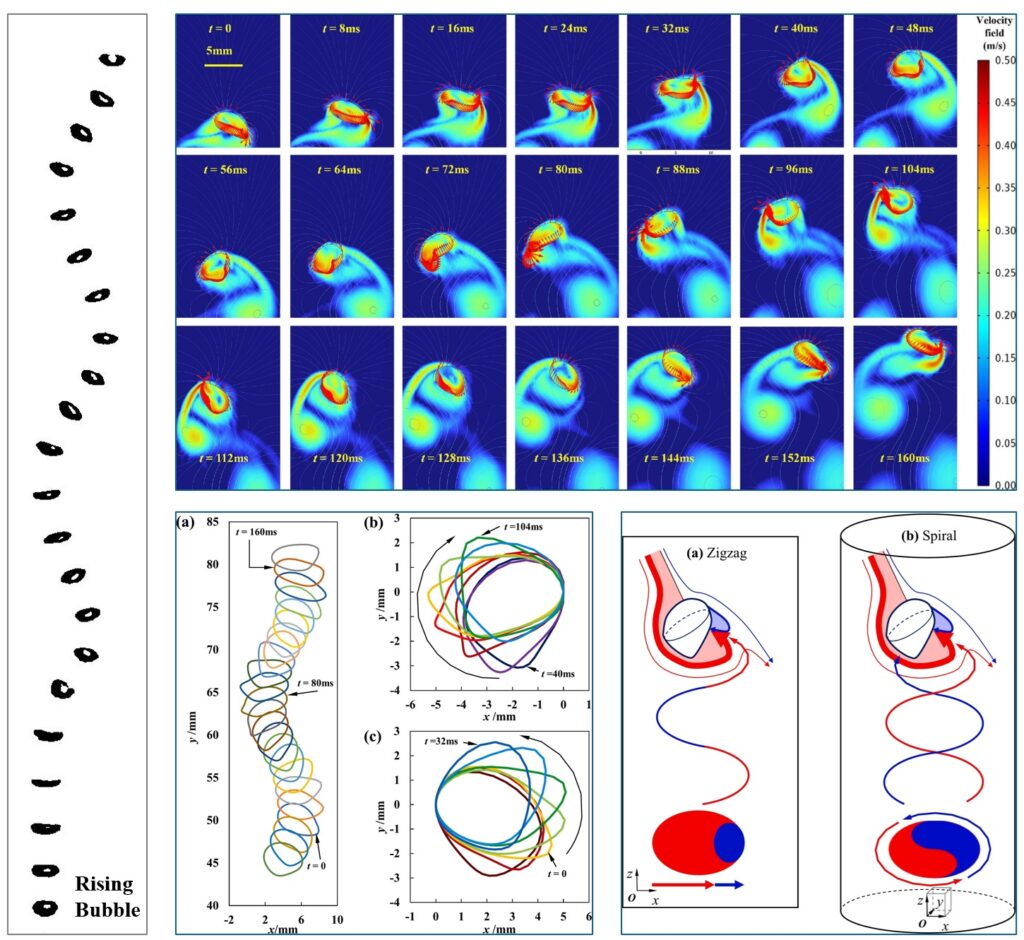
After detachment, the bubble initially rose almost vertically. Once it had ascended a finite distance, the trajectory departed from a straight path and developed into zigzag, oblique zigzag, spiral, or transitional forms. The reported time-averaged rising velocity was about 310 mm/s, and the measured oscillation frequencies showed a clear relation among the motion components: the frequency associated with vertical oscillation was nearly twice that of the lateral components. That relationship is consistent with a bubble whose lateral motion reverses over a repeated deformation cycle rather than one undergoing a purely random sideward drift.
The authors found that during a zigzag cycle, the lower bubble surface did not retain a fixed geometry. It evolved from a backslash-like profile, into a V-shaped lower surface, and then into a forward-slash-like profile. These shape changes were not described as passive distortions. They were tied directly to lateral steering. When the lower surface assumed the V-like form, its two arms acted as steering structures that redirected the bubble’s motion. A specific design choice in the analysis, subtracting the bubble centroid velocity to examine the relative velocity field, changed the physical interpretation: it separated translational motion from local rotational and surface-flow behavior, making the competing interfacial streams visible.
In this relative frame, the bypass flow separated at a stagnation point and produced two counter-rotating surface streams. One travelled counter-clockwise along one side of the interface; the other travelled clockwise along the opposite side. They alternately strengthened and weakened over the cycle. When the counter-clockwise component dominated, it promoted rightward translation and leftward rolling; when the clockwise component dominated, it promoted leftward translation and rightward rolling. The bubble’s quasi-sinusoidal lateral motion therefore arose from alternating dominance between these two surface-flow components.
The team also carried out simulation studies to investigate the relation between surface flow and vortex shedding and noted that counter-rotating surface flows converged near the lower part of the bubble, and the stronger stream could push past the lower stagnation region, impinge on the weaker one, and generate a reflux zone. This local interaction produced sharp changes in surface curvature and inflection points on the bubble. It also displaced portions of the weaker stream away from the interface, contributing to vortex detachment into the wake. They appear as a consequence of the interfacial competition and flow reversal, rather than as the primary origin of the side-to-side motion. The same logic was extended to spiral motion. When the competition between the clockwise and counter-clockwise surface streams remained in the vertical plane, the bubble followed a zigzag path. When the competing motion was redirected into the horizontal plane, the interaction became a chasing-like motion around the bubble and generated a spiral trajectory. Experiments across bubbles of different initial diameters showed zigzag, spiral, zigzag-to-spiral transition, oblique zigzag, and steady vertical ascent, with no strict one-to-one relation between bubble size and trajectory class. The distinction between zigzag and spiral motion was therefore interpreted as a difference in the orientation of the same surface-flow competition, not as evidence for fundamentally separate mechanisms.
The findings of Professor Yanju Wei and colleagues have practical relevance for engineering systems in which bubbles are not simply dispersed gas volumes but moving, deforming hydrodynamic objects that influence transport performance. In gas–liquid contactors, bubble columns, chemical reactors, flotation devices, and thermal-fluid equipment, designers often rely on empirical descriptions of bubble rise velocity, residence time, interfacial area, and mixing intensity. If the lateral motion of a bubble is driven by alternating clockwise and counter-clockwise surface streams, then trajectory control should not be approached solely through wake suppression or bulk turbulence management. It also requires attention to conditions that modify interfacial mobility, lower-surface reflux, stagnation-point behavior, and bubble deformation.
One implication we believe is especially important for reactor and heat-transfer design: bubble path instability can enhance lateral displacement and local liquid agitation even in otherwise quiescent liquid. A bubble that zigzags or spirals sweeps a larger volume than one rising vertically, which may improve local mixing, gas–liquid contact, and renewal of the liquid near the interface. At the same time, because the mechanism depends on interfacial flow competition, small changes in surface condition, fluid cleanliness, bubble size distribution, or confinement may alter the degree of lateral wandering. The work also has implications for numerical modelling of bubbly flows. Many engineering-scale simulations cannot resolve each deforming interface, so they depend on closure relations for lift, drag, path oscillation, and dispersion. A wake-based interpretation may miss the timing and origin of the lateral force if the relevant event begins at the lower bubble surface. The authors’ analysis gives model developers a more physically specific target: the competition of counter-rotating surface flows and the resulting rolling torque. For process control, the findings suggest that trajectory type—zigzag or spiral—should be regarded less as a fixed bubble-size category and more as a geometric expression of the same interfacial instability. The study by Liu, Yang, and Wei therefore provides a useful design insight: controlling bubble motion may require controlling how bypass flow is redirected along the interface, not just adjusting gas injection rate or relying on average bubble diameter.
Reference
Liu He, Yang Yajing, Wei Yanju, Mechanism of the zigzag and spiral bubble ascension: The alternating steering and continuous chase effects of the side reflux on the bottom surface, International Journal of Heat and Fluid Flow, Volume 116, 2025, 109980,
Go to International Journal of Heat and Fluid Flow