Advances in Engineering Advances in Engineering features breaking research judged by Advances in Engineering advisory team to be of key importance in the Engineering field. Papers are selected from over 10,000 published each week from most peer reviewed journals.

Significance Statement
Commodity polymer packaging designed for tissue engineering and food packaging should be chemically inert offering high chemical robustness. Nevertheless, this chemical inertness has an effect on the surface properties, which is undesirable for adhesion, coating, lamination and biocompatibility. Therefore, modifying these materials for critical applications, for instance, laminates, protective coatings, cell cultivating membranes and water treatment membranes calls for modifying their surfaces. Plasma-based treatment, specifically non-equilibrium plasmas can be applied to enhance the surface of organic polymer substrates in order to improve their adhesion, biocompatibility and wettability.
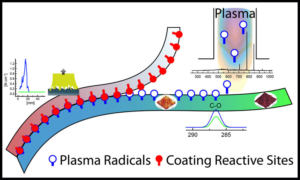
Researcher led by Professor Peter J. Hauser from North Carolina State University applied large area atmospheric pressure plasma system to undertake plasma surface modification of film substrates of polyethylene terephthalate. They used helium as the major seed gas and small fractions of nitrogen and oxygen to assess the reactivity of plasma synthesized from various gas mixtures. The aspects of their study included the analysis of chemical attributes of the plasma and the substrates and the analysis of adhesion of acrylate-based coating onto polyethylene terephthalate substrates. Their work is now published in journal, Surface & Coatings Technology.
After rinsing the proposed specimens of polyethylene terephthalate with hexane and acetone, the authors, mounted the plasma apparatus. This was followed by a flow of various treatment gases; helium, oxygen or nitrogen and a 300W RF power to the working plasma electrode. Helium was used in the plasma system owing to its ability to undergo stepwise ionization. They also realized that the power window for pure helium was independent of the flow rate between the electrodes. When they added a fraction of oxygen or nitrogen, there was an increase in the ignition voltage.
The increase in ignition voltage for the case of oxygen was owing to electronegativity of oxygen, while for the case of nitrogen was owing to quenching metastable helium after penning ionization, which produced positive ions of nitrogen.
The authors presented a large area atmospheric pressure plasma system in order to improve the adhesion of acrylate-based coating to the substrates of polyethylene terephthalate. This system produced a wide plasma source which was appropriate for treatment of substrates such as textile materials as well as industrial polymeric films. Plasma treated samples displayed an increase in surface wettability from a water contact angle of about 87° for untreated specimen to approximately 25° for samples treated with helium and nitrogen. The surface roughness increased from about 0.25 nm from untreated specimens to approximately 0.8 nm for helium and oxygen treated specimens.

Reference
Farzad Rezaei1, Michael D. Dickey2, Mohamed Bourham3, and Peter J. Hauser1. Surface modification of PET film via a large area atmospheric pressure plasma: An optical analysis of the plasma and surface characterization of the polymer film. Surface & Coatings Technology, volume 309 (2017), pages 371–381.
[expand title=”Show Affiliations”]- College of Textiles, North Carolina State University, Raleigh, United States.
- Department of Chemical and Biomolecular Engineering, North Carolina State University, Raleigh, United States.
- Department of Nuclear Engineering, North Carolina State University, Raleigh, United States.
Go To Surface & Coatings Technology