Advances in Engineering Advances in Engineering features breaking research judged by Advances in Engineering advisory team to be of key importance in the Engineering field. Papers are selected from over 10,000 published each week from most peer reviewed journals.

Significance Statement
The microemulsion technique for synthesizing materials with minute sizes has developed interest due to its ability to uniformly disperse small particles and stabilize the disperse phase of either oil or water with the aid of surfactants.
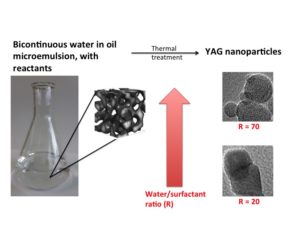
Italian researchers synthesized yttrium aluminum garnet (YAG) nanopowders from the thermal treatment of yttrium and aluminum hydroxides prepared in an aqueous solution/cetyltrimethylammonium bromide/butane/n-heptane microemulsion. The work is now published in Colloids and Surfaces A: Physicochemical and Engineering Aspects.
Following preparation of yttrium aluminum garnet nanopowders, the authors determined their microemulsion property by taking certain measurements involving kinematic viscosity, electrical conductivity and small angle x-rays scattering coupled with transmission electron microscopy analysis and wide angle x-ray scattering measurements to investigate the features of the yttrium aluminum garnet nanopowders.
Outcomes acquired from the kinematic viscosity and electrical conductivity measurements indicated three-phase change form microemulsion containing ammonia solution while a two-phase change became observed for the nitrate solution of yttrium and aluminum.
The authors observed as water content increases, the dispersal of water clusters in the oil phase of microemulsion containing ammonia solution changed from a bi-continuous phase to a lamellar phase, before returning to a bi-continuous phase. With emulsions containing nitrate solutions of yttrium and aluminum, increase in water content led to a solely observed bi-continuous phase as lamellar phase was not interpreted. Measurements from the small angle x-rays scattering techniques additionally expressed similar views with the results obtained from the kinematic viscosity and electrical conductivity measurements.
Wide angle x-ray scattering measurements confirmed two lattice parameters value for the R20 nanopowders which indicated two crystalline phases. The R70 nanopowders with a single lattice parameters value confirmed a monocrystalline phase, indicating a pure garnet phase.
The authors confirmed polygon shapes with high tendency to agglomerate for the R20 nanopowders using transmission electron microscopy analysis. In contrast, the R70 yttrium aluminum garnet nanopowders were spherically-shaped with lower tendency for agglomeration.
This study was able to offer a platform for generating yttrium aluminum garnet nanopowders with uniform dispersed sizes and extinct agglomeration.





Journal Reference
Armetta, F.1, Chillura Martino, D.F.1,2, Lombardo, R.1, Saladino, M.L.1,2, Berrettoni, M.3, Caponetti, E1,2. Synthesis of Yttrium Aluminum Garnet Nanoparticles in Confined Environment, and their Characterization, Colloids and Surfaces A: Physicochemical and Engineering Aspects 511 (2016) 82–90.
[expand title=”Show Affiliations”]- Dipartimento Scienze e Tecnologie Biologiche, Chimiche e Farmaceutiche—STEBICEF, Università degli Studi di Palermo, Parco d’Orleans II, Viale delle Scienze pad. 17, I-90128 Palermo, Italy
- Centro Grandi Apparecchiature—ATeN Center, Università degli Studi di Palermo, Via F. Marini 14, I-90128 Palermo, Italy
- Dipartimento di Chimica Industriale “Toso Montanari” – UOS Rimini, Università di Bologna, Viale Risorgimento 4, I-40196 Bologna, Italy
Go To Colloids and Surfaces A: Physicochemical and Engineering Aspects