Advances in Engineering Advances in Engineering features breaking research judged by Advances in Engineering advisory team to be of key importance in the Engineering field. Papers are selected from over 10,000 published each week from most peer reviewed journals.

Significance
Hydrogen is often talked about as a clean energy vector, almost an obvious solution to the emissions problem, however, most of the hydrogen on the market is made the old-fashioned way of steam methane reforming, coal gasification methods which are efficient but carbon-heavy. Electrolysis is frequently promoted as the greener option, but unless electricity becomes both cheap and reliably renewable, the costs stack up quickly. Because of that mismatch between promise and practicality, researchers have been circling back to biological routes. Dark fermentation, in particular, keeps resurfacing because it can run under fairly mild conditions and doesn’t require exotic infrastructure. The idea that agricultural residues could feed such a system is especially appealing: waste in, clean fuel out. Corn straw is a good example of why the concept is compelling and frustrating at the same time. China produces staggering amounts of it every year, much of which is burned or discarded. On paper, the cellulose content should make it a strong candidate for biohydrogen production. But once you actually try to use it, you run straight into the usual wall: lignocellulosic recalcitrance. The material is structurally tight—cellulose fibers buried under layers of hemicellulose and lignin, all glued together by a network of bonds that microbes and enzymes can’t easily infiltrate. So even if the substrate looks abundant, the fermentative microbes barely see the sugars they need. Not surprisingly, untreated straw produces almost no hydrogen.
Many groups have experimented with ways to break this barrier—acid or alkaline soaking, microwave heating, even electrochemical disruption. Some of these work to a degree, but they come with trade-offs: corrosive reagents, high energy consumption, or equipment that isn’t ideal outside a lab setting. That’s partly why deep eutectic solvents (DES) have gained attention. They’re mixtures formed by pairing a hydrogen-bond acceptor like choline chloride with different donors, and the resulting liquids can be surprisingly good at disturbing lignocellulosic structure without being as harsh as traditional chemicals. The complication is that DES systems are incredibly diverse and their effectiveness depends on the particular chemistry of the donor–acceptor pair, however, most studies only test one or two combinations which makes it hard to tell whether observed improvements come from genuine chemical effects or just from the peculiarities of a single solvent formulation. To this end, new research paper published in ACS Sustainable Resource Management and conducted by Dr. Quan Wang, Dr. Miaoyu Deng, Dr. Yicheng Yuan, Professor Lei Yu, Professor Chen Liu, and Dr. Rong-Ping Chen from the College of Ecology and the Environment at Nanjing Forestry University, the researchers developed a comparative DES-pretreatment framework that relates the functional-group chemistry of six choline-chloride–based solvents to their ability to dismantle lignin–hemicellulose architectures in corn straw. By coupling structural analyses with enzyme-adsorption modeling and fermentation kinetics, they established mechanistic pathways linking pretreatment chemistry to hydrogen yield.
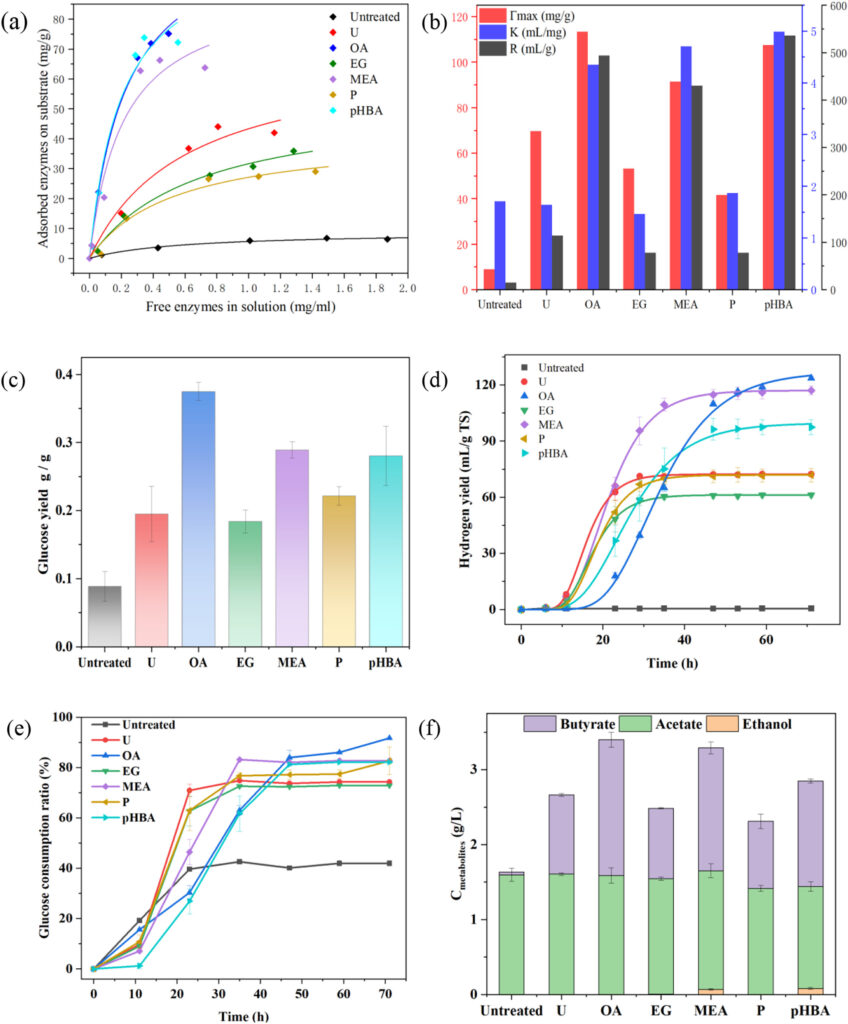
The team prepared six choline-chloride–based DES systems, each paired with a distinct hydrogen-bond donor—urea, oxalic acid, ethylene glycol, monoethanolamine, phenol, or p-hydroxybenzoic acid. Although these choices may appear eclectic, the logic behind them becomes clear once one considers their differences in acidity, basicity, and aromatic character. Each DES was allowed to interact with ground corn straw at 100 °C for two hours, a mild condition relative to many industrial pretreatments. After washing and drying the residues, the authors moved quickly into a suite of structural and compositional analyses to capture how each solvent altered the biomass. The authors performed fluorescence microscopy and found that lignin initially clinging tightly to the straw surface; as pretreatment progressed, fluorescence shifted from the solid to the solvent, indicating solubilization. Oxalic-acid–based DES produced the most dramatic shift. They also conducted scanning electron microscopy and noticed untreated straw retained a smooth, compact surface, whereas oxalic acid, monoethanolamine, and p-hydroxybenzoic acid generated progressively more fractured fibers. Moreover, the authors performed XRD and BET analyses which provided a second layer of confirmation and by removal of amorphous lignin and hemicellulose, exposed cellulose crystalline regions, which lead to higher crystallinity indices across all samples, with ChCl/OA showing the greatest jump. BET surface areas increased markedly as well—most strikingly from 1.36 m²/g in untreated straw to more than 23 m²/g after oxalic acid treatment. This expansion of accessible surface area became a key determinant of later enzyme adsorption. The team also used Langmuir isotherm modeling, to quantify cellulase binding and observed sharp increases in both the maximal adsorption capacity and binding affinity for the oxalic acid, monoethanolamine, and p-hydroxybenzoic acid samples. These effects mirrored the structural measurements: where fibers were more open and lignin was less obstructive, enzymes could establish stable contact. Additionally, their enzymatic hydrolysis data confirmed this relationship and found that untreated straw produced only 0.088 g glucose per gram of biomass, a reflection of its structural inaccessibility. Oxalic-acid–treated straw yielded 0.375 g/g—over four times higher—while monoethanolamine and p-hydroxybenzoic acid treatments also generated substantial gains. These higher glucose concentrations set the stage for fermentation outcomes. When they conducted dark fermentation, hydrogen production responded sharply to these upstream changes and noticed negligible hydrogen evolution from the untreated hydrolysate, which suggest that released sugars were too limited to push fermentation beyond maintenance metabolism. In contrast, DES-pretreated samples, especially those treated with oxalic acid and monoethanolamine, reached hydrogen yields above 120 mL/g total solids. Microbial community behavior mirrored these shifts: the dominance of acetic acid in untreated samples gave way to butyrate-rich profiles in the best-performing DES treatments, reflecting a transition toward more energy-efficient fermentation pathways.
In conclusion, Nanjing Forestry University researchers demonstrated that acidic, basic, and aromatic DES systems enhance dark-fermentative hydrogen production through distinct but convergent modes of lignocellulose disruption. Their findings provide practical design rules for tailoring DES formulations to optimize renewable hydrogen generation from agricultural residues. We believe what stands out in this study is the clarity with which pretreatment chemistry, biomass structure, and hydrogen productivity are linked. Deep eutectic solvents have been proposed for lignocellulosic fractionation for more than a decade, yet their practical relevance often fades because the downstream consequences—enzymatic performance and microbial activity—are reported inconsistently. In their new work and by keeping the feedstock constant and comparing DES formulations head-to-head, the authors provide a map connecting functional groups to measurable changes in lignin solubilization, cellulose exposure, and ultimately fermentative output.
We also think the implications extend beyond the specific solvent systems tested. The strong performance of ChCl/OA underscores how acidity can drive cleavage of lignin–carbohydrate complexes and β-O-4 linkages, while still operating under moderate temperature. But the study also shows that acidity alone is not the only route: monoethanolamine and p-hydroxybenzoic acid, through basic and aromatic interactions, respectively, achieve notable improvements by weakening lignin’s structural dominance in different ways. Indeed, solvent choice should be guided not only by dissolution capacity but by targeted interactions with specific structural motifs in lignocellulose. Hydrogen production, which is often treated as a downstream readout, becomes here a sensitive indicator of how well pretreatment aligns with microbial requirements. The shift from acetate-dominant metabolism in untreated straw to butyrate-associated hydrogen production in DES-treated samples illustrates how biomass structure influences not just hydrolysis but the energetics of fermentation. The rise in soluble microbial products seen in the 3D-EEM spectra is consistent with a more metabolically active system, which suggest that pretreatment improvements propagate through the microbial network rather than stopping at saccharification. From an environmental and operational standpoint, the innovative work suggests that DES-based pretreatment is a promising pathway toward greener hydrogen production—one that avoids the harsher chemical inputs found in classical methods. The strong performance of oxalic acid, a biodegradable organic acid, further positions DESs as feasible candidates for large-scale application, especially if recycling loops can be integrated. Yet the study also cautions that not all DESs are equal: some contribute little to lignin removal and offer limited benefits downstream. This differentiation is valuable, as it encourages a move away from generic adoption of DESs and toward function-informed formulation.



Reference
Wang, Quan & Deng, Miaoyu & Yuan, Yicheng & Yu, Lei & Liu, Chen & Chen, Rong-Ping. (2025). Deconstructing Corn Straw Lignocellulose via Deep Eutectic Solvents to Enhance Hydrogen Production from Dark Fermentation. ACS Sustainable Resource Management. 2. 10.1021/acssusresmgt.5c00115.
Go to Journal of ACS Sustainable Resource Management.