Advances in Engineering Advances in Engineering features breaking research judged by Advances in Engineering advisory team to be of key importance in the Engineering field. Papers are selected from over 10,000 published each week from most peer reviewed journals.

Significance
Three-dimensional (3D) nanostructures hold unique properties that cannot be achieved with lower-dimensional systems, offering opportunities in photonics, metamaterials, and biomedical scaffolding. Among the most powerful fabrication techniques enabling such structures is two-photon lithography (TPL), which uses nonlinear absorption to confine polymerization to nanoscale volumes. Through sequential scanning of the focal spot, TPL can stitch together complex, sub-micron architectures that are otherwise unattainable by conventional lithographic methods. However, despite its transformative promise, TPL faces persistent challenges that limit resolution and reliability. Chief among these are proximity effects, a term that encompasses unwanted broadening, feature merging, and filamentary connections when adjacent voxels are written close together in time or space
Unlike the resolution limits inherent to optical diffraction, proximity effects arise from diffusion and chemical kinetics within the resist. When two features are written in close succession, the local chemical environment—oxygen concentration, initiator density, and radical diffusion—remains perturbed, so the second feature does not develop independently. This interplay can lead to spurious filaments connecting structures or uneven resolution depending on the direction of the scan path. Moreover, these effects reduce tolerance margins, increase variability, and can even trigger local resist damage such as bubble formation. The outcome is a discrepancy between intended and realized geometries, a critical barrier for pushing feature sizes below a few hundred nanometers.
Several advanced approaches have been attempted to circumvent these problems, such as dual-color initiators with radical quenchers, digital optical projection systems, and multiphoton-excited ultraviolet lithography. While these have reduced feature dimensions to tens of nanometers, they come at the cost of specialized resist chemistries, complex multi-mask optics, or additional processing steps. By contrast, single-beam direct laser writing with commercially available resists remains appealing for its accessibility and design freedom, yet it suffers most acutely from proximity effects. To match the demands of next-generation photonic devices—where gaps below 200 nm are often required—strategies are needed to tame these diffusion-driven processes without compromising throughput or practicality.
To this account new research paper published in Additive Manufacturing, and conducted by Dr. Leila Mehrvar, Wei Zhu, Zekun Wang, Darian Modasi, and led by Professor Eric Johlin from Western University in Canada, the researchers developed two complementary models to understand and mitigate proximity effects in two-photon lithography. Experimentally, they established systematic strategies that link resist chemistry, exposure power, and scan timing to nanoscale fidelity, achieving record feature sizes below 200 nm. Computationally, they built a simplified diffusion-driven model that reproduces key experimental trends by balancing oxygen inhibition, initiator depletion, and radical transport.
The team built their investigation around a custom TPL system using an 80-femtosecond, 780 nm pulsed laser focused through a 1.4 NA objective. By employing a piezoelectric stage at 10 μm/s, they gained precise control over exposure timing, essential for isolating temporal effects. Four different resist formulations were prepared: PETA, PETA with thiol crosslinker, TMPTA, and TMPTA with thiol. Arrays of hollow and solid square features, with varying hole sizes and separations from 100 to 500 nm, were printed to probe both conventional resolution and proximity artifacts. These structures were imaged by SEM to quantify deviations from design and to visualize filamentary defects A first set of experiments varied the outline and infill laser powers. The results showed that outline power exerted the strongest influence on feature fidelity. As outline power increased, holes as small as 260 nm gradually closed, and partial connectivity defects appeared in arrays with nominal separations of 300–500 nm. Infill power had a more modest role, affecting vertical interactions between layers but not strongly altering in-plane hole sizes. This asymmetry underscored the sensitivity of boundaries to local depletion effects, as radicals and initiators diffuse differently near edges compared to interiors. Changing resist chemistry revealed even clearer distinctions. TMPTA consistently delivered superior resolution, with clear holes down to 200 nm and reduced temporal effects, attributable to its lower viscosity and higher oxygen diffusion rate. In contrast, thiol-containing formulations introduced significant line broadening and greater filamentary connections. The thiol–ene reaction, while beneficial for mechanical stability, prolonged radical lifetimes and allowed residual groups to diffuse, exacerbating merging at short time delays. Thus, while thiols improved stiffness, they did so at the expense of nanoscale precision. Deposition methods further complicated the picture. Spin-coating created more uniform resist films but unexpectedly worsened temporal effects, producing narrower gaps and stronger filamentary connections compared to drop-cast films. This suggested that substrate–resist interactions and altered diffusion dynamics near thin films intensified proximity issues, despite visual improvements in uniformity. Attempts to thin TMPTA with anisole reduced temporal effects but introduced feature deformation, highlighting trade-offs between chemistry and mechanics.
To probe timing more directly, arrays were written with controlled delays ranging from 400 ms to 4 s. At short delays, virtually all features fused, while increasing the delay gradually restored separations up to ~220 nm in TMPTA resists. Thiol-containing systems, however, required delays of several seconds before clear separations emerged. These results aligned with simulations: a simple diffusion-driven model incorporating oxygen quenching and initiator depletion reproduced the observed non-monotonic trends and even predicted the counterintuitive sign reversal of temporal effects at high power. Finally, vertical structures (woodpiles) confirmed that proximity effects extend into the z-axis. Short interlayer delays led to merged beams and reduced voxel heights, while thiol-containing resists again exacerbated the issue. Shrinkage effects compounded with increasing height, revealing the volumetric nature of proximity phenomena. Altogether, the experiments demonstrated that resolution below 200 nm and gaps under 150 nm are achievable, but only under carefully optimized conditions that balance chemistry, timing, and exposure power.
In conclusion, the findings of Professor Eric Johlin and colleagues from this study are significant because they establish both experimental and conceptual foundations for overcoming long-standing limits in two-photon lithography. By showing that hole diameters below 200 nm and separations under 150 nm can be realized without exotic optical setups or post-processing, the work sets a new benchmark for single-beam infrared TPL. This level of fidelity is particularly important for applications such as photonic crystals, metamaterials, and biomedical scaffolds, where subwavelength spacing dictates function. Importantly, the study identifies TMPTA as a high-performance resist whose favorable diffusion dynamics suppress temporal broadening, positioning it as a practical material for next-generation nanofabrication. Beyond reporting record resolutions, the research disentangles the mechanisms that drive proximity effects. The recognition that temporal effects emerge from the interplay of oxygen depletion and initiator diffusion, rather than purely optical crosstalk, reframes how correction strategies should be designed. Unlike mask-based proximity correction in semiconductor lithography, effective TPL correction requires attention to resist chemistry, laser timing, and even scan path order. This conceptual shift enables the community to approach proximity not as a fixed barrier but as a tunable outcome of reaction–diffusion processes. The computational model, though deliberately simplified, provides an accessible framework for predicting how timing, spacing, and power interact. While not quantitatively predictive, its success in reproducing trends such as non-monotonic gap dependence and sign inversion of temporal effects illustrates that even minimal reaction–diffusion models can capture the essence of these dynamics. This opens opportunities for computationally assisted design of writing strategies, reducing the need for exhaustive trial-and-error in experiments. Equally important are the trade-offs revealed. Incorporating thiols strengthens structures but worsens fidelity; spin-coating enhances uniformity yet magnifies temporal effects; thinning resists reduces broadening but destabilizes features. These tensions underscore that no single variable alone governs resolution, and achieving optimal performance requires balancing chemistry, mechanics, and process dynamics. Such nuanced understanding will help guide practical decisions in laboratories and industries seeking to fabricate high-density nanostructures.
The implications extend across fields. Photonics demands precise periodic arrays with minimal feature drift, which these strategies can now better deliver. Biomedical scaffolds, where pore size and connectivity influence cellular behavior, may benefit from improved control over filamentary artifacts. Metamaterials, often reliant on deeply subwavelength features, can leverage the demonstrated ability to achieve dense, uniform arrays without specialized resists or beam-shaping optics. Moreover, the recognition that volumetric (z-axis) fidelity suffers from the same diffusion-driven constraints emphasizes the need for holistic three-dimensional process control. In sum, this study is more than an incremental step in TPL; it reshapes how proximity effects are understood and managed. By combining rigorous experimentation with a diffusion-based model, the authors provide both practical recipes and conceptual clarity, offering a foundation upon which future advances in high-resolution 3D nanofabrication can confidently build.
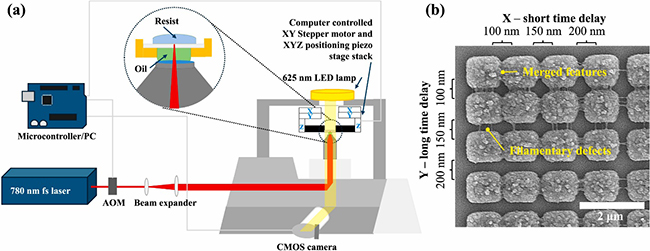
CREDIT: Additive Manufacturing, Volume 110, 2025, 104902,

Reference
Leila Mehrvar, Wei Zhu, Zekun Wang, Darian Modasi, Eric Johlin, Control of temporal and spatial proximity effects in two-photon lithography, Additive Manufacturing, Volume 110, 2025, 104902,