Advances in Engineering Advances in Engineering features breaking research judged by Advances in Engineering advisory team to be of key importance in the Engineering field. Papers are selected from over 10,000 published each week from most peer reviewed journals.

Significance
Manipulation of the pulse front tilt intensity profile of an ultrashort optical pulse has immense potential for novel light-matter interaction and control. Among the successful applications demonstrated and most promising involves the generation of intense terahertz pulses with high source brightness. As a result, there has been a need to simplify and advance different noncollinear phase-matching schemes for efficient terahertz waves generation. However, majority of the developed schemes employ diffracting gratings to produce the required pulse front tilt intensity profile, which are inherently dispersive. Since an imaging apparatus is mandatory to achieve the desired pulse front tilt at the crystal position, it is imperative that a pump-pulse-dispersion evasive imaging device at the crystal position be developed. Recently, the echelon mirror has been seen to yield promising results since it produces a discretely pulse front tilt condition from the specular reflection it offers. Unfortunately, like gratings, echelon mirrors are passive devices that cannot modulate the incident light beam electronically.
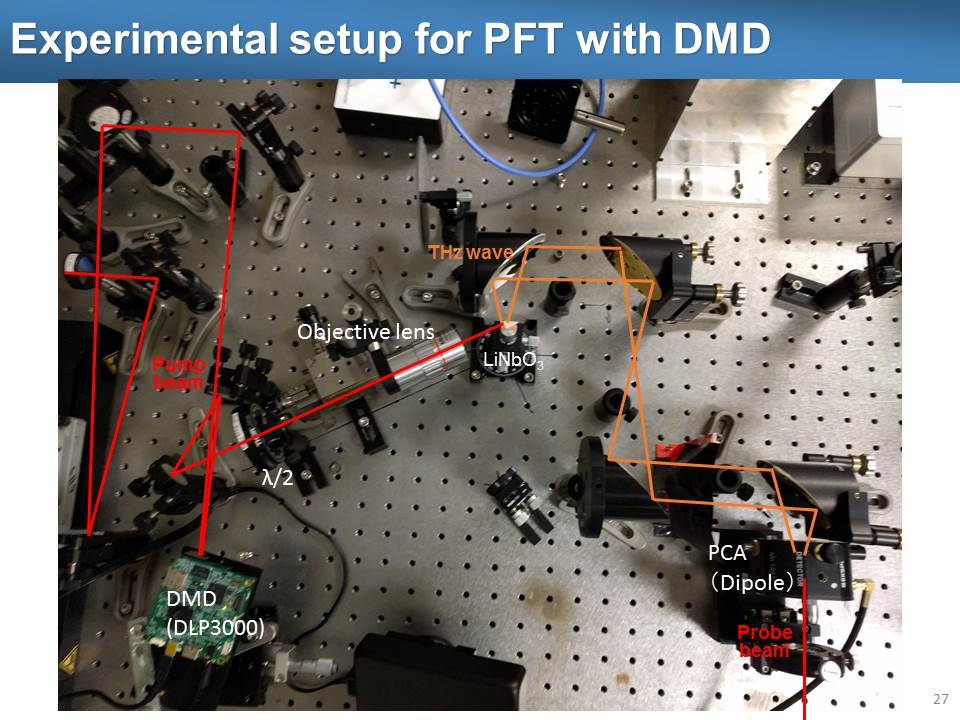
Recently, a team of researchers led by Professor François Blanchard at École de technologie supérieure with Kosuke Murate and Mehraveh Javan Roshtkhari in collaboration with Xavier Ropagnol at Insitut national de la recherche scientifique, Énergie, matériaux et télécommunications used a digital micromirror device as an alternative for echelon mirrors or gratings to produce an adaptive pulse front tilt intensity pump profile. To be precise, they demonstrated terahertz generation in a lithium niobate crystal using the pulse front tilt pumping scheme derived from a digital micromirror device chip. Their work is currently published in the research journal, Optics Letters.
Briefly, the research method employed entailed the use of two methods: pulse width duration measurements and terahertz waves generation in lithium niobate, to confirm and exactly fine-tune the pulse front tilt nature of the reflected pump beam on a digital micromirror device chip. In addition, they set a simple demonstration using autocorrelation measurements so as to validate the tilted nature of the pulse front tilt intensity profile.
The authors observed that a clear terahertz wave generation through the pulse front tilt pumping scheme in lithium niobate could be derived from a digital micromirror device chip. Additionally, they confirmed that the echelon mirror equation they had used to generate the pulse front tilt intensity beam profile, could be used for digital micromirror device in zero-order reflection mode. They also noted that the reflections from the micromirrors had the benefit of being dispersion free although diffraction still occurred due to the small size and step height.
In conclusion, François Blanchard and his research team study presented a new scheme for varying an ultrafast optical beam spatiotemporally, going from exhibiting no pulse front tilt to exhibiting a left- or right-hand oriented pulse front tilt. Generally, their results open doors for terahertz emissions with a subwavelength controllable spatial pump beam pattern in a collinear or noncollinear phase matching geometry. Altogether, it is anticipated that the versatility of digital micromirror device to modify electronically the spatial intensity distribution of pulse front tilt intensity beams will spark novel applications that extend beyond terahertz -related domains.

Reference
Kosuke Murate, Mehraveh Javan Roshtkhari, Xavier Ropagnol, François Blanchard. Adaptive spatiotemporal optical pulse front tilt using a digital micromirror device and its terahertz application. Optics Letters, Volume 43, Number 9 / 1 May 2018.
Go To Optics Letters