Advances in Engineering Advances in Engineering features breaking research judged by Advances in Engineering advisory team to be of key importance in the Engineering field. Papers are selected from over 10,000 published each week from most peer reviewed journals.

Significance
In recent years, the wide use of renewable energy and its acceptance has been a great success. This tremendous achievement can be credited to the increased global awareness and acknowledgment of the impact of carbon-based fuels on the environment, and the integrability of the variable renewable energy (wind power and photovoltaic) to existing power grid systems. As such, the penetration of flexible high voltage DC(HVDC) transmission technology in the smart grid has greatly impacted the configuration of power systems. Well, it is widely known that the high penetration of renewable energy and AC-DC hybrid systems are doubtlessly two essential features of future power systems and will ever change the configurations of power systems.
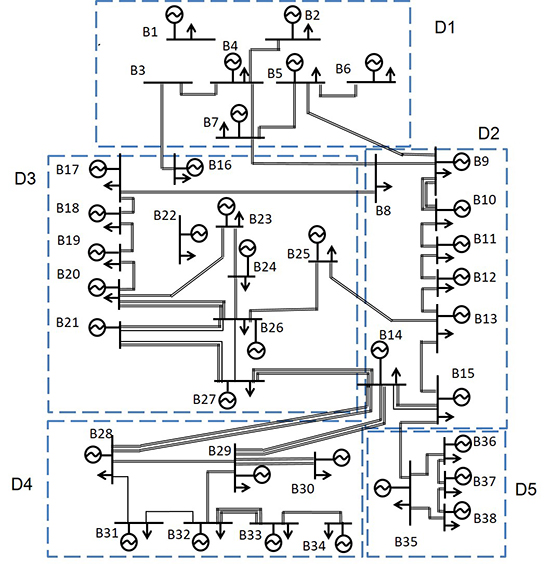
The test systems that reflect the true feature of a real power system are vital tools in this research area. nonetheless, there lacks a standard test system for modern transmission expansion planning research, specifically under high variable renewable energy domain. To address this, researchers from the Tsinghua University in China: Zhenyu Zhuo (PhD candidate), Dr. Ning Zhang, Jingwei Yang and Professor Chongqing Kang in collaboration with Charlie Smith at the Energy Systems Integration Group in the United States and Dr. Mark O’Malley and Dr. Benjamin Kroposki from the National Renewable Energy Laboratory in Colorado developed a new 38-bus TEP test system based on a real regional power grid in China with high variable energy penetration: the HRP-38 system. “HRP” stands for high renewable penetration. They aspired to introduce a transmission expansion planning (TEP) dedicated test system with the feature of high variable renewable energy prediction and AC-DC hybrids. Their work is currently published in the research journal, IEEE Transactions on Power Systems.
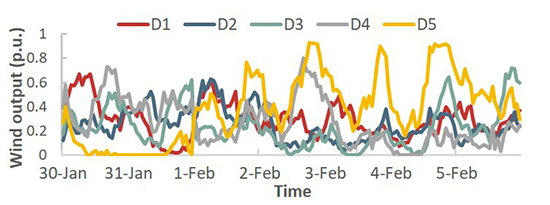
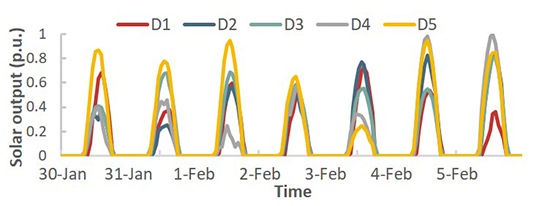
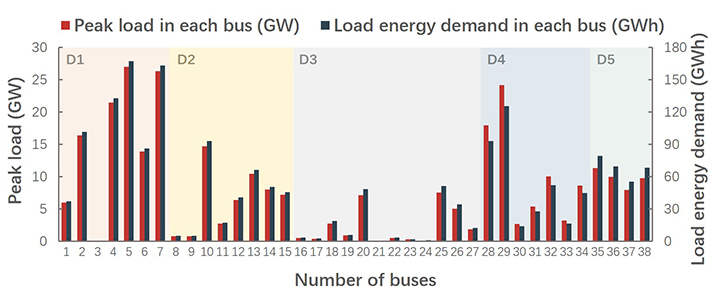
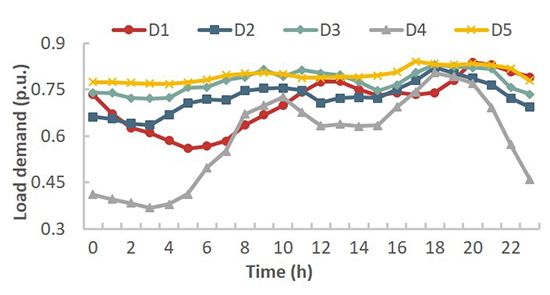
The researchers proposed a test system that considered high VRE penetration of more than 30% energy share, which would be an important feature in many power systems in the future. In the proposed approach, both AC and DC candidate lines were given to provide sufficient transmission planning alternatives. The complexity of the test system was well balanced considering calculation tractability and the ability to test the performance of the TEP planning model. The network topology, generation mix, and load characteristics were also described in detail. The investment cost of transmission assets, detailed parameter of units and other necessary information required for TEP are provided explicitly in the dataset. The codes for operation simulation applied in this paper is uploaded in the dataset linkage. Based on the programs, researchers can compare their customized planning scheme with the benchmarks present in this paper.
The authors reported that their variable renewable energy output was able to satisfy 30.1% of the load energy demand. Additionally, both AC and DC candidate lines were given to provide sufficient transmission planning alternatives. Indeed, the intricacy of the test system was seen to be well balanced considering calculation tractability and the ability to test the performance of the TEP planning model.
In summary, the study presented a 38-bus test system i.e. the HRP-38 system, dedicated to TEP. Overall, the contribution of the study was in two folds: first, the development of a medium size test system that includes hourly variable renewable energy data and an AC-DC hybrid candidate branch set, and second, the provision of several TEP schemes with different optimization settings, that could offer a benchmark with which different studies could be directly compared. In a statement to Advances in Engineering, Professor Chongqing Kang highlighted that the developed system could facilitate comparisons and collaborations between different TEP studies worldwide.
This work is one of the outcomes of a five-year Major Project under National Key Research and Development Program of China, named Fundamental Theory of Planning and Operation for Power Systems with High Share of Renewable Energy Generations (No. 2016YFB0900100), leading by Professor Chongqing Kang. The project addresses two challenges in high penetration renewable energy system: 1) how to address significant uncertainty and risks brought by the stochastic and intermittent renewable energy into the power system planning and operation. 2) the unknown control mechanisms and stability problems in power system operation due to the heavy integration of converter based renewable energy and DC transmission systems.








Reference
Zhenyu Zhuo, Ning Zhang, Jingwei Yang, Chongqing Kang, Charlie Smith, Mark J. O’Malley, Benjamin Kroposki. Transmission Expansion Planning Test System for ACDC Hybrid Grid with High Variable Renewable Energy Penetration. IEEE Transactions on Power Systems.