 Advances in Engineering Advances in Engineering features breaking research judged by Advances in Engineering advisory team to be of key importance in the Engineering field. Papers are selected from over 10,000 published each week from most peer reviewed journals.

Significance
During the past decade, hybrid organic-inorganic materials are emerging as multifunctional materials with a wide range of useful applications such as flexible electronics, thermoelectrics, solar cells, light emitting diodes, and even batteries. Such applications are only realized since these hybrid organic-inorganic materials enable convenient design for properties that are difficult to achieve in either organic or inorganic materials alone. Thermal stability, however, remains a critical issue that affects both performance and reliability (lifetime) of the hybrid material based devices. Unfortunately understanding of thermal transport within the hybrid materials remains insufficient. Depending on the strength of organic-inorganic bonding and the feature size of organic and inorganic components, the hybrid materials can be classified as crystals, superlattices, and nanocomposites. Existing reports on thermal transport mainly focus on hybrid nanocomposites where phonon interface scattering governs the thermal transport process. However, in hybrid superlattices and crystals, organic and inorganic components are blended at the atomic scale by chemical bonds without a clear interface, and the phonon transport physics is not well understood.
Researchers led by Professor Ronggui Yang at University of Colorado reviewed the recent progress in ab-initio modeling on phonon transport and thermal conductivity in hybrid crystals and superlattices based on their extensive experiences in both experimental measurements and modeling activities over the past few years. Their objective was to provide guidance for modelling thermal conductivity of materials with complex atomic structures from the first principles. They also hoped this can provide a good prediction, comparison and review of thermal conductivity of a few typical examples that are of great interests to electronics and energy applications including II–VI based organic-inorganic semiconductors, organometal perovskites and organic-intercalated titanium disulphide superlattices. Their authoritarian review is now published in Nano Energy.
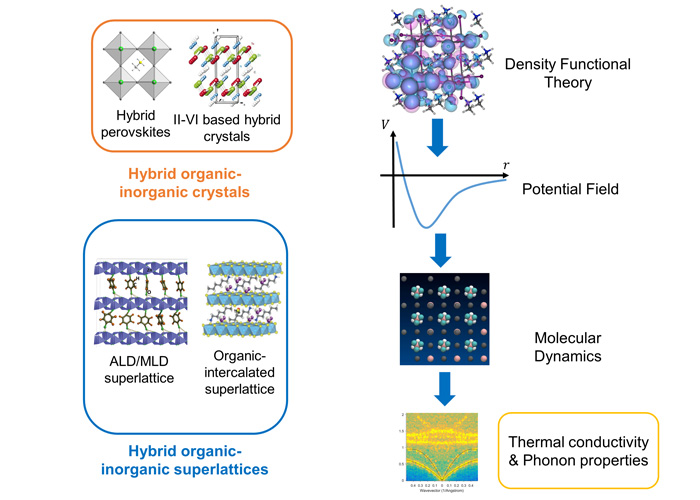
This review article focused on discussing a general first-principles-driven computational methodology for calculating the lattice thermal conductivity of complex semiconductive hybrid crystals and superlattices whose dominant heat carries were the lattice vibrations/phonons. An integrated Density Functional Theory-Molecular Dynamics simulation strategy was reviewed in detail for modeling the thermal conductivity of hybrid crystals and superlattices.
The authors successfully developed empirical potential fields for the range of emerging hybrid organic-inorganic crystals and superlattices, that includes: organic-inorganic II–VI based hybrid crystals, the organometal halide perovskites, and the organic-intercalated titanium disulphide superlattice. This was achieved through fitting of the energy surface/interatomic forces from the ab-initio based first-principles simulations. The development of these potential fields was of significant importance as they were then used to predict the anisotropic thermal conductivity of these novel materials. Their novel simulation technique avoided both the computational challenges in the direct first-principles simulations and the limits of classical molecular dynamics simulation.
The review which we at Advances in Engineering highly recommend to read offers crucial guidance for modeling thermal conductivity of materials with complex atomic structures from the first principles, which could serve as a good tutorial for both graduate students and proficient researchers who are interested in thermal energy transport in emerging hybrid materials.



Reference
Xin Qian, Xiaokun Gu, Ronggui Yang. Thermal conductivity modeling of hybrid organic-inorganic crystals and superlattices. Nano Energy 41 (2017) 394–407
Go To Nano Energy