Advances in Engineering Advances in Engineering features breaking research judged by Advances in Engineering advisory team to be of key importance in the Engineering field. Papers are selected from over 10,000 published each week from most peer reviewed journals.

Significance
The Moon is now seen in more practical terms—as a destination for construction. It’s no longer just about planting flags or collecting samples. If humans are going to stay there for any meaningful duration, they’ll need buildings, roads, shelters. The problem, though, is obvious: we can’t haul cement and steel across space. That’s where lunar regolith—the dusty, volcanic debris blanketing the Moon emerges as a potential construction material. Researchers have proposed geopolymerization as one promising method to turn that local material into something structurally useful. On Earth, we do this all the time with industrial waste like fly ash or blast furnace slag. You mix it with alkaline solutions, and you get a hardened, stone-like product. It’s efficient, low-carbon, and scalable. But lunar regolith isn’t fly ash. It’s dominated by crystalline minerals—pyroxene, olivine, feldspar—that are chemically far more difficult. That changes everything. Even more complicated is the fact that the regolith isn’t the same everywhere. Its chemistry can vary drastically depending on where and how you collect it. Therefore, a one-size-fits-all recipe for lunar geopolymer concrete does not work. Moreover, it is not possible or ideal to conduct trial-and-error experiments when the Moon is 384,000 kilometers away. Recent research paper published in Composites Part B: Engineering Journal and conducted by Dr. Guangjie Xue and Professor Guofu Qiao from the School of Civil Engineering at Harbin Institute of Technology, the researchers investigated carefully the pore solution—the chemical soup inside the material during curing. They tracked which elements dissolved, which reacted, and how that affected the final strength. Then they built a thermodynamic model to tie all of it together. By feeding real experimental data—on ion concentrations, phase evolution, even calorimetric profiles—into that model, they created something much more useful than just another dataset. It’s a predictive framework. One that doesn’t just say “this worked,” but instead helps you figure out what will work when the material changes. That’s essential if we’re serious about building off-Earth.
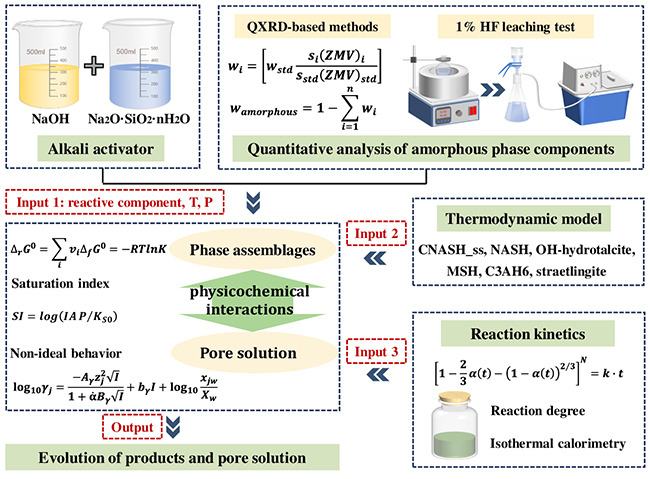
Dr. Guangjie Xue and Professor Guofu Qiao started with HIT-L-1, a lunar regolith simulant sourced from volcanic scoria in Jilin. On paper, it looked promising, but they didn’t take that at face value. They used a combination of Raman spectroscopy, XRD, and elemental analysis to compare its signature against known lunar samples from Apollo and Chang’E missions. This ensured that HIT-L-1 mimics real regolith. From there, they moved to formulation. Using sodium hydroxide and sodium silicate, they prepared a range of activator solutions with different dosages and moduli. The water-to-binder ratio was held constant—likely to isolate chemical variables from rheological ones. Once mixed, the pastes were cured under Earth-like conditions, as close as feasible to a controlled lunar setting in the lab. It’s not perfect, obviously, but for these early-stage studies, ambient curing still tells us a lot. Afterward, they tracked the geopolymerization reaction using isothermal calorimetry. The authors found the pattern to be as following: The higher alkali dosages accelerated the reaction, cutting down the induction period and causing the second exothermic peak—the gelation signal—to occur sooner. But interestingly, those high-dosage systems also produced C₃AH₆, a secondary phase associated with long-term instability. It’s a classic case of more being less. Accelerated kinetics may look good early on, but if they lead to undesirable crystallization, strength and durability suffer later.
To understand what part of HIT-L-1 was truly reactive, Dr. Xue and Professor Qiao performed XRD-Rietveld analysis and paired it with mild HF leaching which allowed them to quantify the amorphous, geopolymer-active fraction—a key distinction, since a lot of the raw material remains inert under alkaline conditions. They fed this data into a thermodynamic model using Cemdata18. Surprisingly, or perhaps reassuringly, the model outputs closely mirrored the lab results. As modulus increased, the gels took longer to form but ended up more developed. At low modulus, they simply lacked enough soluble silica to polymerize fully. Indeed, the consistency between simulation and observation was encouraging. Additionally, TGA showed gel-bound water loss right where it should, and XRD identified the predicted crystalline phases. ICP-OES confirmed the ion concentrations modeled for the pore solution. And the mechanical data aligned, too—samples with mid-range dosage and modulus performed best, striking a balance between rapid activation and structural integrity.
In conclusion, the research work of Dr. Guangjie Xue and Professor Guofu Qiao successfully combined hands-on experimental data with thermodynamic modeling to create something much more useful than raw data: a working framework that can guide material design under conditions we can’t fully replicate on Earth. One of the more striking aspects of the study is its treatment of the pore solution—not as a background detail, but as a central player. Too often in materials research, the focus is narrowly placed on compressive strength or reaction speed, and everything else is treated as secondary. But this team shows that long-term performance is deeply rooted in the chemistry of what’s happening in solution. Their new findings make it clear: it’s not just about getting silica and alumina to react, it’s about getting them to react in just the right proportions. Oversaturate the system and you risk instability. Underdeliver, and you sacrifice structural integrity. It’s a delicate balance—and they managed to chart it with surprising precision. There are practical implications here that reach well beyond academic circles. When we talk about building on the Moon, we’re talking about doing so with materials that must be manufactured on-site, often with little room for error. This new research opens the door to developing adaptable formulations that can be tailored to the specific composition of the local regolith, wherever a mission might land. It introduces the possibility of pre-mission calibration—something we haven’t really had the tools to do until now.


Reference
Guangjie Xue, Guofu Qiao, Coupling thermodynamic modelling with experimental study to reveal the evolutionary relationship of pore solutions, products, and compressive strength for lunar regolith simulant geopolymers, Composites Part B: Engineering, Volume 289, 2025, 111949,