Advances in Engineering Advances in Engineering features breaking research judged by Advances in Engineering advisory team to be of key importance in the Engineering field. Papers are selected from over 10,000 published each week from most peer reviewed journals.

Significance Statement
Energy dissipation in nano-resonators can be categorized into two types, extrinsic dissipation and intrinsic dissipation. Intrinsic dissipation mainly includes thermoelastic damping, Akhiezer damping and surface damping. Understanding and predicting the roles these intrinsic damping mechanisms play in nano-resonators is of crucial importance in design and development of high performance nanoelectromechanical systems (NEMS).
A research led by Dr. Gang Li at Clemson University in the United States, which was published in International Journal of Heat and Mass Transfer, proposed a quasi-continuum thermomechanical computational model, using ballistic phonon transport and phonon modulation theories for numerical analysis of intrinsic damping in crystalline nano-structures. “The quasi-continuum thermomechanical model bridges the atomistic and continuum descriptions of the thermomechanical interactions in crystalline solids,” said Dr. Gang Li, “with this model, computational design tools can be developed for more efficient design and optimization of NEMS.”
For the quasi-continuum thermomechanical model, the researchers applied the lattice dynamics theory to compute thermodynamic and mechanical properties of the crystal lattice, including the phonon dispersion, phonon group velocity, specific heat, and elastic constants. They input those properties into the frequency dependent multi-band Boltzmann transport equation for phonon transport analysis and also into the continuum elasticity theory for mechanical analysis.
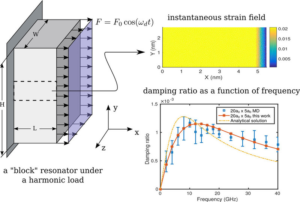
The team used numerical methods, including the finite element and finite volume methods, to solve the thermomechanical model and calculate the damping ratio and quality factor of single crystal silicon nano-resonators under forced vibration.
The team observed that, from their numerical results, for nano-resonators subject to longitudinal vibration and having small surface-to-volume ratio, the damping mechanism is primarily Akhiezer damping. The damping ratio exhibits a Lorentzian behavior as a function of vibration frequency. For nano-resonators with significant surface-volume ratio, the modulated phonons undergo Akhiezer, thermoelastic and surface mechanisms simultaneously to reach thermal equilibrium. In this case, the damping ratio still shows the Lorentzian behavior but with a reduced magnitude. For nano-resonators subject to flexural vibration and having significant surface-to-volume ratio, the strain profile exhibits strong spatial gradient during the vibration. In this case, the thermoelastic and surface damping are dominant and damping ratio varies nearly linearly with the frequency.
Comparison of the results from the quasi-continuum model and molecular dynamics (MD) simulations indicated that the lower size limit of the quasi-continuum model is around 10 nm. Below this size, the finite size effects of the elastic and phonon properties of the nano-resonators must be incorporated in the quasi-continuum model for accurate prediction of the damping ratio.



Journal Reference
Y. Yu, H. Zhao, G. Li, A Quasi-Continuum Thermomechanical Model for Phonon Damping Analysis of Single Crystal Silicon Nano-Resonators, International Journal of Heat and Mass Transfer 106 (2017) 491–502.
Department of Mechanical Engineering, Clemson University, Clemson, SC 29634-0921, United States.
Go To International Journal of Heat and Mass Transfer