Advances in Engineering Advances in Engineering features breaking research judged by Advances in Engineering advisory team to be of key importance in the Engineering field. Papers are selected from over 10,000 published each week from most peer reviewed journals.

Significance
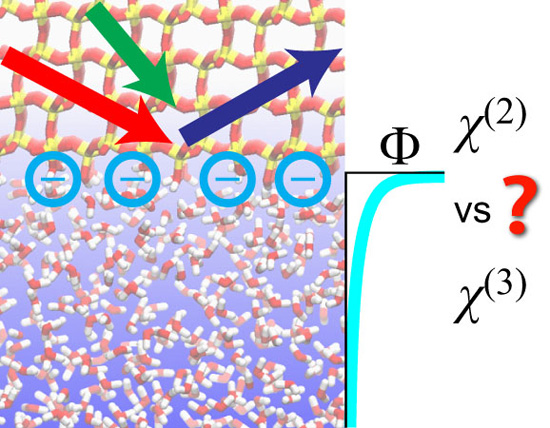
Non-linear spectroscopies, such as second-harmonic generation (SHG) and sum frequency generation (SFG), have in the past been utilized to reveal detailed structures and dynamics at water interfaces. Their use can be attributed to the fact that such spectroscopies are inherently sensitive to the interfaces, as the second-order polarization arises from the broken symmetry. Regardless, when applying these nonlinear spectroscopies to charged medium, interpretation of the resulting signals demand additional caution as the charges generate an electric field which can penetrate to the bulk region of the medium. The perturbed region by the electrostatic field generates an additional polarization of sum frequency: i.e. a third-order signal. Previous studies have demonstrated that the distinction between the second-order (χ (2)) and third-order (χ (3)) terms is vital when it comes to analyzing the SFG/SHG spectra in terms of interfacial structure. Unfortunately, such experimental decomposition have not been so straightforward, since they necessarily requires some assumption or phenomenological modeling of the χ(2) and χ(3) terms as well as the electric field. Therefore, to resolve this issue, molecular dynamics (MD) simulations have been successfully employed since they provide molecular pictures in vibrational spectra directly from the MD trajectories.
In a recent paper published in Physical Chemistry Chemical Physics, Professor Akihiro Morita and Mr. Tomonori Hirano (PhD student) from Tohoku University in collaboration with Dr. Tatsuya Joutsuka at Ibaraki University and Professor Michiel Sprik at University of Cambridge evaluated the third-order susceptibility χ(3) in the vibrational SFG spectrum of water using molecular dynamics simulations. They demonstrated that the intrinsic spectra of the charged interfaces become clearer after correcting the χ(3) contribution in the SFG spectra.
The research method employed by the authors involved calculating the χ(3) spectrum of bulk liquid water, where the second-order signal inevitably vanished due to its isotropy. Next, the researchers performed molecular dynamics computations of χ(3) with the same water model that they had previously used to reproduce the SFG spectra of liquid water. With the calculated χ(2) and χ(3) spectra at hand, the researchers then analyzed the vibrational SFG spectra of the air/water interface under an electric field so as to evaluate both contributions. Lastly, the molecular dynamics analysis of χ(2) and χ(3) contributions was further applied to silica/water interfaces with varying charges.
The research team observed that the intrinsic spectra converged up to ~7.0 Å from the interfaces, thereby demonstrating that the surface contributions converge within a few molecular layers. In addition, it was noted that at the air/water interface under an external field, the intrinsic spectrum showed a large perturbation in the free OH and its shoulder band, which indicated that the structure of free OH was particularly perturbed under an electric field. Furthermore, at the deprotonated silica/water interface, the intrinsic spectrum was seen to be composed of a negative low-frequency band and a positive high-frequency one.
Tatsuya Joutsuka and colleagues study revealed the χ(3) contribution of water in the SFG spectroscopy using molecular dynamics simulations. It was noted that the χ(3) effect was mainly attributed to the effect of induced molecular orientation by the electric field on the nonlinear susceptibility. Altogether, their analysis of the spectral changes allows for further comprehension of the intrinsic change of the interface structure and the χ(3) effect from bulk liquid.




Reference
Tatsuya Joutsuka, Tomonori Hirano, Michiel Sprik and Akihiro Morita. Effects of third-order susceptibility in sum frequency generation spectra: a molecular dynamics study in liquid water. Phys.Chem.Chem.Phys., 2018, volume 20, page 3040
Go To Phys.Chem.Chem.Phys.