Advances in Engineering Advances in Engineering features breaking research judged by Advances in Engineering advisory team to be of key importance in the Engineering field. Papers are selected from over 10,000 published each week from most peer reviewed journals.

Significance
The authors replicated Ma et al.’s experimental configuration using a 0.5 m diameter, 0.9 m length isothermal cylinder rotating in quiescent air. The surrounding computational domain was twenty times larger in diameter to ensure undisturbed plume development. Boundary conditions included no-slip, isothermal cylinder walls at 307 K, ambient air at 293 K, and open pressure outlets. Using ANSYS Fluent v2023-R1, the authors solved the incompressible Navier–Stokes and energy equations with both laminar and SST k–ω turbulence models, selecting each based on the rotational Reynolds number (Rer). A fine hexahedral mesh (≈2.3 × 10⁶ elements) and first-order implicit time stepping (Δt = 5 × 10⁻⁴ s) yielded stable convergence, while grid-independence and time-step sensitivity were verified using the Grid Convergence Index (GCI) method.
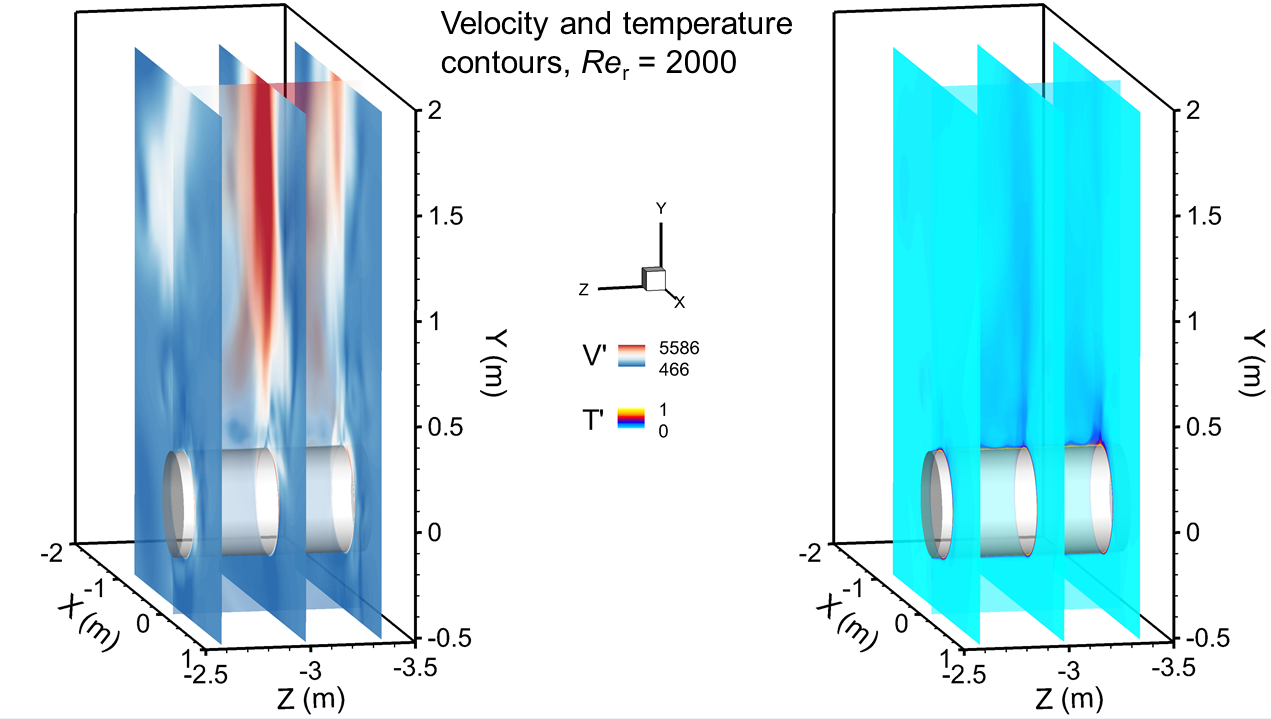
The authors found that at low Rer (< 1.7 × 10⁴), buoyancy dominated and the computed fields displayed a vertical Rayleigh–Bénard plume rising from the cylinder top, obstructing upper-surface convection. Moreover, temperature contours revealed thin boundary layers and a highly stratified plume that reduced local Nusselt numbers near the top. Increasing Rer weakened this plume while promoting lateral flow attachment, causing surface temperature uniformity and a gradual rise in the mean Nusselt number (Nu). When rotation exceeded the critical Reynolds number, turbulent behavior emerged. The SST k–ω model reproduced the experimental Nu–Rer relationship with less than 4% deviation and an overall normalized root-mean-square error (NRMSE) of 0.035 compared with large-eddy simulations. Distinct transitions were identified: (i) plume detachment at Rer ≈ 2 × 10⁴, (ii) plume merging with the cylinder at 5.6 × 10⁴, and (iii) boundary-layer thickening and enhanced turbulent mixing beyond 7 × 10⁴. These dynamic changes altered the circumferential Nu(φ,z) profiles—lower on the descending side due to plume shading, higher near axial ends where boundary layers thinned. The team showed that visualization of cross-sections revealed thumb-like plumes at mid-span evolving into multiple small eddies near the ends which confirmed the need for three-dimensional modeling. Despite thicker boundary layers at higher speeds, intensified turbulence compensated by enhancing overall convective flux. They reported the mean Nusselt numbers to increase monotonically with Rer, which align with empirical correlations however, this exposed localized variations unseen in experiments. Additionally, the computed deflection angle of the trailing vortex also matched Schlieren images from previous studies and demonstrated less than 5% error in predicting plume orientation.
In conclusion, the research work of Professor Kuang C. Lin and colleagues form a unified three-dimensional framework capable of accurately predicting both average and local Nusselt number distributions across transitional regimes, marking a substantive advance in the numerical analysis of rotating-surface convection. It actually redefines how rotating-surface convection is understood, offering the first quantitatively validated three-dimensional CFD model that continuously links laminar buoyant flow to fully turbulent rotation-induced convection. Beyond reproducing experimental averages, it exposes the spatial heterogeneity of heat transfer—how boundary-layer evolution along both circumferential and axial directions dictates performance. The findings clarify that plume-cylinder interactions, rather than average flow speed alone, control where thermal resistance arises. The new findings have implications for several engineering systems. In rotary kilns and drum reactors, plume detachment reduces uniform heating; managing rotational speed near the critical Rer may stabilize convection. In rotating machinery such as electric motor drives or turbine rotors, the study’s results help predict hot-spot formation on descending surfaces where buoyancy opposes rotation. Likewise, in nuclear heat-exchanger arrays and chemical reactors, the axial thinning of boundary layers identified here can inform optimal spacing and cylinder aspect ratios. The research also demonstrates the utility of the SST k–ω turbulence model as a computationally efficient alternative to LES for rotating systems. By capturing near-wall shear and pressure gradients accurately, it balances precision and cost, enabling broader use in industrial design optimization. Equally notable is the observation that heat-transfer enhancement scales not linearly but conditionally with Rer: once plume merging occurs, further rotation increases turbulent dissipation rather than merely advection. This nuanced understanding could guide the development of adaptive cooling systems where speed is modulated to maintain thermal efficiency. We believe the methodology can be extended to non-isothermal, multi-phase, or confined rotating geometries, providing predictive capability for next-generation energy systems. The authors emphasize that future models should resolve transient instabilities and surface roughness effects under variable Grashof numbers to fully characterize transition dynamics. In a nutshell, the work by Professor Kuang C. Lin and colleagues establishes a new reference for CFD-based thermal design in rotating systems, transforming how engineers analyze, predict, and control convective heat transfer in air.




REFERENCE
Nguyen, Thi & Kuo, Han-Hsiang & Liao, Chuan-Chieh & Lin, Kuang. (2025). 3-D CFD Analysis of Convective Heat Transfer from a Heated Horizontal Cylinder Rotating In Air: From Laminar to Turbulent Flow. ASME Journal of Heat and Mass Transfer. 147. 1-31. 10.1115/1.4068377.
ASME Journal of Heat and Mass Transfer.