Advances in Engineering Advances in Engineering features breaking research judged by Advances in Engineering advisory team to be of key importance in the Engineering field. Papers are selected from over 10,000 published each week from most peer reviewed journals.

Significance
The global construction sector is currently dominated by use of steel and concrete. However, modern engineered timber products are rapidly penetrating the construction sector including for tall buildings. Generally, timber is more sustainable compared to steel and concrete and thus is capable of reducing the overall environmental footprint.
Height limitations have for a long time prevented the use of timber in tall buildings due to perceived limitations under lateral loads such as wind forces and earthquakes. To overcome this limitation, several innovative systems such as the Holz-Stahl-Komposit (HSK) hold-down and materials such as cross-laminated timber (CLT) have been developed to provide resistance against lateral loads as a solution for tall timber buildings.
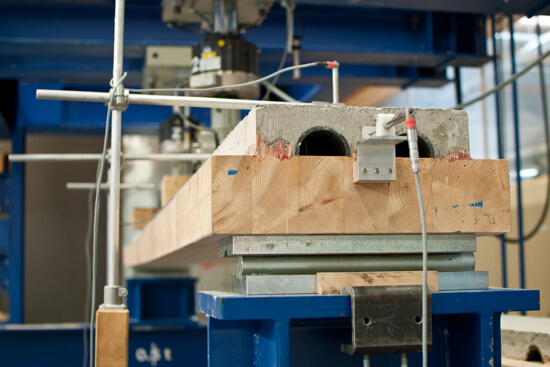
Drs. Xiaoyue Zhang at The University of British Columbia, Marjan Popovski at PFInnovations and Thomas Tannert at the University of Northern British Columbia designed a modified HSK as a yielding fuse inside CLT panels. They conducted material small-scale, component mid-scale and system full-scale tests under quasi-static monotonic and reversed cyclic loading and published their work in the research journal, Construction and Building Materials.
The Canadian research team devised two experimental set-ups to evaluate the connection properties. In the first setup, specimens were rotated at 14.5° with one shear plane while in the second setup, two shear planes were used. They observed that the first set-up provided better alignment for the support and resultant loading force thereby suitable for quasi-static monotonic tests while the second set-up was better suitable for reverse cyclic tests.
The authors observed that the designed arrangements and modifications prevented lateral buckling and increased energy dissipation of the hold-down by allowing development of yield mechanisms inside the CLT. Connection properties such as strength, ductility and stiffness entirely depended on the number of adhesive dowels and covered rows of steel links in the connections while the grain orientation of the timber had no effect on the connection properties of the modified system.
Consequently, the hold-down tests carried out validated the hypothesized behavioral properties of the modified HSK system. The Canadian researchers presented a novel high-capacity hold down solution that will advance and escalate the development and use of timber products in construction, especially in tall buildings.

Reference
Zhang, X., Popovski, M., & Tannert, T. (2018). High-capacity hold-down for mass-timber buildings. Construction and Building Materials, 164, 688-703.
Go To Construction and Building Materials