Advances in Engineering Advances in Engineering features breaking research judged by Advances in Engineering advisory team to be of key importance in the Engineering field. Papers are selected from over 10,000 published each week from most peer reviewed journals.

Significance Statement
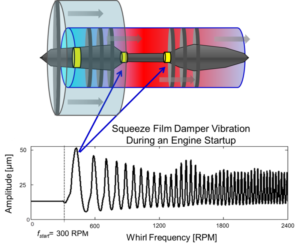
Turbomachinery such as centrifugal compressors and aircraft engines will undergo startups/shutdowns and traverse critical speeds. While in operation, turbomachinery may also experience sudden maneuver loads, loss of lift due to turbulence or interruption in lubricant supply, or even blade loss events that trigger large amplitude rotor vibration. Squeeze film dampers (SFDs) reduce the amplitude of rotor vibration during these transient events and enhance system stability and structural isolation of the rotor.
Prior to startups and while at rest, rotors and dampers may sit at their clearance bottom, which may be in contact with the engine’s housing. As the engine accelerates, hydrodynamic pressure produced in the lubricant film lifts the rotor/damper and displaces it away from the housing. Until the rotor is centered within the clearance, however, the housing and supporting structures fatigue from large cyclical transmitted loads emanating from asymmetrical and skewed orbits of the rotor. Furthermore, during an aircraft hard landing, loss of lift, or blade loss event, the rotor-bearing system undergoes large elliptical whirl orbits that are also severely off-centered within the available clearance and consequently experiences large amplitude transmitted loads as well.
In their publication in Journal of Engineering for Gas Turbines and Power Professor Luis San Andrés led a team of researchers in presenting the findings from an elastically supported short-length SFD operating during transient conditions with movements originating from large static eccentricities. The authors composed an experiment that quantified dynamic performance of a SFD exposed to centered and off-centered whirl orbits initiated by various combinations of dynamic and static loads. They measured the SFD displacements, accelerations, and oil film pressures that were central to characterizing the response of the damper while crossing two system natural frequencies.
Among the experimental findings, some of the more interesting observations were that the amplitude of the motions from the off-centered operation was smaller compared to that of motions from the centered position. This was owing to the large damping produced by a small lubricant film thickness that exists in an off-centered position. Also the SFD, for off-centered positions, exhibited lower resonance frequencies when compared to the frequencies for centered operation.
findings, along with others highlighted in their article, enabled the authors to demonstrate that SFDs can effectively control a rotor-bearing system’s amplitude of vibration in response to several operating conditions and even during transient conditions – for instance an engine start-up from an off-centered rotor position.


Reference
Luis San Andres1, Sean Den2, and Sung-Hwa Jeung3. Transient response of a short length (L/D=50.2) open-ends elastically supported squeeze film damper: centered and largely off-centered whirl motions. Journal of Engineering for Gas Turbines and Power, volume 138 (2016).
[expand title=”Show Affiliations”]- Mast–Childs Chair Professor, Fellow ASME, Turbomachinery Laboratory,
Mechanical Engineering Department, Texas A&M University, College Station, TX 77843 - Mechanical Maintenance Engineer, Formosa Plastics Corp., Point Comfort, TX 77978
- Graduate Research Assistant, Turbomachinery Laboratory, Mechanical Engineering Department, Texas A&M University, College Station, TX 77843
Go To Journal of Engineering for Gas Turbines and Power