Advances in Engineering Advances in Engineering features breaking research judged by Advances in Engineering advisory team to be of key importance in the Engineering field. Papers are selected from over 10,000 published each week from most peer reviewed journals.

Significance
In modular steel construction, volumetric building units are largely completed in the factory before being transported to the site. Their structural framing, interior finishes, plumbing, insulation, and waterproofing are often pre-installed, meaning that inter-module connections must satisfy both structural and construction requirements. They must transfer lateral forces, accommodate erection tolerances, remain accessible for inspection, and avoid damaging pre-installed finishes and envelope layers. These demands are especially important under lateral loading, when adjacent modules must transfer shear forces and accommodate relative translation, gap opening, and local deformation. Many existing inter-module connections depend on field welding, concealed engagement devices, complex components, or large access openings. Although such systems may provide adequate structural resistance, they can slow construction, increase fabrication costs, and interfere with finished floors and walls.
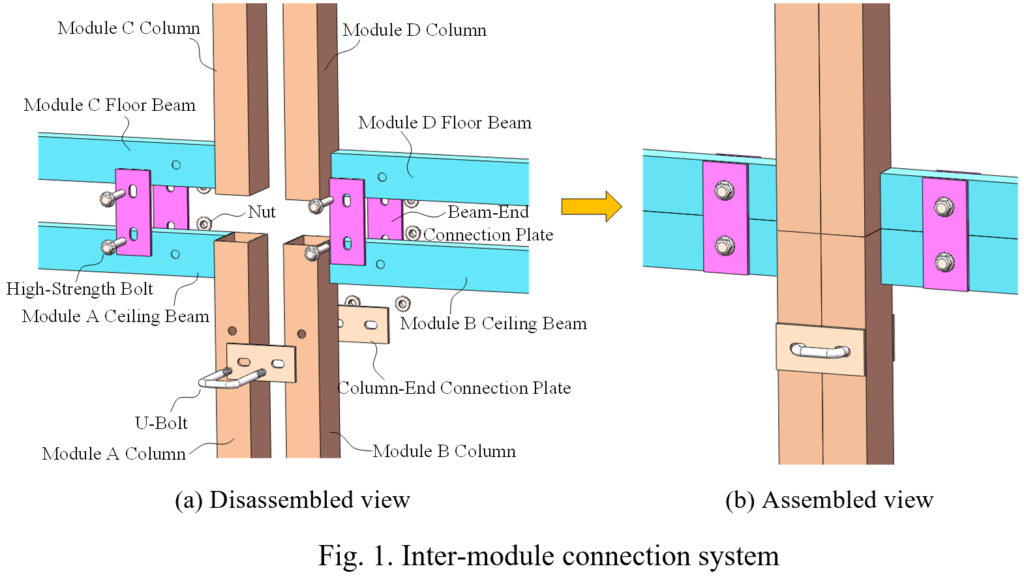
In a recent study published in the Journal of Building Engineering, Dr. Xin Yan, Professor Jingfeng Wang, Tianyang Hu, and Zhengyuan Wu from Hefei University of Technology, together with Mr. Baochun Pan from Hefei Royalstar Electronic & Electrical Appliances Group Co., Ltd., developed an envelope-compatible, all-bolted inter-module connection for low-rise modular steel buildings. The main novelty of the new study is the use of U-bolts and column-end plates to connect adjacent module columns, combined with high-strength bolted plates joining the stacked floor and ceiling beams. Instead of attempting to create full moment-resisting continuity, the system acts as a partial-strength connection that transfers lateral forces while allowing controlled relative movement between modules.
The U-bolts transfer force through clamping and bearing against the column-web bolt holes. This arrangement improves deformation compatibility between adjacent columns during cyclic loading. The connection components are also concentrated in accessible regions of the column and beam webs. No U-bolts are placed at the bases of the upper columns, where installation could disturb pre-installed insulation and waterproofing. The design therefore combines structural performance with practical construction requirements.
Another benefit is the reliance on standard plates, U-bolts, and high-strength bolts rather than proprietary locking mechanisms, sleeves, or grouted components. This simplifies fabrication and procurement, reduces dependence on field welding, and provides clearly visible load-transfer paths that can be inspected after installation.
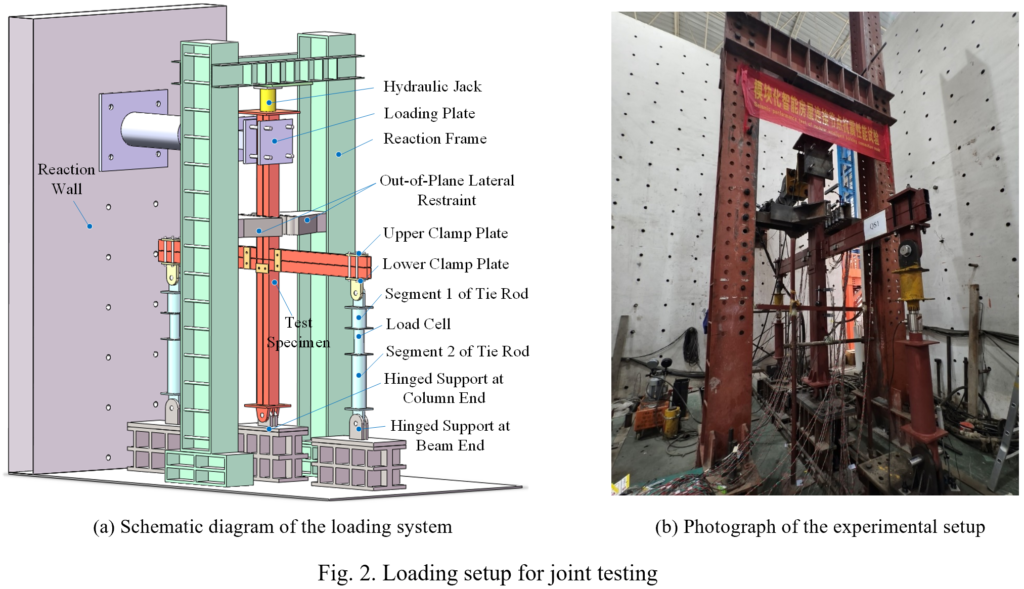
The researchers tested seven full-scale cruciform joints fabricated from Q355B structural steel. One fully welded specimen served as the reference. The remaining specimens used high-strength bolted beam connections together with either U-bolt–plate or conventional high-strength bolted column connections. The column connectors were placed on the web, on the flange, or at both the upper and lower column levels.
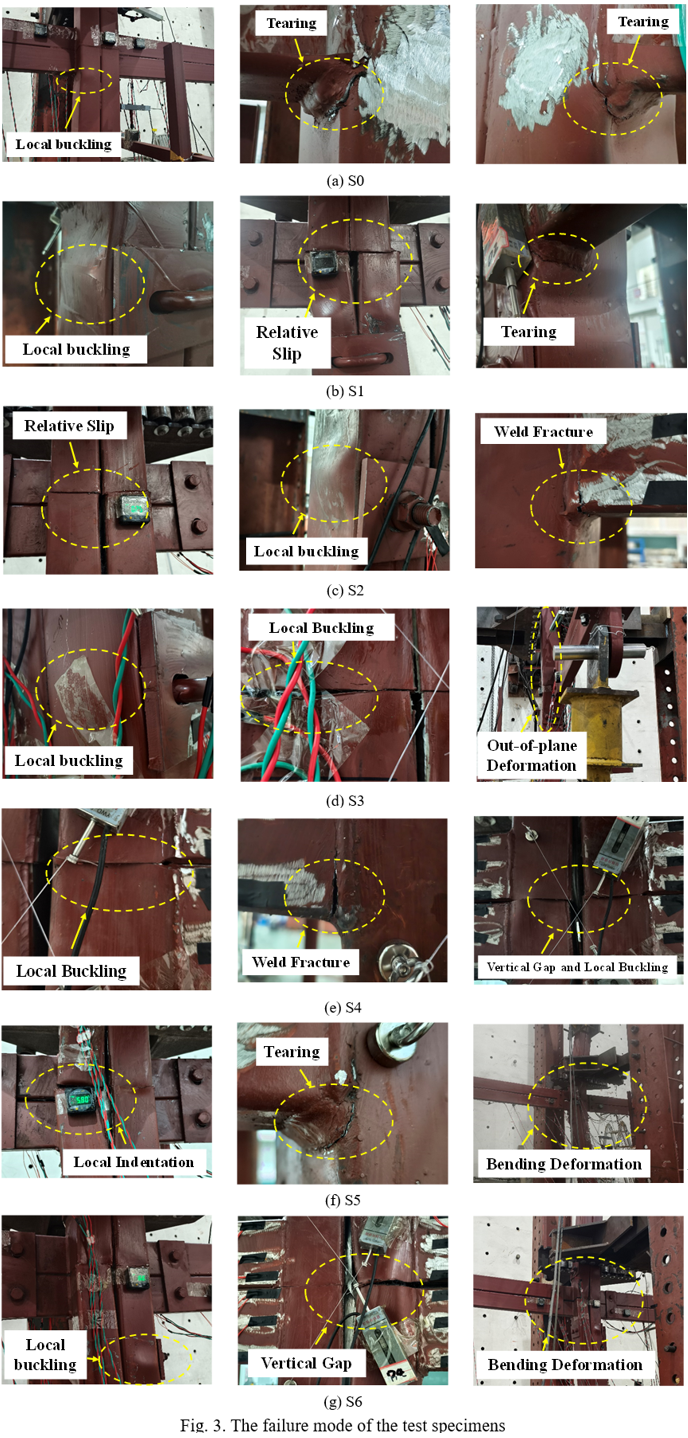
The authors applied a constant axial load through the upper columns while the specimens were subjected to cyclic lateral displacement. The tests measured hysteretic response, peak resistance, stiffness degradation, deformation capacity, energy dissipation, local displacement, and strain development. They also developed a finite element model to examine stress distribution and the force-transfer mechanisms within the joint. The team found that, across the specimens, damage generally began with local buckling of the column walls near the inter-module connection. As drift increased, relative movement and gap opening developed between the upper and lower modules. Final deterioration was commonly associated with column-wall tearing or weld fracture near the interface between the ceiling beam and the lower modular column. Damage was therefore concentrated in the joint region and lower-column segment rather than through widespread yielding of the modular beams.
The main advantage of the U-bolt detail became evident once the drift ratio exceeded approximately 1.0%. The team observed that, at smaller drift levels, the bolted configurations showed similar resistance. At larger drift, however, the U-bolt specimens achieved higher peak loads and sustained greater deformation than comparable specimens using conventional high-strength bolted column connections. In the web-connected comparison, the U-bolt specimen reached 2.0% drift before column-wall tearing, whereas the conventional bolted specimen failed at 1.5% drift because of weld fracture. A similar result was observed for the flange-connected pair. The U-bolt specimen maintained resistance to 2.0% drift, while the conventional bolted specimen experienced sudden strength loss at 1.5%. These results show that the U-bolt assembly provided a more adaptable force-transfer mechanism and delayed abrupt local failure. The location of the lower-column connector on the web or flange had only a limited effect on overall strength and stiffness.
When the authors installed bolted restraints at both the upper and lower columns, a significant change occurred. These double-level arrangements created additional load-transfer paths and allowed the specimens to reach 2.0% drift. However, their hysteresis loops became more asymmetric under load reversal, which indicates that the force-transfer mechanism differed between the two loading directions.
The authors performed strain measurements to better understand the joint response and found the stacked floor and ceiling beams largely behaved as separate flexural members, and most beam-web strains remained below nominal yield before joint deterioration. Much higher strains developed in the beam connection plates, showing that the beam-to-beam interface carried a large share of the local force transfer. Beyond approximately 0.5% drift, deformation increasingly concentrated in the lower-column segment below the inter-module joint. The finite element models reproduced the main hysteretic trends, initial stiffness, peak resistance, and stress development observed experimentally. They identified elevated stresses in the column walls and beam connection plates, consistent with the measured strains and physical damage. The validated finite element model therefore provides a useful tool for investigating local strengthening measures and connection refinements before further full-scale testing.
The connection proposed by Xin Yan et al. provides an accessible, all-bolted load-transfer path made from common components and allows relative movement between stacked modules during cyclic loading. The U-bolt connection better accommodates relative displacement between adjacent modules under repeated loading while maintaining force-transfer capacity at larger drift levels than comparable conventional bolted connections.


Reference
Xin Yan, Jingfeng Wang, Tianyang Hu, Zhengyuan Wu, Baochun Pan, Seismic performance of a novel U-bolt–based inter-module connection: Experimental investigation and finite element modeling, Journal of Building Engineering, Volume 125, 2026, 116020.
Go to Journal of Building Engineering