 Advances in Engineering Advances in Engineering features breaking research judged by Advances in Engineering advisory team to be of key importance in the Engineering field. Papers are selected from over 10,000 published each week from most peer reviewed journals.

Significance
With the ever-growing demand for efficient heat dissipation in high heat flux electronics and energy systems, conventional working medium are rapidly approaching their thermal performance limits. Developing scalable, low-concentration nanofluid solutions for enhanced boiling heat transfer has thus become a critical research priority. In response to this challenge, the present study introduces and investigates a novel class of metal-functionalized graphene nanoplatelet (GNP) nanofluids. By integrating experimental boiling measurements with theoretical modeling, the work reveals both the enhancement mechanisms and engineering potential of these advanced working media.
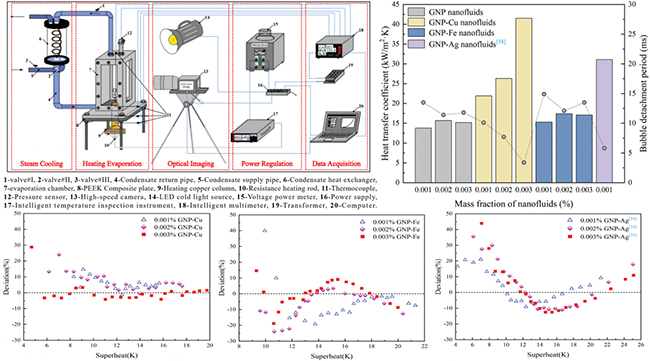
The research team synthesized ultra-low-concentration nanofluids (0.001–0.003 wt%) using copper (Cu) and iron (Fe) functionalized GNPs, and systematically evaluated their boiling characteristics. The results show that GNP-Cu nanofluids, at only 0.003 wt%, achieve a critical heat flux (CHF) of 1900.7 kW/m² and a heat transfer coefficient (HTC) of 96.3 kW/(m²·K). These values represent increases of 75.1% and 80.4%, respectively, over deionized water, marking one of the most significant enhancements reported to date at such low concentrations. This demonstrates the highly efficient utilization of nanomaterial properties without the need for large particle loadings.
To facilitate practical application, the study further develops a modified boiling curve model based on the classical Rohsenow correlation. By introducing correction factors tied to nanoparticle type and concentration, a linearized formulation is proposed that accurately predicts boiling behavior across GNP-Cu, GNP-Fe, and GNP-Ag nanofluids. The resulting model is compact, tunable, and generalizable—making it a valuable tool for rapid thermal system assessment and design.
Microscale bubble dynamics were investigated using high-speed visualization. Compared to unmodified GNP nanofluids, GNP-Cu nanofluids displayed higher nucleation site density, smaller bubble departure diameters, and shorter detachment cycles. These features effectively delayed the onset of film boiling and improved local heat transfer. The study also proposes a novel mechanism termed “nanobubble–radiation synergy,” where the high infrared emissivity of graphene leads to localized vapor layer formation, enhancing microscale agitation and vaporization processes. Though not directly validated, this hypothesis offers a forward-looking direction for nanofluid research involving optical or radiative effects.
In summary, this study presents an integrated advance in nanofluid design, performance measurement, mechanistic understanding, and predictive modeling. It convincingly demonstrates that significant boiling heat transfer enhancement can be achieved through metal-functionalized GNPs at low concentrations, avoiding the need for high loading or rare materials. The results provide a solid theoretical and experimental foundation for deploying these working media in next-generation thermal management systems for electronics, power devices, and renewable energy platforms.



Reference
Xiang, L., Song, Y., Yang, D., Zhang, Z., Cui, Y., & Vafai, K. (2023). Experiments and modeling of boiling heat transfer of GNP nanofluids with metallic elements. Experimental Heat Transfer, 38(2), 127–144. https://doi.org/10.1080/08916152.2023.2298495