Advances in Engineering Advances in Engineering features breaking research judged by Advances in Engineering advisory team to be of key importance in the Engineering field. Papers are selected from over 10,000 published each week from most peer reviewed journals.

Significance
To this account, new research paper published in Science Journal and led by Professor Andrea Cavalleri from the Max Planck Institute for the Structure and Dynamics of Matter in Hamburg in collaboration with Professor Paolo Radaelli from the Department of Physics at University of Oxford, researchers developed two complementary models describing how circularly driven Eu phonons act as an effective axial conjugate field capable of biasing and reversing ferroaxial domains. One model treats the phonon displacement and terahertz electric field as coupled vectors whose cross-product directly shifts the ferroaxial potential landscape, while the second uses equations of motion to capture threshold-dependent switching dynamics.
The research team tested whether circular phonon excitation can function as a true ferroaxial conjugate field by combining time-resolved terahertz excitation with SHG-CD probing at micrometer-scale sample locations. Their experimental platform was built around resonant excitation of the 24-THz doubly degenerate Eu phonon modes, which produce in-plane atomic motions. By shaping the terahertz pulses to be circularly polarized, they caused the electric field and displacement vectors to rotate in tandem, ensuring that their cross-product remained directionally fixed throughout the pulse. This dynamical configuration is essential because it injects a torque on the ferroaxial soft mode with a sign strictly governed by the helicity of the terahertz field. The first step was to prepare RbFe(MoO₄)₂ below its ordering temperature (TC ≈ 190 K) and identify the ferroaxial domain using static SHG-CD. At 180 K, the team targeted an unambiguously identified A⁺ domain and delivered a single right-circularly polarized terahertz pulse with a fluence of 20 mJ/cm². Once the lattice had relaxed thermally, the same spot was re-probed using static SHG-CD. The signal, originally positive, reappeared with nearly the same magnitude but negative sign—direct evidence that the domain had switched to A⁻. A second pulse of opposite helicity restored the A⁺ domain, demonstrating single-shot, helicity-controlled reversibility. To examine this behavior systematically, the authors applied sequences of terahertz pulses with alternating helicities, each followed by an SHG-CD readout. The ferroaxial domain flipped back and forth in synchrony with the pump’s handedness, establishing a direct causal link between phonon helicity and axial switching. A fluence-dependent study further revealed a threshold around 14 mJ/cm², below which the potential wells remain nearly degenerate and the domain is stable, but above which the dynamical bias introduced by the circular phonon motion is strong enough to overcome the barrier. This threshold behavior matches numerical solutions of the coupled equations of motion governing the phonon displacement and axial coordinate, confirming the mechanism proposed. The experiments also probed the para-axial state above TC, where no static ferroaxial order exists. At 200 K, a left-circular terahertz pulse induced a short-lived positive SHG-CD signal—a transient A⁺ axial polarization—while a right-circular pulse produced a negative response. The sign change followed the helicity precisely and disappeared when linearly polarized pulses were used. The lifetime of the signal, tracking the overlap between the terahertz envelope and the phonon coherence, corroborated a mechanism rooted in driven lattice dynamics rather than slower structural relaxation.
In conclusion, the new study by Cavalleri, Radaelli, and colleagues developed new route for controlling ferroic order that is rooted in nonlinear lattice dynamics engineered at terahertz frequencies. Beyond demonstrating the first nonvolatile optical switching of ferroaxial domains, the results carry broader implications for the future of ultrafast materials control. Because ferroaxial systems lack the depolarizing fields that frustrate ferroelectric switching at optical frequencies, the domain reversal achieved here remains stable over hours without external fields or feedback mechanisms. This inherent stability sharply distinguishes ferroaxial switching from earlier attempts to reverse ferroelectric polarization through nonlinear phononics, where the induced state tended to decay due to internal electrostatic pressures.
We believe the ability to write and rewrite ferroaxial domains using single terahertz pulses also opens a new parallel with magnetic all-optical switching, yet with potentially greater robustness. The energy scales and timescales observed—threshold fluences on the order of tens of mJ/cm² and switching dynamics expected in the picosecond regime—are competitive with or faster than many optical magnetism schemes, suggesting a viable foundation for ultrafast, high-density information storage that uses rotational order instead of spin or polarization. A second major implication is in their demonstration of helicity-dependent transient axial polarization above TC and this capability points toward the active design of “non-equilibrium ferroics,” where functionalities emerge only under dynamic driving. This approach may substantially broaden the palette of symmetry-broken states available for future devices, especially in materials where equilibrium phases are difficult to stabilize.
Moreover, the resonance between the Eu phonon and the driven axial response also reinforces the role of phononic engineering as a new design principle in condensed matter physics. Rather than relying on static fields that couple poorly to certain order parameters, one can tailor light–phonon interactions to craft effective fields with the correct symmetry properties. The universality of the underlying symmetry arguments suggests that this mechanism should extend to many other ferroaxial compounds, as well as multiferroics where axiality underpins couplings between electric and magnetic textures. In sum, the innovative work provides us with the roadmap toward devices that operate by steering rotational degrees of freedom in crystals, introduces a pathway to explore hidden non-equilibrium phases, and highlights terahertz circular phononics as a powerful and generalizable tool for manipulating complex solids.
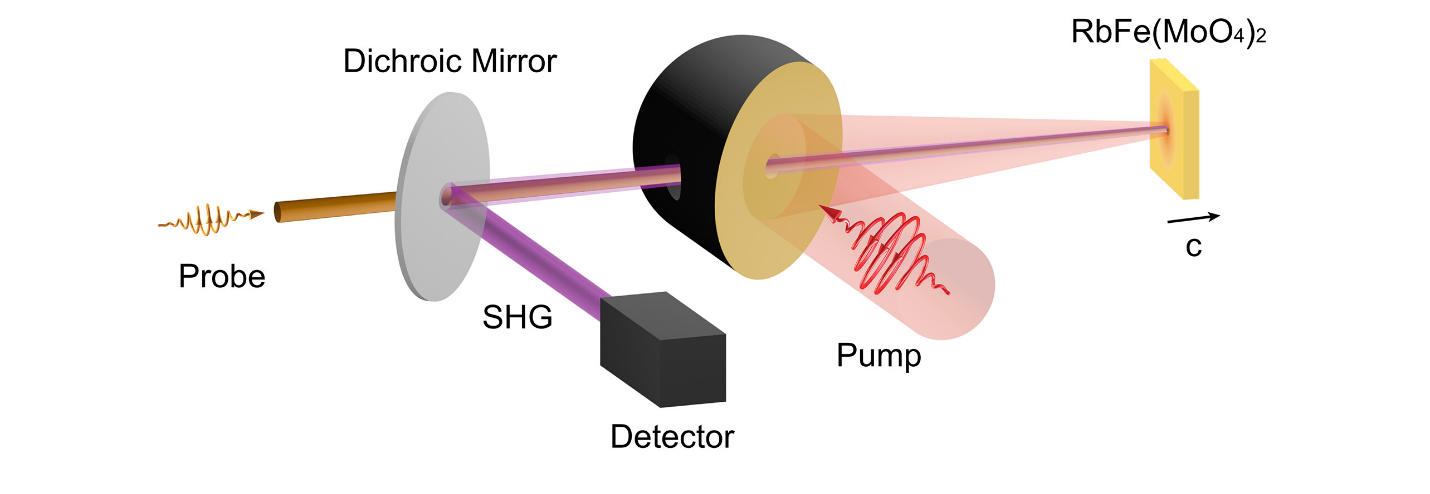
Schematic of the experimental setup. A circularly polarized terahertz excitation pulse, polarized in the ab plane, drives circular motion of the doubly degenerate Eu symmetry phonons in RbFe(MoO4)2. SHG-CD monitors the ferroaxial state at the excited position. Credit: Science. 2025 Oct 9;390(6769):195-198. doi: 10.1126/science.adz5230.


REFERENCE
Zeng Z, Först M, Fechner M, Prabhakaran D, Radaelli PG, Cavalleri A. Photo-induced nonvolatile rewritable ferroaxial switching. Science. 2025;390(6769):195-198. doi: 10.1126/science.adz5230.
Go To Science