Advances in Engineering Advances in Engineering features breaking research judged by Advances in Engineering advisory team to be of key importance in the Engineering field. Papers are selected from over 10,000 published each week from most peer reviewed journals.

Significance
Although refrigeration-based approaches remain effective at large scales, their energy demands and mechanical complexity make them difficult to deploy in remote settings. Sorption–desorption systems, by contrast, have attracted considerable interest because they can function at low relative humidity and can be paired with renewable energy sources. However, they carry a persistent drawback: nearly all require substantial heat input to desorb water from the sorbent. Even modern sorbents such as polymer hydrogels, salt–polymer composites, metal–organic frameworks, and advanced hygroscopic materials—must ultimately overcome the enthalpy of vaporization to release liquid water. The temperatures required for this step vary widely across materials, but the associated energy burden routinely exceeds both theoretical limits and practical thresholds for low-cost deployment. In many studies, the actual energy consumed during thermal desorption is an order of magnitude higher than the ideal thermodynamic minimum, largely because the supplied heat also warms the sorbent and surrounding hardware, and significant losses occur to the environment. These constraints raise an important question for the field: is the reliance on heat intrinsic to atmospheric water harvesting, or merely a consequence of the techniques traditionally used to release stored water? A growing body of work hints that alternative mechanisms may be possible. Mechanical actuation, for example, has been exploited in atomizers and micro-electromechanical systems to propel liquid droplets using high-frequency vibration. If similar principles could be applied to moisture-laden sorbents, it might be feasible to expel water without imposing the energetic cost of phase change.
To this account, new research paper published in Nature Communications and conducted by Ikra Iftekhar Shuvo, Carlos Díaz-Marín, Marvin Christen, Michael Lherbette, Christopher Liem, and led by Professor Svetlana Boriskina from the Department of Mechanical Engineering at Massachusetts Institute of Technology, the researchers developed a vibrational water-extraction system that couples tailored hydrogels with a high-displacement piezoelectric actuator to release moisture mechanically rather than through evaporation. They also created two analytical models—an anomalous-diffusion framework describing water transport under ultrasound and a deep-learning classifier that interprets impedance signatures to track sorbent hydration in real time. The research team approached the problem by coupling tailored hydrogels with piezoelectric ultrasonic actuators, testing whether mechanical oscillation could liberate water far more efficiently than heating. They synthesized a family of PAM–LiCl hydrogels with different crosslinking densities and compared them to a commercial hydrogel. By adjusting the amount of MBA crosslinker, they produced samples that varied widely in stiffness, swelling behavior, and microstructure. Mechanical testing confirmed large differences in storage modulus, and SEM images revealed how pore density changed as the network became more rigid. These structural variations turned out to be crucial, because they controlled how ultrasonic waves propagated through the material and how easily water could be mobilized out of the polymer network.
The authors also engineered a set of ultrasonic actuators consisting of PZT rings bonded to stainless-steel membranes perforated with micro-nozzles. They fabricated several variants differing in resonant frequency and nozzle diameter, then characterized each by vibrometry and electrical impedance spectroscopy. This characterization made it possible to identify which transducers delivered the largest displacement amplitudes and highest membrane velocities—key parameters for maximizing mechanical forcing on the hydrogel. Through these comparisons, the device with 100-µm nozzles (PZ-C) emerged as the most effective, exhibiting strong resonance around 107 kHz and the greatest vibrational amplitude. The team’s water extraction experiments involved soaking hydrogel samples, placing them onto the vibrating membrane, and actuating the device with controlled voltage and duty cycles. Instead of forming vapor, water emerged as liquid droplets propelled through the micro-nozzles, a behavior captured using laser illumination and high-speed photography. Across a range of sample sizes and moisture levels, the investigators observed that heavier, well-saturated hydrogels tended to extract water more efficiently, likely because they maintained stable contact with the membrane. They compared with Joule heating and demonstrated the advantage of mechanical actuation. When both heating and vibration were driven at the same 1.5 W input power, the piezo-driven process removed water dramatically faster and at a fraction of the energy cost. Extraction kinetics showed that the membrane temperature rose moderately due to hysteresis loss in the PZT, but the mechanical component dominated performance. Moreover, the authors analyzed mass-loss data using the Korsmeyer–Peppas model. The fitted exponents indicated anomalous diffusion, suggesting that the polymer network undergoes relaxation under ultrasonic forcing, enabling water to move non-Fickianly through the matrix. Ultrasonic attenuation measurements further showed that stiffer gels dissipated acoustic energy more strongly, which correlated with reduced extraction efficiency.
In conclusion, Professor Svetlana Boriskina and colleagues demonstrated water extraction using vibrational energy at levels far below the thermal limit, the authors reveal a path toward systems that operate primarily through mechanics rather than phase change. If implemented at scale, such systems could make decentralized water production economically viable in regions where thermal systems struggle. The energy cost measured here—on the order of 0.3–0.6 MJ per kilogram of water in optimized cycles—is lower not just than conventional desorption but even than idealized dehumidification. That means that an ultrasonic AWH device, powered by modest photovoltaics, could run continuously without requiring large solar collectors or high-temperature components. Vertical stacking becomes feasible, allowing installations with small land footprints but high yield. The projected production rates of several liters per square meter per day already surpass many current solar-thermal prototypes, and further improvements in sorbent materials could drive these numbers higher.
The new work also highlights the importance of coupling materials science with device-level engineering. Because acoustic attenuation increases sharply with stiffness, future sorbents may need to be designed not only for water uptake but also for acoustic transmissibility. Likewise, the geometry and resonant properties of actuators can be tuned so that vibrational modes couple efficiently into the sorbent matrix. This interplay between polymer relaxation, ultrasound propagation, and droplet ejection suggests an emerging design space in which sorbent chemistry, mechanical compliance, and acoustics co-optimize one another. We believe there are also implications for reliability and automation and the new findings that piezoelectric actuators can simultaneously harvest water and monitor the sorbent state opens the door to closed-loop systems that determine for themselves when to switch between sorption and extraction. Integrating simple neural-network classifiers, as demonstrated in this work, would enable field-deployed devices to adapt autonomously to changing humidity patterns.
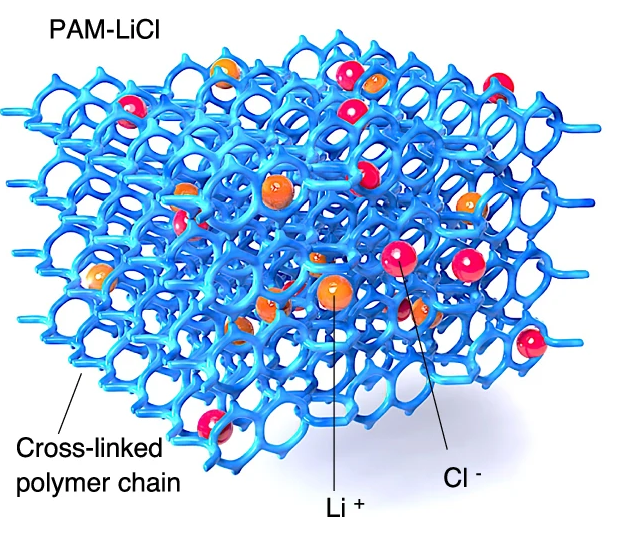
Figure: A schematic of the structure of a PAM-LiCl hydrogel with solvated lithium (Li⁺) and chloride (Cl⁻) ions diffused into a polymer network. Image credit: Nature Communications, 2025; 16 (1) DOI: 10.1038/s41467-025-65586-2


REFERENCE
Ikra Iftekhar Shuvo, Carlos D. Díaz-Marín, Marvin Christen, Michael Lherbette, Christopher Liem, Svetlana V. Boriskina. High-efficiency atmospheric water harvesting enabled by ultrasonic extraction. Nature Communications, 2025; 16 (1) DOI: 10.1038/s41467-025-65586-2
Nature Communications