 Advances in Engineering Advances in Engineering features breaking research judged by Advances in Engineering advisory team to be of key importance in the Engineering field. Papers are selected from over 10,000 published each week from most peer reviewed journals.

Significance
Barium titanate (BaTiO₃) is a ferroelectric material with attractive optical properties for electro-optic modulation, nonlinear photonics, and integrated optical circuits. Its strong Pockels effect enables rapid changes in the refractive index in response to an applied electric field, while its broad optical transparency makes it suitable for operation across different wavelength ranges. However, despite decades of research into barium titanate, its intrinsic optical constants remain insufficiently established. Reported refractive indices and extinction coefficients vary substantially, complicating the accurate prediction of light propagation, optical confinement, and absorption in photonic devices.
The difficulty originates largely from the crystallographic structure of barium titanate. At room temperature, the material adopts a tetragonal structure in which the displacement of titanium ions produces spontaneous polarization along the crystallographic c-axis. This distortion creates two distinct optical responses, described by the ordinary and extraordinary refractive indices. The difference between these indices, known as birefringence, determines how light propagates according to its polarization relative to the crystal orientation.
Even nominally single-crystalline barium titanate commonly contains multiple ferroelectric–ferroelastic domains with mutually perpendicular optic axes. These domains form to accommodate internal strain and can vary in their spatial distribution and relative abundance. Consequently, optical measurements performed over a large sample area may average the responses of differently oriented domains, obscuring the intrinsic optical anisotropy. Conventional spectroscopic ellipsometry is further complicated by changes in polarization and partial depolarization arising from such domain configurations. An additional difficulty is accurately measuring the extremely weak absorption within the material’s transparent spectral region.
In a recent research paper published in ACS Photonics, Jiwon Kang and Nina Hong, together with their colleagues from the California Institute of Technology, Korea Advanced Institute of Science and Technology, Korea Research Institute of Standards and Science, and J.A. Woollam Co., under the leadership of Professors Harry Atwater and Min Seok Jang, investigated the intrinsic optical properties of tetragonal barium titanate across the ultraviolet to far-infrared spectrum. Their strategy combined polarization-sensitive optical measurements, transmission spectroscopy, and independent crystallographic characterization to distinguish the fundamental optical properties of the material from those arising from its multidomain structure.
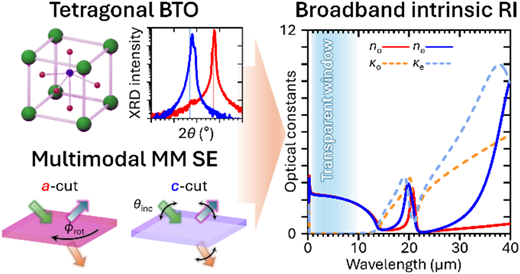
The investigation began with two quasi-single-domain barium titanate crystals selected to provide complementary access to the ordinary and extraordinary optical responses. In the a-cut crystal, the optic axis lies predominantly within the sample plane, whereas in the c-cut crystal, it is predominantly perpendicular to the surface. High-resolution X-ray diffraction confirmed the dominant crystallographic orientations, while reciprocal-space mapping supported the absence of a detectable secondary in-plane domain variant in the a-cut sample.
The researchers employed Mueller-matrix spectroscopic ellipsometry, which characterizes how a material modifies the polarization state of incident light. Unlike conventional ellipsometry, this technique accounts for coupling between polarization components and depolarization. Measurements performed at different rotational orientations of the a-cut crystal produced distinct polarization responses. When its optic axis was parallel or perpendicular to the plane of incidence, cross-polarization was suppressed. Rotating the crystal by 45° produced pronounced coupling between polarization components, providing sensitivity to its intrinsic optical anisotropy. Complementary measurements at different incidence angles on the c-cut crystal further constrained the ordinary and extraordinary optical constants.
Because different physical processes govern light absorption across the investigated spectrum, the researchers divided the optical analysis into separate wavelength regions. Electronic transitions governed the ultraviolet response, weak absorption characterized the transparent region, and optical phonons dominated the longer-wavelength infrared response. Fitting the entire spectrum with a single model could artificially extend absorption associated with infrared phonons into the transparent region. To avoid this effect, separate dispersion models consistent with the Kramers–Kronig relations were employed and combined to obtain broadband optical constants.
The resulting complex refractive-index tensor covered wavelengths from 190 nm to 40 μm. Analysis of the ultraviolet absorption edge yielded an estimated optical bandgap of approximately 3.5 eV. At longer wavelengths, pronounced differences between the ordinary and extraordinary optical responses occurred near phonon resonances around 20 μm. Interestingly, the birefringence approached zero near 12.1 μm, where the refractive-index response became effectively isotropic despite the material retaining its tetragonal crystal structure.
Accurate determination of optical absorption within the transparency window required an additional measurement strategy. Ellipsometry alone lacked sufficient sensitivity to resolve the small extinction coefficients characteristic of this region. The researchers measured polarization-dependent transmission through polished crystal slabs approximately 500 μm thick and incorporated these measurements into the optical analysis while constraining the refractive indices obtained from ellipsometry. This approach resolved extinction coefficients on the order of 10⁻⁵ within the investigated low-loss region. Barium titanate exhibited extremely weak absorption at infrared wavelengths up to approximately 5 μm, although the absorption coefficient in part of this region remained below the sensitivity of the transmission measurements.
Having determined the intrinsic optical constants, the researchers investigated how differently oriented domains modify the optical response of a multidomain crystal. Electron backscatter diffraction, confocal Raman microscopy, Kelvin probe force microscopy, and X-ray diffraction confirmed the coexistence of three tetragonal domain variants rather than randomly oriented crystallites.
The macroscopic polarization response was modeled as a weighted combination of the individual domain responses, assuming that their relative optical phases were effectively lost across the measurement area. The best agreement with the experimental spectra corresponded to approximately 43% and 48% of the two in-plane domain variants and 9% of the out-of-plane variant. The comparable abundance of the two perpendicular in-plane variants explained the substantially reduced macroscopic in-plane birefringence. Differences between domain fractions obtained from optical measurements and localized electron microscopy were attributed to spatial variations in domain distribution and the different areas sampled by the two techniques.
An important distinction arising from California Institute of Technology researchers work is the interpretation of optical isotropy in ferroelectric crystals. A nearly isotropic optical response measured across a multidomain sample does not necessarily imply weak intrinsic anisotropy. Instead, it can result from the spatial arrangement and relative abundance of crystallographic domains. Separating these effects provides a physical basis for selecting optical parameters that correspond to the actual crystal microstructure rather than treating barium titanate as an inherently isotropic material.
The research team of Professors Harry Atwater and Min Seok Jang established a broadband, polarization-resolved complex refractive-index tensor for tetragonal barium titanate by integrating Mueller-matrix spectroscopic ellipsometry with sensitive transmission measurements. They also developed an incoherent optical domain model that connects the intrinsic dielectric properties of individual tetragonal variants with the macroscopic polarization response of multidomain crystals. The resulting optical data and modeling approach provide experimentally grounded parameters for electromagnetic simulations of barium titanate-based photonic devices.
The quantitative determination of weak absorption is also valuable for designing high-quality optical resonators and low-loss waveguides, where even small material absorption can affect device performance. Assuming negligible absorption may produce unrealistic estimates of achievable optical efficiency. Similarly, identifying wavelengths at which the birefringence vanishes or the dielectric response approaches zero provides more precise spectral reference points for designing nonlinear optical systems.
The intrinsic optical constants obtained from bulk crystals also provide a benchmark for assessing barium titanate thin films. Substrate-induced strain and changes in crystallinity can modify the optical properties of deposited films, whereas thin films exfoliated from high-quality bulk crystals are expected to retain properties closer to the reported intrinsic values.
The domain-based measurement and modeling strategy could also be extended to other anisotropic ferroic materials in which heterogeneous domain orientations complicate the determination of intrinsic optical properties. Its applicability depends on the spatial characteristics of the domains and their relationship to the probing wavelength and optical coherence length.


Reference
Jiwon Kang, Nina Hong, Christopher M. Yi, Yun Su Go, Martin Thomaschewski, Hwi Je Woo, Prachi Thureja, Junghoon Jahng, Harry A. Atwater, Min Seok Jang; Broadband Optical Characterization of Tetragonal Barium Titanate by Mueller-Matrix Spectroscopic Ellipsometry. ACS Photonics 2026; https://doi.org/10.1021/acsphotonics.6c01514