Advances in Engineering Advances in Engineering features breaking research judged by Advances in Engineering advisory team to be of key importance in the Engineering field. Papers are selected from over 10,000 published each week from most peer reviewed journals.

Significance Statement
The thermodynamic properties of a system result from averaging over microscopic atomic constituents with statistical mechanics. Statistical mechanics allows one to “build up”from the microscopic to the macroscopic. However,this agenda can run into difficulties at the mesoscopic scale in the event that volumes of the order of the correlation volume x3contain many atoms. This situation results in some of the most difficult problems in physics; for example, the unitary thermodynamics expected for strongly interacting degenerate systems of Fermi gases, such as quark-gluon plasmas, neutron star matter, and high temperature superconductors. Also difficult are problems with long-range gravitational interactions, and critical point phenomena where special methods such as renormalization group theory must be employed.
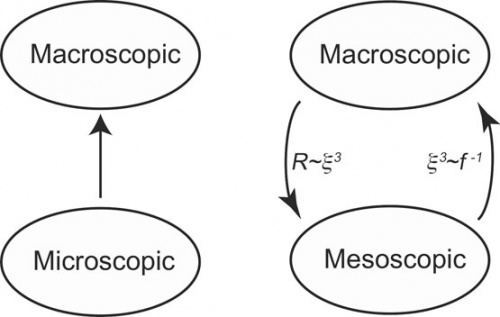
The argument in this paper is that the very considerations difficult for statistical mechanics (too many atoms in the organized fluctuating mesostructures) play in favor of a thermodynamic approach. The more atoms we have, the better thermodynamic averaging works. However, to exploit this principle requires a special thermodynamic tool, the thermodynamic curvature R, which is proportional to the correlation volume: R~x3. R allows us to build down from the macroscopic thermodynamic regime to the mesoscopic regime. If we add to the discussion the principle from the theory of critical phenomena called hyper scaling, which asserts that the correlation volume is proportional to the inverse of the free energy per volume, x3~f-1, we have a means of building back up to the macroscopic from the mesoscopic. This interplay between macroscopic and mesoscopic (shown in the figure) leads immediately toR~f-1: the curvature is proportional to the inverseof the free energy per volume. This geometric equation constitutes a partial differential equation for the free energy f. Its solution, subject to appropriate boundary conditions, yields the full thermodynamics for the system with no explicit use of any microscopic properties.
The solution to this geometric equation generally requires a scaling assumption reducing the partial differential equation to an ordinary differential equation. Solutions display nice universal properties, independent of specific atomic details. A solution to the problem of unitary thermodynamic is one example.
Figure Legend Statistical mechanics builds up from microscopic to macroscopic. But if there are too many atoms at the mesoscale in a correlation volume x3, statistical mechanics gets challenged. In this event, however, a thermodynamic calculation method based on the interplay between macroscopic and mesoscopic, and employing the thermodynamic curvature R becomes viable, and universal properties independent of the specific atomic properties emerge.
Journal Reference
Journal of Low Temperature Physics 174, 13-34 (2014).
George Ruppeiner
Abstract
Degenerate Fermi gases of atoms near a Feshbach resonance show universal thermodynamic properties, which are here calculated with the geometry of thermodynamics, and the thermodynamic curvature R. Unitary thermodynamics is expressed as the solution to a pair of ordinary differential equations, a “superfluid” one valid for small entropy per atom z≡S/NkB, and a “normal” one valid for high z. These two solutions are joined at a second-order phase transition at z=zc. Define the internal energy per atom in units of the Fermi energy as Y=Y(z). For small z, Y(z)=y0+y1zα+y2z2α+⋯, whereα is a constant exponent, y0 and y1 are scaling factors, and the series coefficients yi (i≥2) are determined uniquely in terms of (α,y0,y1). For large z the solution follows if we also specify zc, with Y(z) diverging as z5/3 for high z. The four undetermined parameters (α,y0,y1,zc) were determined by fitting the theory to experimental data taken by a Duke University group on Li in an optical trap with a Gaussian potential. The very best fit of this theory to the data had α=2.1, zc=4.7, y0=0.277, and y1=0.0735, with χ2=0.95. The corresponding Bertsch parameter is ξB=0.462(40).