Advances in Engineering Advances in Engineering features breaking research judged by Advances in Engineering advisory team to be of key importance in the Engineering field. Papers are selected from over 10,000 published each week from most peer reviewed journals.

Significance Statement
The fatigue behavior of titanium alloy Ti-6Al-4V at a very high cyclic region is of interest as fatigue fractures seem to originate from internal initiation sites instead of the surface. Despite previous research highlighting that the internal fatigue cracks propagate through a vacuum-like environment, the behaviors of small crack propagation and assumed existence of gases at the internal fracture would definitely shed more light on the effect of the vacuum environment on crack propagation.
Fumiyoshi Yoshinaka and colleagues from Hokkaido University in Japan conducted small fatigue crack propagation tests on Ti-6Al-4V in the air, ultrahigh vacuum and argon to investigate vacuum effects on crack propagation processes based on the idea that internal fatigue cracks in very high cyclic fatigue propagate through a vacuum-like environment. The research work is now published in peer-reviewed journal, International Journal of Fatigue.
When observing the crack propagation behavior in relation between crack length and number of cycles, the number of cycles needed to reach a specified crack length was far larger in the vacuum as compared to air and argon. The smallest number of cycles to failure was discovered in an air environment followed by that of argon and vacuum respectively. This result indicates a slow generation of crack propagation at the vacuum environment.
The crack propagation rate observed in the vacuum environment was found to be far lower than that of air. The difference is about one to three order of magnitude at a given stress intensity factor range, and the pronounced retarding effects of the vacuum were shown in the lower stress intensity factor range corresponding to the small crack length.
The authors found similar crack propagation rates in argon with that of air at lower stress intensity factor range, but showed similar values with that in vacuum of higher stress intensity factor range. This shows that the rate of crack propagation in the presence of argon environment depends on the stress intensity factor range or crack length.
Scanning electron microscopy images from the study observed in view of the fracture surface at a certain stage II of crack propagation indicated different average values of transition stress intensity factor range from stage IIa to IIb with the lowest value observed in vacuum environment. The low value of transition stress intensity factor range of vacuum was attributed to the presence of higher plasticity at the crack tip. The different values found in the argon environment despite being chemically inert suggests that the presence of gases also play a major role in the plasticity of the material.
According to the authors, the absence of chemical and physical adsorption aids the study of small crack propagation behavior in a vacuum.
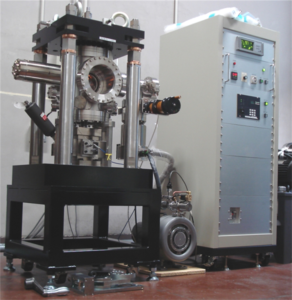 Fig.1 Ultrahigh vacuum uniaxial fatigue testing machine
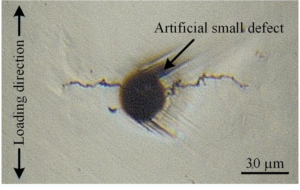 Fig.2 Fatigue crack originating from the artificial small defect
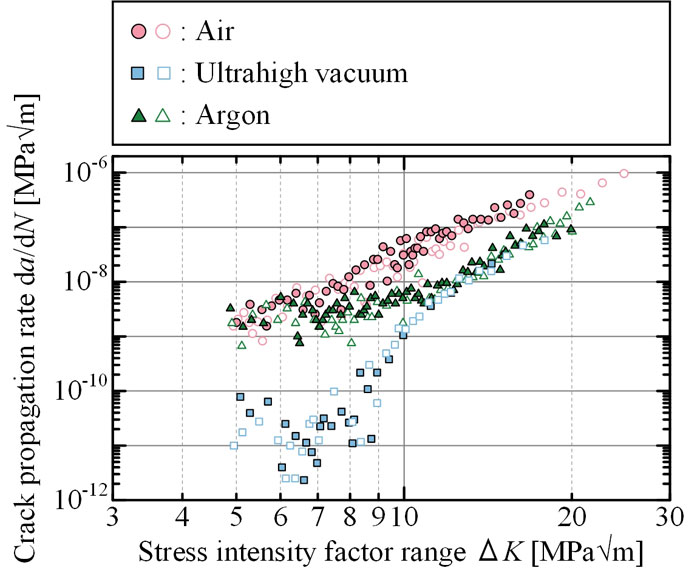 Fig.3 Relationship between crack propagation rate and stress intensity factor range


Reference
Yoshinaka, F.1,2, Nakamura, T.3, Takaku, K.1 Effects of Vacuum Environment on Small Fatigue Crack Propagation in Ti–6Al–4V, International Journal of Fatigue 91 (2016) 29–38.
[expand title=”Show Affiliations”]- Division of Mechanical and Space Engineering, Graduate School of Engineering, Hokkaido University, Kita 13, Nishi 8, Kita-ku, Sapporo, Hokkaido 060-8628, Japan.
- JSPS Research Fellow, Japan.
- Division of Mechanical and Space Engineering, Faculty of Engineering, Hokkaido University, Kita 13, Nishi 8, Kita-ku, Sapporo, Hokkaido 060-8628, Japan.
Go To International Journal of Fatigue