Advances in Engineering Advances in Engineering features breaking research judged by Advances in Engineering advisory team to be of key importance in the Engineering field. Papers are selected from over 10,000 published each week from most peer reviewed journals.

Significance
Micro-electro-mechanical system (MEMS) resonators now sit at the core of many modern technologies, from precision sensing and frequency control to signal filtering and actuation. Their importance is not simply a consequence of shrinking devices to ever smaller scales, but of the impressive degree of control they provide over mechanical motion once dimensions enter the microscale regime. At the same time, this miniaturization comes at a cost. As MEMS resonators transition from carefully tuned laboratory prototypes into robust, high-performance components, accurately describing their dynamic behavior becomes far less straightforward than classical theory might suggest. In practice, the dynamics of MEMS resonators are shaped by a delicate interplay of effects that are often weak or negligible at larger scales. Nonlinear restoring forces emerge naturally, electromechanical coupling can no longer be treated as a small perturbation, and even minor fabrication imperfections may leave a measurable imprint on system response. Under these conditions, simplified analytical models—useful as they may be for intuition—frequently struggle to capture what is actually observed in experiments.
Historically, parameterized modeling has been the dominant framework for understanding micro-resonator dynamics. In this approach, one assumes a governing equation in advance, often borrowing from canonical forms such as the Duffing oscillator, and then adjusts a small set of parameters to match experimental data. When the underlying assumptions hold, this strategy can be remarkably effective. However, it also embeds a strong prior belief about what the system “should” look like. It assumes that the relevant nonlinearities are known ahead of time and that the true dynamics do not deviate too far from the chosen template. With our experimental capabilities improved, these limitations have become increasingly apparent and high-resolution measurements now reveal behaviors—amplitude-dependent frequency shifts, asymmetric responses, or regime-dependent nonlinearities—that sit awkwardly within traditional models. This has motivated growing interest in data-driven identification techniques, which seek to extract governing dynamics directly from measurements. While machine-learning approaches offer flexibility, their reliance on large datasets and opaque internal representations raises its own concerns, particularly when physical interpretability and predictive trust are paramount.
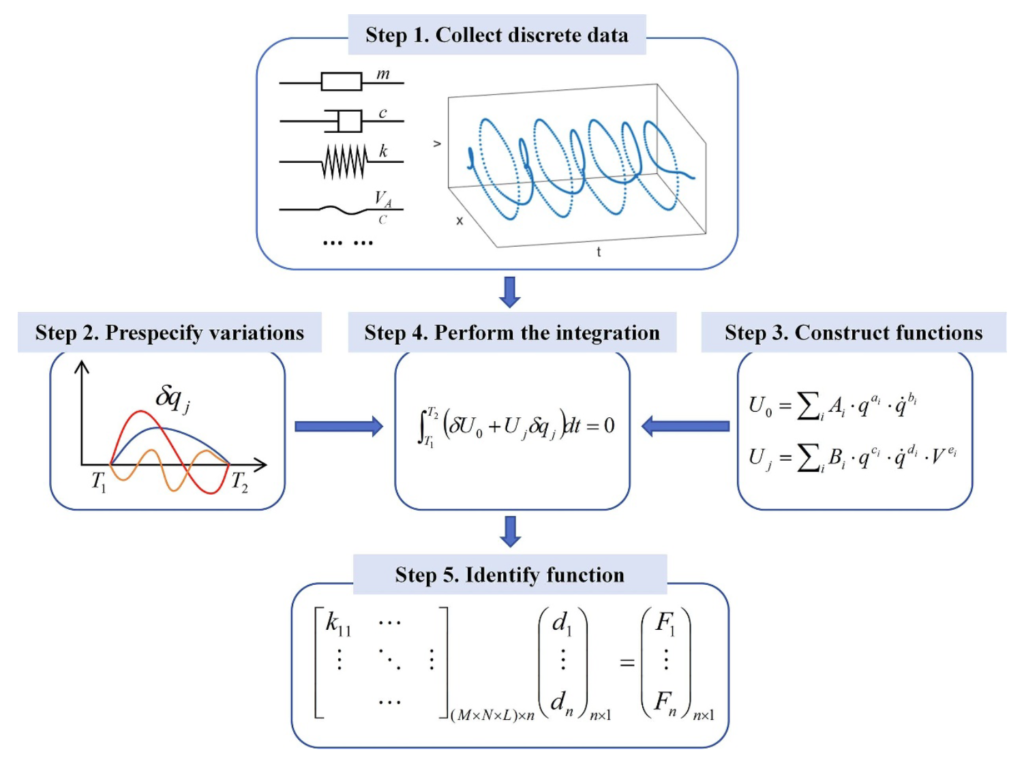
A recent paper published in Journal of Micromechanics and Microengineering, conducted by Mr. Zhen Pan, Dr. Zhan Shi, Mr. Hongsheng Dai, and Professor Zhilong Huang, led by Professor Ronghua Huan (corresponding author) from the Department of Mechanics at Zhejiang University, in collaboration with Professor Xueyong Wei from Xi’an Jiaotong University, reports a variational, data-driven framework for identifying the governing equations of MEMS resonators directly from experimental measurements. The proposed approach avoids assuming a predefined model structure and instead embeds measured responses into an integral variational formulation, enabling the extraction of physically interpretable dynamics while maintaining robustness against measurement noise. The method was experimentally validated on two MEMS resonators exhibiting opposite nonlinear behaviors and demonstrated superior predictive robustness compared with conventional Duffing-based identification techniques. The work was carried out in collaboration with researchers from Zhejiang University and Xi’an Jiaotong University.
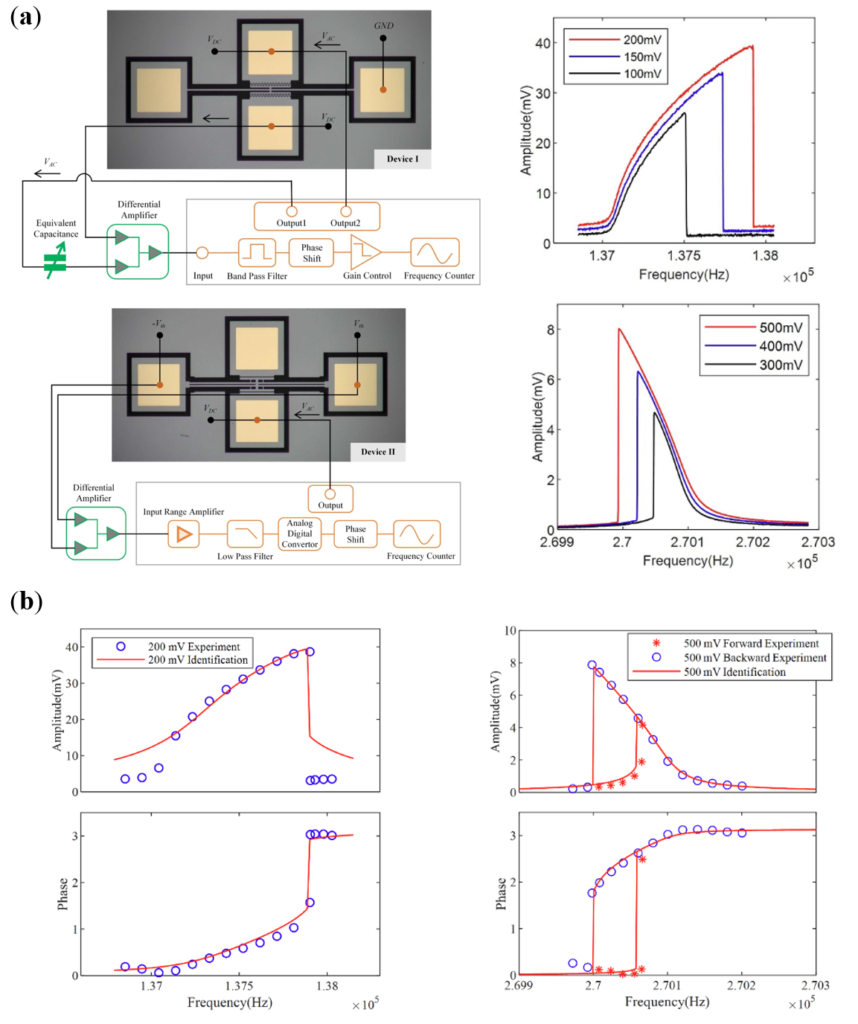
The research team examined the feasibility of variational-based data-driven identification using two MEMS resonators chosen to exhibit contrasting nonlinear characteristics. Both devices were doubly clamped beam structures, but their geometries and detection mechanisms differed, which led one system to display pronounced hardening nonlinearity and the other clear softening behavior. This contrast allowed the method to be tested across qualitatively different dynamical regimes. The authors found the resonators were electrostatically actuated near their fundamental modes and operated under high vacuum to suppress air damping. They acquired time-domain response signals using lock-in amplification, ensuring phase-resolved measurements under steady-state excitation. Rather than fitting these responses to a predefined oscillator model, the authors treated the measured voltage signals as generalized coordinates within a variational formulation. Carefully constructed variations, satisfying temporal boundary conditions, were introduced over short time segments of the recorded data.
Moreover, the method generated large overdetermined linear systems whose solutions yielded the coefficients governing system dynamics by integrating over many time intervals and excitation frequencies. This integration process inherently averaged out random measurement noise, a critical advantage given the small signal magnitudes typical of MEMS experiments. Furthermore, the team found the identified governing equation successfully reproduced experimentally observed amplitude-frequency and phase-frequency curves across multiple excitation levels. When they used the same model to predict responses under reduced drive amplitude, the agreement with experimental data remained strong, indicating that the extracted dynamics were not overfitted to a single operating condition. Parallel identification using a conventional Duffing assumption produced reasonable fits but showed reduced predictive robustness, particularly when extrapolated beyond the calibration regime. Additionally, the softening resonator presented a more demanding test, as its response exhibited hysteresis and asymmetric frequency sweeps and despite this complexity, the variational-based model captured both forward and backward sweep behavior with notable accuracy. Predictions under altered excitation amplitudes again aligned more closely with measurements than those obtained from simplified parameterized models. These results underscore a key empirical finding: allowing the variational integrand to include a broader set of admissible terms enables the identification process to adapt naturally to system-specific nonlinearities.
In conclusion, this work from Zhejiang University represents an important advance in experimental system identification for microscale dynamics. By combining variational principles with data-driven learning, the study establishes a physically grounded framework that enables direct extraction of governing equations from experimental data without reliance on restrictive predefined models. The approach not only achieves strong predictive robustness across different nonlinear regimes, but also preserves mathematical interpretability and intrinsic noise suppression—two properties that are critical for real-world MEMS applications. As such, the work provides a new paradigm for physics-informed data-driven discovery in microscale systems.




Reference
Pan, Zhen & Shi, Zhan & Dai, Hongsheng & Wei, Xueyong & Huan, Ronghua & Huang, Zhilong. (2025). Variational-based data-driven model identification of micro resonator systems. Journal of Micromechanics and Microengineering. 35. 10.1088/1361-6439/adf5cb.