Advances in Engineering Advances in Engineering features breaking research judged by Advances in Engineering advisory team to be of key importance in the Engineering field. Papers are selected from over 10,000 published each week from most peer reviewed journals.

Significance statement
Journal Reference
Journal of Polymer Science Part B: Polymer Physics, Volume 52, Issue 9, pages 633–639, 2014.
Meiyu Zhai , Gregory B. McKenna*
Department of Chemical Engineering, Texas Tech University, Lubbock, Texas.
Abstract
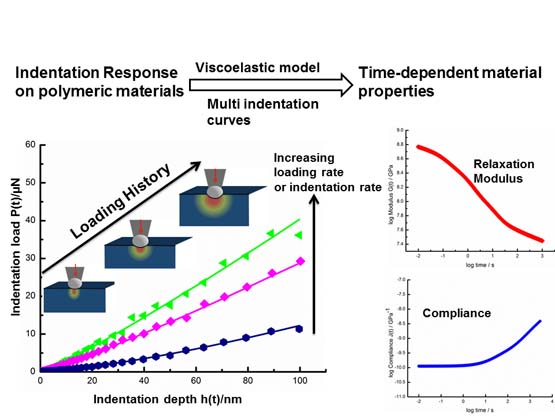
Nanoindentation is an increasingly used method of extracting surface mechanical properties of viscoelastic materials, especially polymers. Recently, Hutcheson and McKenna used a viscoelastic contact mechanics model to analyze the contact problem between a nanosphere and polystyrene surface. In nanoindentation experiments, the ramp loading test is a similar problem to the particle embedment experiment except that the indentation load function differs. The motivation in this work is to expand the Hutcheson and McKenna analysis to the nanoindentation problem. In particular, we illustrate the limitations of analyzing only a single load-indentation curve, which does not provide enough information to determine the full range of the viscoelastic response of a polymer, and we show that performing a test sequence that includes multiple loading rates or indentation rates spanning two or more orders of magnitude greatly improves the extracted viscoelastic properties.
© 2014 Wiley Periodicals, Inc.