Advances in Engineering Advances in Engineering features breaking research judged by Advances in Engineering advisory team to be of key importance in the Engineering field. Papers are selected from over 10,000 published each week from most peer reviewed journals.

Significance
Metamaterials are artificial structures capable of exhibiting properties not found in natural media. They are based on subwavelength units that can be engineered to meet specific parameters, which opened the door to the proposal of novel devices and the observation of interesting phenomena like negative refraction. Acoustic metamaterials with negative bulk modulus or negative mass density have deserved much attention during the last decade. Double-negative structures (where both parameters are simultaneously negative) were also reported, although only a few have been experimentally demonstrated.
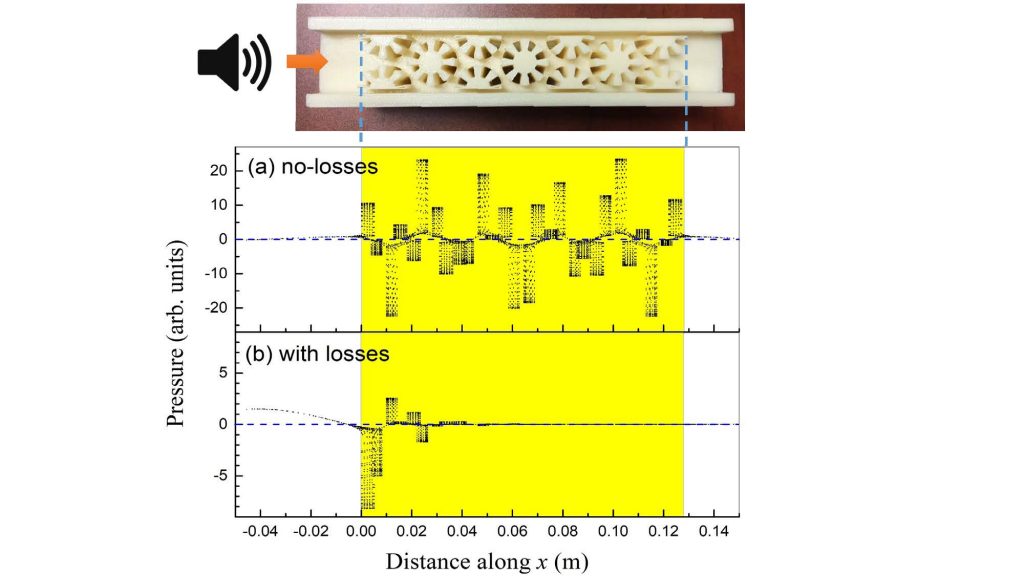
Professor Vicente Cutanda Henríquez at Technical University of Denmark in collaboration with Dr. Víctor M. García-Chocano and Professor José Sánchez-Dehesa at Universitat Politècnica de València in Spain report the influence of viscothermal losses in acoustic metamaterials based on rigid structures. Although viscothermal phenomena are often negligible, it is demonstrated that the associated losses can suppress the predicted double-negative behavior of the metamaterial. The research work is now published in journal Physical Review Applied.
The authors report simulations based on the Boundary Element Method (BEM), which has been implemented including acoustic viscous and thermal losses to create the metamaterial models. The BEM with losses is based on the Kirchhoff decomposition of the linearized Navier-Stokes equations with no flow. The BEM formulation is validated against an equivalent solution using the Finite Element Method (FEM) with losses, as implemented in the COMSOL software package. The BEM model, which in this case is less computationally heavy, is employed in the remaining calculations, which include a very fine frequency resolution, down to 2,5 Hz, and the scaling of the setup to up to 20 times its original size.
The unit cell of the metamaterial consists of a cavity drilled into a waveguide. In addition, a rigid cylinder is placed at the center of the cavity surrounded by eight rigid fins defining a metafluid shell. The results obtained are consistent with the reported experimental data.
The research demonstrates that losses have paramount relevance at the frequencies where double-negative parameters are theoretically expected. This result is present even when the dimensions of the samples are increased. It is concluded that artificial structures based on fin-based rigid elements are not suitable for the implementation of double-negative metamaterials. The authors propose developing efficient absorbers based on the absorptive properties of these type of double-negative metamaterials.



Reference
Henríquez VC, García-Chocano VM, Sánchez-Dehesa J. Viscothermal losses in double-negative acoustic metamaterials. Physical Review Applied. 2017 Jul 25; 8(1):014029.
Go To Physical Review Applied