 Advances in Engineering Advances in Engineering features breaking research judged by Advances in Engineering advisory team to be of key importance in the Engineering field. Papers are selected from over 10,000 published each week from most peer reviewed journals.

Significance
Fluid dynamics describes the flow of fluids and how they interact with various forces. Earlier studies in this field revealed that when a fluid of one density propagates laterally into a stratified ambient along an intermediate height, it forms an intrusive gravity current, also referred to as an intrusion. Attempts to develop analytical models for flows with different stratifications have been ongoing for over half a century. The first analytical model for symmetric intrusions propagating into linearly stratified ambient, based on the shallow water approach, was developed about a decade ago. Unfortunately, published studies had not yet incorporated the upstream propagating wave into their models, based on the assumption that the wave’s energy is much smaller than the potential and kinetic energies associated with the mean flow.
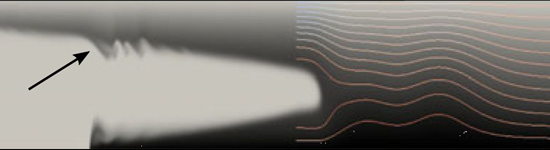
Recently, a research group at the University of California at Santa Barbara led by Professor Eckart Meiburg from the Department of Mechanical Engineering extended the vorticity-based modelling concept to intrusive gravity currents propagating into linearly stratified ambients. Specifically, they investigated the equilibrium and non-equilibrium intrusions released from long, full-depth locks and advancing into linearly stratified ambients using the aforementioned approach. Their work is currently published in the research journal, Journal of Fluid Mechanics.
In brief, the research method employed focused on the upstream-propagating wave ahead of the intrusion, thereby taking the lock length to be sufficiently long so that wave reflection from the rear wall could be neglected. For this purpose, they progressed to develope vorticity models for both equilibrium and non-equilibrium intrusions. Next, they performed direct numerical simulations to test the developed models. Lastly, they compared their theoretical findings to experimental observations and theoretical predictions of other authors in order to validate their results.
The authors observed that the obtained predictions, for both thickness and propagation velocity of the intrusion as functions of the intrusion density, were in close agreement with direct numerical simulations and earlier experimental and computational observations made by other investigators. Moreover, their model was the first ever to predict the properties of top-/bottom-propagating gravity currents. Furthermore, it confirmed the formation of equilibrium intrusions when the density of the intrusion fluid equals the mean density of the ambient fluid, and non-equilibrium intrusions otherwise.
In summary, Professor Eckart Meiburg and his research team successfully presented the development of a vorticity-based modelling approach for intrusive gravity currents advancing into linearly stratified ambients, by extending earlier investigations. Their model is considered the first to accurately capture the propagation velocity of the fastest-propagating internal gravity wave mode. Altogether, their results were consistent with those reported in related studies, and they confirm that the minimum propagation velocity occurs for equilibrium intrusions. “This analysis highlights the central role of vorticity for the dynamics of density-stratified flows”, said Professor Eckart Meiburg.

Reference
M. A. Khodkar, K. El Allam, E. Meiburg. Intrusions propagating into linearly stratified ambients. Journal of Fluid Mechanics (2018), volume 844, page 956–969
Go To Journal of Fluid Mechanics